

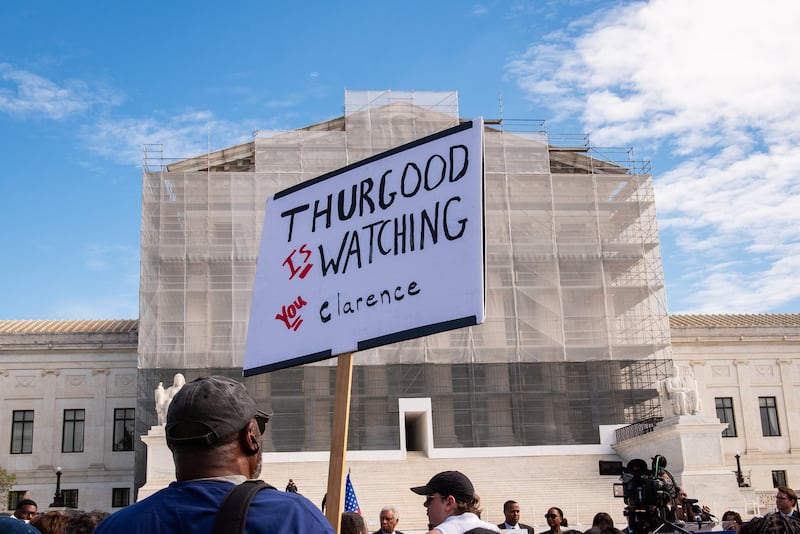

The Supreme Court on Wednesday struck down a Louisiana congressional map that added a second majority-Black district, a decision that will have big impacts for the future of the Voting Rights Act.
Louisiana adopted the map in 2024 and a group of “non-African American” voters argued the map creating a second majority-Black district was an unconstitutional racial gerrymander. They argued the map lines wrongly sort voters based primarily on their race, which is a violation of the 14th Amendment.
The ruling Wednesday was 6-3, divided along ideological lines. The majority opinion in Louisiana v. Callais was delivered by Justice Samuel Alito with Justice Clarence Thomas issuing a concurring opinion. Justice Elena Kagan delivered a lengthy dissent.
While the justices didn’t explicitly strike down part of the Voting Rights Act, the ruling Wednesday has major implications for minority voters both in Louisiana and across the country.
The question before the justices was whether the lower court was correct when it said that the second majority-Black district was unconstitutionally created via a racial gerrymander.
Alito, in his majority opinion, argued that Section 2 was designed to enforce the Constitution, “not collide with it.”
Section 2 of the Voting Rights Act prohibits racially discriminatory voting practices or procedures.
In her dissent on behalf of the court’s three liberal justices, Kagan said the ruling makes Section 2 “all but a dead letter” and argued that the consequences will be “far-reaching and grave.” Minority voters in areas of residential segregation and in places where voting is racially polarized, Kagan argued, are now to be “cracked out of the electoral process.”
It’s the second time this matter had been before the high court.
Louisiana v. Callais case background
In 2022, the Louisiana Legislature adopted a map that featured just one Black-majority district out of six that the state was allotted.
A group of Black voters, who make up about one-third of the state’s population, challenged the map in federal court saying it diluted their votes. They argued that the state was violating the Voting Right Act that prohibits racial gerrymandering.
A federal district court ruled the maps violated Section 2 of the Voting Rights Act and banned the map from being used in the future and directed the state to create a new map that created a second majority-Black district.
In Louisiana, a three-panel judge paused the map with two majority-Black districts from being used in congressional elections, but the Supreme Court put that ruling on hold in 2024, allowing Louisiana to use the map in that year’s elections.
Cleo Fields, a Democrat, was elected to represent the second majority-Black district. He previously represented the state in Congress in the 1990s before the state redrew the lines and he opted to not run for reelection and the district elected Republican John Cooksey.
The new map, S.B. 8, is the one the Supreme Court allowed to be used in 2024 elections.
The Trump administration filed a brief to the court arguing they uphold the district court decision to strike down the two-district majority-Black map.
Implications of Louisiana v. Callais
The ruling Wednesday holds that Louisiana’s map creating the second majority-Black district was an unconstitutional racial gerrymander.
The ruling narrows the Voting Rights Act precedent on race-based or race-conscious redistricting and could prompt challenges in other states that could flip multiple congressional seats.
It’s likely too late in the year for many states to redraw their maps now ahead of the 2026 midterms, but many may jump into action to try and do so.
Kyle Kondik, an elections analyst and managing editor of Sabato’s Crystal Ball, said it seems unlikely that states with upcoming primaries would be able to successfully redistrict this year, but given the redistricting arms race started last year, he said he is “ready for anything.”
“2025-2026 redistricting has taught us that things that don’t seem possible can become possible. We’re just going to have to take it on a state by state basis as reactions to this ruling come,” Kondik said, adding that the redistricting battle could stretch into 2027 and 2028 with this ruling.
In fact, Tennessee Republican Sen. Marsha Blackburn, who is running for governor, posted online Wednesday urging the state legislature to reconvene to redistrict and create “another Republican seat in Memphis.”
“It’s essential to cement @realDonaldTrump’s agenda and the Golden Age of America,” she said. “I’ve vowed to keep Tennessee a red state, and as Governor, I’ll do everything I can to make this map a reality.”
It follows another ruling from the Supreme Court in 2013 that axed a different provision in the Voting Rights Act.
Louisiana will now have to redraw its congressional map but since the Supreme Court did not rule on the matter earlier, the state may use the six existing congressional districts for the midterms.
State lawmakers convened last October hoping to push back election deadlines one month in the event the Supreme Court issued a ruling by the end of 2025. The court didn’t expedite the decision and the state moved to a closed party primary system that created a limited window for redrawing the maps ahead of November 2026, the Louisiana Illuminator reported earlier this year.
Still, early voting in Louisiana begins Saturday, May 2, just days away, and the primary is on May 16.
Louisiana Gov. Jeff Landry, a Republican, said it’s too early to say whether they would try and race to redraw the map.
Fields, whose district was invalidated by the court’s ruling, said “it is what it is.”
“The final court has spoken. Louisiana now must make its decision. I think the wise decision is if they’re gonna redraw lines, they need to redraw them for the next election,” he told Punchbowl News.