

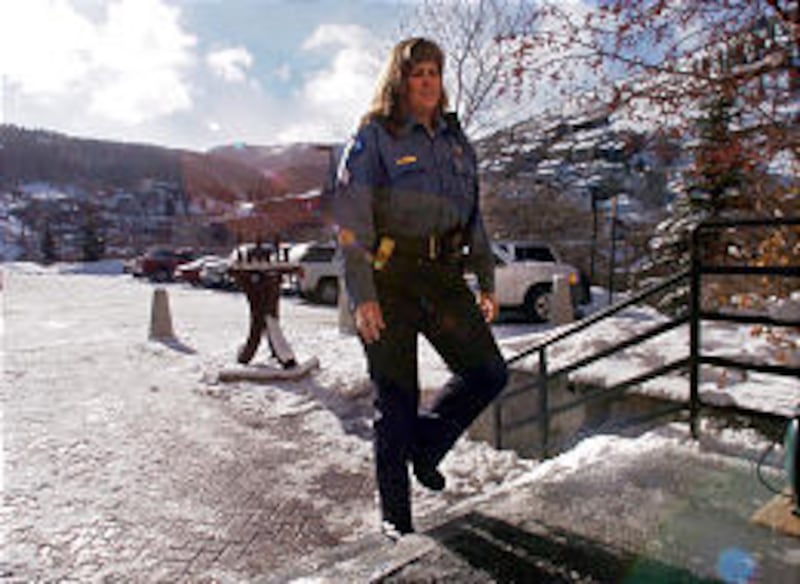
PARK CITY — Annette Ellis is a veteran cop with 14 years of traffic stops, domestic disputes and calls to help "keep the peace" under her belt, which, by the way, is well stocked with handcuffs, a nightstick and extra bullet magazines.
Recently she added something new to her uniform attire: a pair of sergeant stripes.
Ellis, 38, is the first woman in the 119-year history of the Park City Police Department to earn the rank. She was officially promoted in a ceremony before the City Council Dec. 11.
"We were founded in 1884 . . . this is sort of a historic day," Park City Chief Lloyd Evans said after the ceremony. "I certainly hope it won't be the last."
Evans has made a pointed effort to add women to his force, and although no one is officially tracking or comparing department-to-department statistics, he believes that with 20 percent of his officers of the female persuasion, Park City may have the highest percentage of women in blue.
But the number of women who graduate each year from Utah's police academy is still quite small, said Sid Groll, director of POST, also known as Peace Officers Standards and Training.
Between four and six classes, each containing about 30 new police officers, graduate from POST each year. Women are in some but not all of those classes. Still, Groll notes, a walk through the gallery of graduating class photos in the hallway at POST administration shows just how far women have come since the academy was founded.
Not a single woman enrolled at POST between 1968 and 1973. Then an average of about three women a year completed the 17-week course. It wasn't until the late 1980s and early 1990s that women officers were graduating several times a years in greater numbers.
On Dec. 12, POST graduated its largest single class of women — six.
"In the early days of law enforcement, you looked at females and said, 'Why? There are other jobs,' " said Groll, who just marked his 30th year in the profession. "The more we looked at the necessity for female officers and then you go a little farther to see the the skills that match the female mentally, and you see (law enforcement) is a very good fit."
In fact, physical considerations aside, Ellis and others say that in many ways women may be more suited to the job than men.
Women tend to be better communicators and have a way of calming a heated situation. They bring a different sensitivity to crimes such as domestic violence or sexual assault and have a tendency, Ellis said, to slow down, listen and think things through.
And she agrees with Evans' philosophy that the demographics of a police department should reflect the population of the community they serve.
Park City isn't alone in its desire to add women officers to its ranks. The Utah Highway Parol, which has 20 women among its 516 sworn officers, would "love to have more in the Highway Patrol," UHP spokeswoman Tammy Palmer said. But few women apply, she said.
And that's true for most police departments, despite offers of scholarships or sponsorships to cover the $3,000-plus costs of attending POST.
Salt Lake County recruiters go to job fairs, post classified listings and have attended women's conferences to try to introduce women to career opportunities within the sheriff's office, including both law enforcement and corrections.
"It just has not been a traditional field for women," said Gaylyn Larsen, county human resources manager. "We don't have women who grow up thinking about law enforcement or corrections."
Those who inquire, she says, will find an abundance of opportunity, especially in corrections, where many women at work in the Salt Lake County Jail have quickly risen to supervisory positions, or have gone on to the police academy and been hired as deputies.
Of the 900 total sworn officers who work for the county, about 11 percent are women. Women make up about 20 percent of the correction staff of 520 officers, Larsen said. The county promoted its first woman patrol officer to the rank of lieutenant this year.
As good as the opportunities might be, the demands of a law enforcement career — shift work, rigid salary and promotions schedules and the potential danger — are great.
"I think females think pretty hard about that," said Larsen. "(A law enforcement career) takes a little thinking outside of the box. I really admire those people who stay in law enforcement long term. As a profession, it can be a good one, and yet, it's a hard life."
One that Ellis wouldn't trade, however, even on the hardest of days.
"There are really bad days when you wonder why you are still here and what made you get here in the first place. If you think about it, honestly the times you call the police, 80 or 90 percent of the time it's because something bad is going on. We deal with a lot of the negatives," she said. "Then there are days you really make a difference and helped someone. You do get the positive, and the positives seem to be strong enough to outweigh the negatives."
E-MAIL: jdobner@desnews.com