
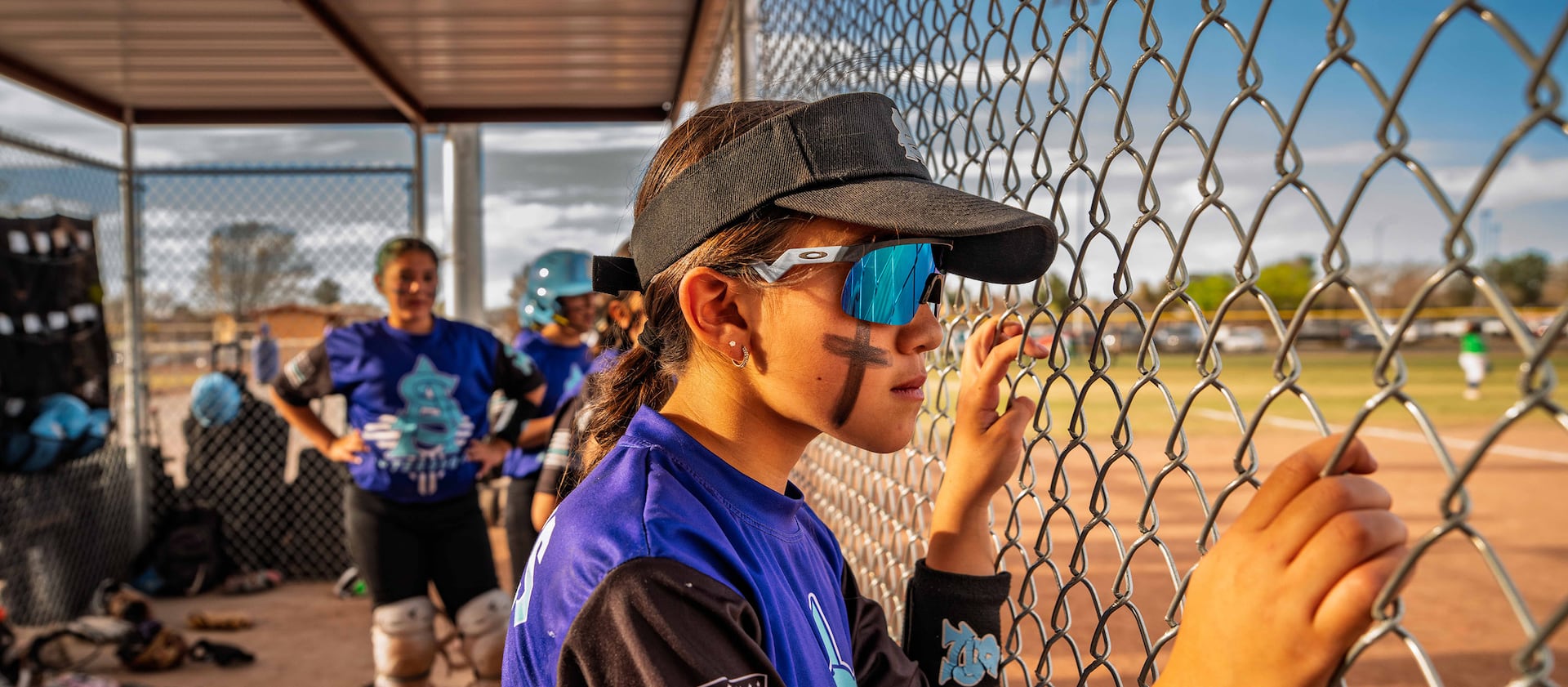


It already felt late in the day for Auggie Valladares even though it was still midmorning. He sat at a tall table under dim lighting, up against the wall of an indoor batting cage in Las Cruces, New Mexico. In the next room, his daughter, Amaya, hurled heaters and change-ups into a catcher’s glove. Pop. Pause. Pop. From where he sat, he could hear it but couldn’t see it.
He knew well enough what it looked like. Amaya, a left-hander with bangs cut just above her brows, was working hard. Windmilling pitch after pitch to perfection. He rarely misses the chance to see her do it, even though sometimes he wonders why.

Between softball and basketball, Amaya practices upwards of 10 hours per week. Tournaments take the family around the country most weekends. Auggie, who works in heating, cooling and refrigeration at a nearby NASA facility, estimates they spend $7,000 annually, “if not more.”
His wife, Hope, works for a health insurance company and has taken a second job working concession stands. And this morning, he’s been up since 3, because last night they were five hours away in Midland, Texas, for an All American team tryout and had to get back to Las Cruces in time for a 10 a.m. practice.
He knows the sacrifices he and his family are making for softball are bound to prompt questions. “Why are we so into this?” Auggie asked, tugging at his gray goatee on that morning in early March. “Why are we spending all this money?”
I’d come to Las Cruces because I had similar questions.
My son is only two, so my questions aren’t as urgent, but my wife and I know we’ll need answers soon enough. Both of us grew up playing sports, and we want our son to have the chance to play, too.
But we also want his experience to be better than ours. Amaya Valladares’ team from Las Cruces, the Aftershock, seemed like a good model of what to anticipate, though admittedly an extreme one.

According to United States Specialty Sports Association rankings, the Aftershock finished the 2025 softball season with an overall record of 100-30-2 — a slate just 30 games shy of a Major League regular season. Their success gave them the highest points total of any 10-and-under B Division team in the country, crowning them official national champions, with bejeweled rings to prove it. Perhaps, by spending a day with them, I could learn something about the journey ahead, for better or worse.
I’d heard plenty about the worse.
Youth sports are too expensive, critics say. Too exclusive. Too demanding of kids who just wanna have fun. The complaints are legitimate. Families are spending nearly $1,500 per child per year on average, with families earning over $100,000 spending more than $2,300 per child.
Even just between 2019 and 2024, average family spending on their child’s primary sport rose 46 percent — a rate far exceeding inflation — as the U.S. youth sports industry’s total annual revenue reached $40 billion. And while it could be tempting to roll your eyes and blame the “crazy sports parent,” a trope that certainly exists, the truth of today’s youth sports insanity is much more complicated.
Between 2019 and 2024, average family spending on youth sports rose 46 percent, a rate far exceeding inflation.
Most parents are not Earl Woods or Marv Marinovich. Most parents just want their kids to have fun, compete and learn about winning and losing. Most parents just want to give their kids an opportunity to play, period.
A 2025 Aspen Institute survey found that half of parents felt pressured to have their kids specialize in one sport early — not to play in college or go pro, but simply to make their high school team. Many of them eventually brush up against the same questions Auggie has. That I have.
Where’s the sweet spot between enjoyment, access and not pushing too hard if the kid isn’t into it? What’s really necessary for a kid to keep playing? How much investment should that require?


Watching Amaya hone her pitching skills in the cage, some of those questions dissolve. Look at her focus. Look at her slinging that grapefruit-sized yellow ball at top speed. Look at the determination in her eyes; you can almost see her desire to keep playing in college someday. But who knows?
Amaya is 11. For now, she’s one of the taller girls on her team, and she dominates. Yet the stats aren’t in her favor. Only 1.6 percent of high school softball players reach the NCAA Division I level, much less a powerhouse like her dream school, the University of Oklahoma. At 11, sure, dream big. Why not? But what if it doesn’t work out?
Would all this tournament-chasing and title-winning still impart the life lessons and lifetime of memories common to youth sports in generations past? Or would the wallet-busting pursuit of achievement end up consuming Amaya’s childhood, my son’s childhood and every parent’s sanity?
Then and Now
It wasn’t always this way.
The system was genuinely different in the 1980s and ’90s, says Jon Solomon, community impact director at the Aspen Institute’s Sports and Society program. Local, recreational competition took priority, with much more room for unofficial, kid-led pickup games, “The Sandlot” style. Travel sports existed, too, but of a lesser magnitude, with most taking place within an hour’s drive and perhaps one big tournament per year. “These days, of course,” Solomon says, “you can be traveling every weekend.”
So what changed?
Solomon points to milestones like the opening of Disney’s Wide World of Sports complex in 1997. That facility began hosting major youth tournaments, which brought kids and parents from all over down to Florida for vacation.
Municipalities across the country took notice and started investing in their own sports complexes to draw out-of-state club teams, a new revenue driver, “viewing children as a tourism (and) economic engine,” Solomon says. The Great Recession of 2008 became an accelerant, with many local governments cutting back on recreational sports.
It was right around this time that my own youth sports journey was winding down. I was not an athlete of any particular ability, but I loved playing — particularly baseball. I started in second grade with a coach-pitch team at a league run by my Catholic elementary school. The league was fun and simple; not quite the suburban idyll of “The Sandlot,” but closer than much of what exists today. Yet “fun” didn’t make me a very good baseball player. I didn’t make my school’s team in fifth grade, nor in sixth, at which point I abandoned baseball altogether.
Would all this tournament-chasing and title-winning still impart the life lessons and lifetime of memories common to youth sports in generations past?
My wife, meanwhile, played competitive club softball for most of her life. She traveled to faraway tournaments, from Disney World to Colorado. She played on her high school team. She talked with college recruiters. She loved softball. She also hated softball, depending on the day. It was demanding, and she’d moved teams several times, leaving her with few close friends in the dugout. By the time college arrived, she was done with it.
Looking ahead to our son’s youth sports future, we don’t want him to get burnt out like her, nor do we want his opportunities to be limited like mine. But today’s landscape is much more complicated, and commercialized, than it was even back then.
Private equity has started pumping even more money into youth sports of late, viewing it as a reliable investment opportunity. The industry’s annual $40 billion revenue is more than the NFL and Major League Baseball combined.
Travis Snider, a former first-round MLB draft pick who spent eight seasons in the Majors, now leads 3A Athletics, a company that promotes a new path for youth sports. The way he understands it, the youth sports industry is awash in bad incentives. “I don’t think all the ideas behind monetization are cruel and evil,” he told me, “but I think this thing has really taken off in a direction where it’s tough for (stakeholders) to really separate what is best for the kid and what is best for the financial health of the program.”
What Solomon sees in all these anecdotes and all this data is a story of a hollowed-out middle. “There’s almost like a middle space that’s missing,” he says, “in between the highly competitive travel sports environment versus the really local, beginner programming.”
Steve Magness, one of the world’s top long-distance running coaches, blames parental “safetyism” that ultimately prioritizes control and monetization. But parents struggle to make any sense of the system to begin with. Many parents don’t want the system we have but feel like they have to play the game — or else.
“I don’t blame (them),” Solomon adds, “because they’re entering into a very fragmented, confusing youth sports system that has pretty much no regulation. It’s hard to understand the right pathway.”
Inside the Grind
Back at the indoor batting cage, I met David Melendez, known as “Chubbz” to the girls when they’re not calling him coach. He’s 36, short and stocky with a goatee and a perpetual ballcap. He got into this as a volunteer T-ball coach for his daughter, then decided to go out on his own.
“I felt like I could make a difference and elevate these girls to another level,” he told me. “I fell in love with it. It’s everything I always wanted for the kids, and I treat them like they’re my kids.” Auggie feels like that’s appropriate.
“He’s a kid himself,” he said. “He makes it fun.”
Chubbz has been bringing the Aftershock to this facility, The ClubHouse, since it opened in 2020. “They work hard, and they’re in here all the time,” ClubHouse owner Luisa Solorzano told me. “We’ve seen the kids grow.”

Amaya most of all. “(She) started doing lessons with my daughter when we first opened,” Solorzano said, “and she was teeny tiny.”
Amaya actually played basketball first, starting when she was two. One night Auggie asked if she also wanted to play softball. She said no. He asked a few more times over the next few years, and around the fourth time, she finally said yes.
She started playing at five, with a squad called the Nitro Cuties. When that team disbanded, Auggie found the Aftershock, and they’ve never left. It’s been six years now, and his phone’s camera roll overflows with evidence of her progress.
One clip from the All American tryout in Midland — the one that caused him to wake up at 3 that morning — shows her wearing a tucked yellow jersey, staring down the hitter.
No pause, no deep breaths, just right into it: The hitter hacks halfway, and misses. Not even close. Next a called strike. Then a change-up, fouled off. Barely. Zip — a fastball, swing and miss, strike three. These days, her heater tops out at 49 miles per hour.
She still plays basketball, but softball reigns supreme. To Auggie, it’s been obvious since the beginning. “That was it,” he remembered of her earliest days playing softball. “She fell in love with it.”
The trophies and medals Amaya has amassed — somewhere around 70, her father guesses — fill the Valladares home. So many championship and MVP rings that she needs two display cases. In a nook of the family living room, a statue of the Virgin of Guadalupe presides over a stack of softballs. Amaya prays before and after every game. She tries to be grateful.

Not only for all these physical manifestations of success, but most of all for the pieces that aren’t so visible. The friends, the travel, the purpose softball gives her.
In the cages this morning, to an unknowing observer, she’s just another pitcher. But in her mind, when she’s in there, she’s the pitcher, destined for greatness at OU. She says so all the time. She even scrawled it on a piece of paper and taped it to her parents’ refrigerator. Just like her dad said, she fell in love with softball, and that’s why she plays.
The Parent Trap
Amber Corrales, whose daughter joined the team last year, lives across the state border in El Paso, about 40 minutes from The ClubHouse on a good day. She makes the drive twice a week for softball — and twice a week for basketball practice, too.
Most of these girls are multisport athletes, including several wrestlers. The calculus for Amber, and for all the others who spend weekends schlepping to and from some tournament, is simple: “She’s happy,” Amber said. “And the competitiveness, the coaches, the environment, the culture — it’s unlike any other team.”
Yet when I asked whether it ever feels overwhelming, just about every single parent nodded.
Auggie’s wife, Hope, told me they’d just had a conversation about it this morning on the way back from Midland. “As a mom,” she’d said, “you don’t realize what we take on.” Hope also recently started that second job working concession stands through a special program that allows her to use her income only for her daughter’s sports expenses; she has to document how she’s using the money with receipts. All of them, it seems, exist in a near-perpetual state of fundraising.
From across the circle of parents, Bernice Barela leaned on a cane and spoke as a grandparent. The difference between raising her own children in youth sports versus watching her granddaughter, she said, cannot be overstated. She stands in awe of her granddaughter’s dedication, which Barela attributes to the demanding nature of modern youth sports.
But she’s just as awed by the parents. “I don’t know how they manage these days, with all the competition and the traveling and the expenses,” she told the group. “I just give them a lot of credit.”
When this is all over, Auggie hopes Amaya will pay it forward with her own children. That she’ll say, “My parents did this for me. I want to do this for my kids.” It’s a very natural impulse.
One of the casualties of the move toward a more commercialized model has been the erosion of free play.
“We, as parents, want to see our children succeed, and one very public arena of success for young people is sport,” said Travis Dorsch, a former NFL placekicker who now leads the Families in Sport Lab at Utah State. “It’s easy to post on social media, and it reflects well upon us as parents.”
And that’s fine, as long as the child is still taking the lead. “We shouldn’t dissuade young people from having big goals. I love that,” Dorsch said. “At the same time, we have to recognize what the odds are of those kids making it, and ensure that … there isn’t an expectation of some return on investment.”
But a return on investment can take many forms.
After I finished talking to the circle of parents, I headed into the cages, where practice was humming along at four different stations. Chubbz tossed batting practice lobs from behind a net. Metal bats clanged and leather gloves popped.
Veronica Garcilazo, a mother wearing a $30 custom-made Aftershock hoodie, lamented the expenses. She’s a pharmacy tech. Rachelle Serna, seated beside her, is a middle school social studies teacher. Assistant coach Juan Gomez is a K-9 unit police officer. It’s sometimes a stretch to make this work. But when it does, they agreed it’s sublime.
It’s Chubbz lobbing soft tosses and offering encouragement. It’s their daughters running an agility relay race to close practice — diving over each other, running into each other. It’s setting up a bounce house for an afternoon birthday party at The ClubHouse, then watching the kids take a spin inside themselves.
The investment doesn’t have to be out there somewhere. It can be right here, right now — as long as they don’t lose sight of what’s right in front of them.
Winning, for Kids and Adults
After practice, the team had lunch together at the astroturfed back patio of a sports-themed grill across town. I sat down beside two 11-year-olds who were absolutely kinetic: Kaitlyn Barela wore braces and tortoiseshell transition frames and a necklace announcing her nickname, “Honey”; Autumn Corrales was taller with hoop earrings, her hair held back in a ponytail. Amaya sat at a table with the other girls, picking at plates of nachos and tossing fries into fellow players’ mouths.
Aftershock kids and parents get together like this all the time. It’s part of their success, they say: the bonding that comes from so many practices, games and tournaments together. From all those moments in between.
If success is measured in wins and losses alone, it’s hard to argue. The Aftershock is a national championship-winning team, and coach Chubbz is proud of it. “We teach them to be dawgs,” he told me. “We teach them to challenge each other, to compete.”
Sometimes they’ll organize bouts of tug-of-war. Pushup competitions. Relay races. Because nothing — nothing — matters more than competition. “Everything’s a competition,” Chubbz explained. “There’s no participation awards. It’s a competition because everything in life is a competition as soon as you step up.”
That’s often how adults frame it, but kids tend to disagree. “When we survey youth around the country, the top reasons they tell us for why they play sports are to have fun and be with friends, by far,” Solomon says. “Winning ranks lower.”
Sure enough, “I like the bonds we get to make, and all the friends,” Honey said when I asked what she loves most about softball. “It’s just — it’s something I can look forward to.” Autumn agreed. “Just being around the girls and making these special relationships with them,” she added, “and just having fun.” Amaya also said nothing about winning. She liked getting to play with her friends — and, actually, traveling to faraway tournaments with her parents and friends on the team. Yet winning, whether the girls realize it or not, might just be the engine that enables the rest of it.

The Aftershock, unlike many successful youth sports programs, is not part of some conglomerate or national chain of clubs with different squads filling slots at every age. It is its own entity, which will disband when these girls are done playing. That’s a refreshing throwback to an earlier era, but it also makes the team vulnerable.
Larger entities sometimes try to lure away their players. Winning helps swat those entities away, and for that, parents and coaches alike are grateful.
“For me, that’s just not what I wanted for my daughter,” assistant coach Efren Corrales, Autumn’s dad, said of the bigger clubs. They’re too serious. Too concerned with perfection — and with consequences. It starts looking like a job. “They have to perform well,” he said. “Here, there’s really no consequences.”
That also leaves plenty of room for pure enjoyment, even if the players can feel just as overwhelmed as their parents. “Sometimes it’s fun,” Honey told me, “but on days when you’re really tired, it’s like, ‘Softball practice? Ugh. I just wanna go to sleep.’”
Sometimes they’d rather imagine their futures. Honey wants to be an anesthesiologist, or a lawyer. Autumn would like to work helping people, maybe as a therapist. Amaya, meanwhile, sees herself as a future college softball player.
And then maybe a teacher, perhaps of reading or P.E.
Fear and Loving in Las Cruces
New Mexico State University’s softball complex mimics the desert that surrounds it: sparse, understated, unassuming. Yet like in the real desert, looks can be deceiving; what appears somewhat barren and minimal can teem with life.
After lunch that Saturday afternoon, a pair of 11-year-olds stood at the stadium’s gate sporting matching purple jerseys pressed with “Aftershock” and bedazzled blue jeans. They’d gathered to attend a college softball contest between New Mexico State and Louisiana Tech, but also to receive the biggest prize of their young lives.
Soon more kids arrived wearing those same jerseys. Five of them spilled from the back bench of a bright-red Toyota Tundra driven by Chubbz, then dashed toward their friends, running to the rhythm of the stadium speakers blasting “Suavemente” by the Puerto Rican pop star Elvis Crespo. After parking, Chubbz hurried over himself in square-toed cowboy boots, carrying a pair of plastic Ziploc bags.
Inside the stadium, the girls in purple jerseys, by then numbering 12, gathered behind the third-base dugout. Coach Chubbz called on one girl named Delina. Then he called on Amaya. He told them to face each other for a game of rock-paper-scissors. The winner would get to throw out a ceremonial first pitch.
“Frick!” screamed Delina.
Amaya would take the mound.
She felt nervous right away. The stands were packed with several hundred people, and they’d all be watching her. She wanted to deliver. Even in her off-day Uggs and jeans, she wanted everyone to see the best version of herself. But she only had one chance to get it right.
No matter. She’d faced pressure before. Last year, in a tournament representing the state of New Mexico in Florida, she faced a 3-1 count in the fifth inning, with runners on first and third, two outs, tied at seven. She needed to get back in the count to keep her team in the game, and she’d done so. She calls it her proudest softball moment.
Overall in that tournament, she struck out 33 while allowing just two hits and no earned runs. “She’s a natural,” Auggie told me, and what a thrill it’s been to see her grow into her God-given talent. But there’s something else.
That morning, back at The ClubHouse, Auggie had said so. They’re really here, spending all this money, all this time, because of something few parents readily admit.
Because of fear.
Where would his family be if not here? Watching TV? Sitting on the couch? Without all this, Auggie believes his daughter’s opportunities would be squandered, and like a lot of parents, that ranks among his greatest terrors.
Besides, look at the day they’d had. What softball-loving kid wouldn’t want to be at a first-rate facility on a Saturday morning, have lunch with her teammates in the afternoon and attend a college softball game where she’s the guest of honor at night? What parents wouldn’t want this for their kid? And if it squashes that pesky, lingering fear of not doing enough, well, all the better. “It makes mom and dad feel that much more confident,” Auggie told me, “that she’s gonna give the same effort in life as she gets older.”
I want my son to at least have the option of playing in high school, if he wants to, and I’m afraid that if I don’t start early, he’ll lose that chance. But I’m also not so sure about the tradeoff of turning play into practice.
When you’re practicing 10 hours a week and playing in tournaments every weekend, it doesn’t leave much time to do anything just because, and that’s really how I want him to see sports: something you do because you want to, rather than as a means to a hypercompetitive end. The trick is striking a good balance.
Amaya is clearly on track to make her high school team and then some. She has high goals for herself, including playing on a college field like this one. She admits it’s challenging, “just going from place to place, practice after practice.” But is it worth it? “Yes sir,” she said. Because it leads to moments like the spirited rock-paper-scissors match, and what came next.
“C’mon, ladies,” barked the guy running things. He led them onto the field. Chubbz followed, still carrying those plastic Ziploc bags. Amaya toed the rubber in her off-day Uggs, wound up and tossed a leather-popping strike. Mission accomplished. Sort of.
“No!” she said upon jogging off the clay, a half-smile stretching her lips. “I got my Uggs dirty!”
The Moments that Matter
The girls settled into the back row of the bleachers as the game between the Aggies and Bulldogs began. I sat in the front row next to Chubbz. We were all waiting until the end of the third inning, which is when the contents of those Ziploc bags would be distributed.

The moment arrived quickly. A video board displayed a photo of the Aftershock, and the PA announcer welcomed the team, listing off its accomplishments. National champions. State champions. Then, with enthusiasm: “Please welcome Kaitlyn Barela!” The guy running things reached into the plastic Ziplocs to hand her two shimmering title rings. One of them fell, but she kept walking and didn’t look back.
That happened a few more times as the announcer hurried through the list of names. The actual rings, provided by the USSSA, were too big for most 11-year-old fingers. The girls put them on anyway, flashing their new bling for pictures. The whole thing was over in about a minute.
Back in the stands, I joined the girls to watch the game. They seemed to care little if at all. They were too busy going nuts for the chance to snag a free T-shirt, sneaking away to record TikTok dances, chasing down a rogue foul ball. Between distractions, they munched on Sour Patch Kids and Van Holten’s Pickle-in-a-Pouch, which soured the air with vinegar. “They’re gas,” Honey told me, which I took as young-person slang for something between “cool” and “exceptional.”
Now this reminded me of my own youth sports experience, and what made those memories special. Not the winning or the trophies, but the moments in between. The postgame trips to Pizza Hut, the way we’d practice our victory handshakes even when we were losing. The way the girls eventually started getting more invested in the game, together.
The Aggies soon took the lead, then sealed it. With many adults clapping tepidly from beneath blankets and hoodies, the girls stomped the bleachers, none of them wearing so much as a light jacket.
After the game, a few of them found their way onto the field, running up the first-base line, laughing all the way. They followed that up with some cartwheels. With another TikTok dance. When the sun had vanished and the temperature was still dropping, the girls kept running, still sweaterless, their laughter echoing off the empty bleachers.
Who wouldn’t want this for their kid, I thought. I have no idea whether that means I’ll end up becoming a good sports parent, or just another sucker who’s lost the plot. “Aren’t you guys cold?” I asked at one point. They looked at me like a teacher who’d said algebra is “gas.” Of course they weren’t cold. They were just getting started.
This story appears in the May 2026 issue of Deseret Magazine. Learn more about how to subscribe.