



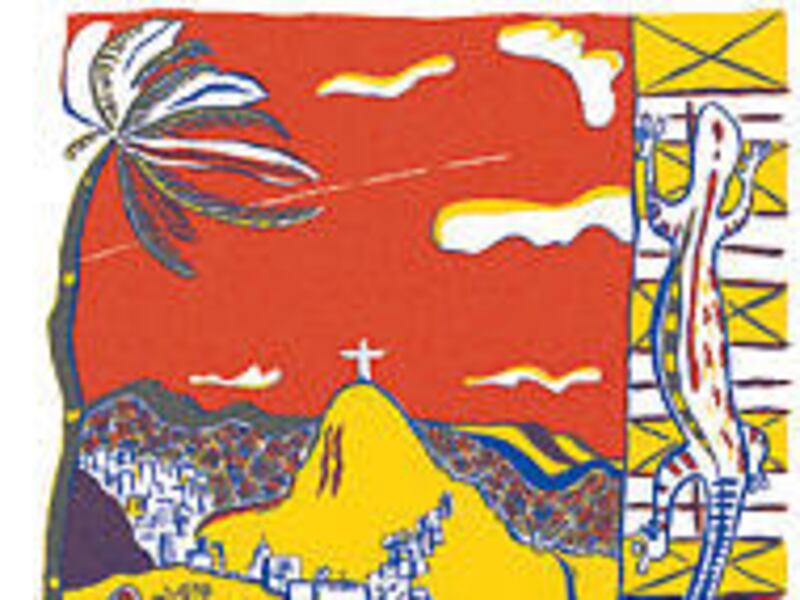

Prints are created by drawing a composition not on paper but on another surface and transferring the composition to paper. This is done by placing a sheet of paper on the drawn surface and running it through a press or by pressing the paper onto the surface by hand. There are five principal printmaking techniques: relief printing, intaglio printing, lithography, screenprinting and monotypes.
Relief printing
The artist sketches a composition on a wood block or other surface and then cuts away pieces from the surface, leaving only the composition raised. Ink is then applied to the surface with a roller and transferred onto paper with a press or by hand burnishing. Since the recessed, cutaway areas do not receive ink, they appear white on the printed image. Relief prints are characterized by bold dark-light contrasts. The primary relief techniques are woodcut, wood engraving and linocut.
Woodcut is the earliest and most enduring print technique, first seen in ninth-century China. Western artists have made woodcut prints for hundreds of years.
Wood engraving is made from the end-grain surface of blocks. This surface has no grain, which allows for great precision and detail.
Linocut is printed from linoleum, usually backed with wood for reinforcement. The printed surface is more supple than wood, giving a softer image. The material is best suited to large designs with contrasting tints.
Intaglio printing
An image is incised with a pointed tool or etched with acid into a metal plate, usually copper or zinc. The plate is covered with ink and then cleaned so that only the incised grooves contain ink. The plate and dampened paper are run through a press to create the print. The intaglio family of printmaking techniques includes engraving, drypoint, mezzotint, etching, and aquatint.
Engraving is a process where a metal plate is marked or incised with a tool called a burin. The shavings that result, the burr, are removed before printing, giving the engraved line a sharp, clean appearance.
Drypoint prints are created by scratching a drawing on the plate with a needle. The incised lines are shallower than in an etching, and the burr is not scraped away before printing. The result is heavier, softer-looking lines than those in an engraving.
Mezzotints have soft tonalities ranging from gray to black. The entire surface of the plate is roughened by a spiked tool called a rocker. If inked, the plate would print in solid black. Therefore, the artist burnishes out areas so that they do not hold ink, yielding the mezzotint's modulated tones.
Etching begins with a metal plate (usually copper) coated with a waxy substance called a "ground." The artist creates the composition by drawing through the ground to expose the metal. The plate is then immersed in an acid bath, which "bites" or chemically dissolves the exposed lines. For printing, the ground is removed, ink is introduced into the incised lines, and the plate is wiped clean and run through a press under great pressure in order to force the paper into the lines.
Aquatint is an etching process concerned with tone rather than line. For this technique, a metal plate is covered, in defined areas, with particles of acid-resistant material, such as resin, around and heated to make the particles stick. The treated plate is then placed in an acid bath, which bites into the copper that is exposed between grains of resin, yielding a composition marked by texture and tone.
Lithography
The artist uses a greasy medium such as crayon or tusche to create a composition on a stone or metal plate. The surface is then dampened with water, which is repelled by the greasy areas, absorbed only by the sections of the plate that have not been marked by the artist. Printer's ink is then applied to the plate with a roller. This, in turn, sticks only to the greasy sections, as the water protects the rest of the plate. The stone or plate is then covered with paper and run through a press to create the print.
Screenprinting
An image that has been cut out of a material such as paper or fabric is attached to a piece of tautly stretched mesh. Paint is then forced through the mesh-or screen-onto a sheet of paper below by means of a squeegee. The uncovered areas of the screen allows the paint to pass through, while the areas covered by the compositional shapes will not. For works with more than one color, a separate screen is required for each color.
Monotype and monoprint
Monotypes or monoprints (the words are used interchangeably) are prints of a single impression. The artist creates a composition on a smooth surface, which is then covered with dampened paper and run through a printing press or rubbed with the back of a spoon or with another tool.
Information garnered from www.ku.edu/~sma/prints.html and www.coskunfineart.com