



A version of this article was first published in the Right to the Point newsletter. Sign up to receive the newsletter in your inbox every Wednesday morning and to vote in subscriber polls.
A few months ago, colleges and universities were bracing for student protests about Israel at their commencement ceremonies, with New York University even decreeing that student speeches would be prerecorded instead of given live.
But there’s been a plot twist.
It’s AI that’s making headlines, as students booed commencement speakers like former Google CEO Eric Schmidt at the University of Arizona and real estate executive Gloria Caulfield at the University of Central Florida.
The backlash against AI arrives as more and more colleges are using the technology for the task of reading the names of graduates walking across the stage. This was done with little complaint last year, but this year, the tide of public sentiment about AI is starting to turn. And also, in some places, the automated announcements haven’t gone well.
At Glendale Community College in Arizona, for example, the ceremony had to be stopped twice as some students’ names were skipped or didn’t match the person on the stage. And yes, there was booing in Glendale.
AI programs like Tassel are supposed to solve an actual problem: the mispronunciation of graduates’ names, which can occur even when students have submitted recordings of them to the school.
But beyond the fact that AI doesn’t always function as intended — witness the Waymos recently circling a cul-de-sac in suburban Atlanta — the technology that seemed so magical when ChatGPT was first unveiled is suddenly not.
Has anyone’s cheeseburger been improved by AI ordering at Wendy’s? Are AI-generated sermons leading anyone to a deeper relationship with God?
More to the point for the class of 2026, is AI getting anyone a job?
Some, to be sure, but a greater number are having a hard time finding work because of the proliferation of AI. The Los Angeles Times reported Tuesday on the struggles of tech workers to find jobs in this changing landscape, noting that Meta is laying off 10% of its workforce this week and reassigning thousands of others to work on AI.
And that doesn’t even begin to address the PR problems the titans of AI are having with massive data centers they want to build, and the debate over whether AI is a public utility.
So of course the students are booing. And of course people are cheering them on, like Aaron Earls, a writer at Lifeway Research, who wrote on X, “College graduates booing every time a commencement speaker mentions the greatness of AI … brings a tear to my eye.”
This is quite the turn of events, that unruly college students are speaking for much of America. In their boos, we may have found an issue that unites America just in time for our 250th birthday celebration.
But all the booing does make one wonder if a class on civility and manners should be a requirement for graduation.
How the commencement speech became a thing
Writing for The Chronicle of Higher Education this week, Sonel Cutler said that commencement addresses in general have become an “especially thorny” issue for universities and colleges.
Cutler quotes a communications executive, the Castle Group’s Philip T. Hauserman, who sums up the problem this way: “Do we let this person speak and deal with potential protests and reputational damage in what is supposed to be the most exciting time of your own campus, or do we rescind the invitation and go with somebody maybe a little more vanilla?”
We had vanilla for much of the past, it turns out.
“Back in the 1700s, graduating students or faculty would deliver Latin orations. ... Those addresses eventually turned into English speeches but were still largely given by members of the college and rarely made the news,” Cutler wrote.
That is, until Gen. George C. Marshall’s address at Harvard University’s commencement in 1947 in which he revealed his now famous plan for rebuilding Europe after World War II.
And with that, the lowly commencement speech showed it could serve a grander purpose, and scores of speakers in decades since have tried to make theirs memorable. (Check out NPR’s catalog of more than 350 speeches going back to 1774 for inspiration and examples.)
Meanwhile, Jonathan Haidt’s address at New York University, published in its entirety by The Atlantic, pushed back against Big Tech companies and told students they needed to become “antifragile” by intentionally doing hard things.
Haidt told the graduates and their families to “treasure your attention more than the people who want to take it from you. Never forget what it’s worth. For Meta, it’s a trillion dollars. For you and your life, it is priceless.”
The selection of Haidt, author of “The Coddling of the American Mind” and “The Anxious Generation,” had been controversial, and the NYU students booed him, too.
By the way, I asked AI when is it appropriate to boo a speaker. The answer: “It is generally appropriate to boo a speaker only in traditional forums that explicitly permit raucous crowd participation — such as political rallies, sports events, comedy clubs, or theatrical performances. However, in academic, professional, or strictly informative settings, booing is widely considered poor etiquette.”
The gas tax debate
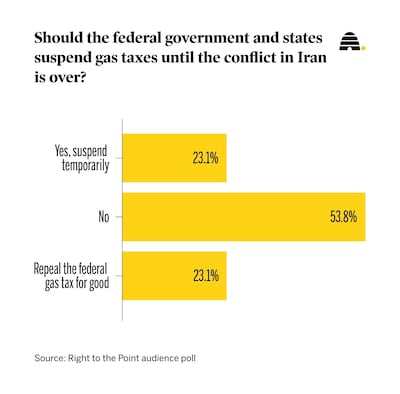
Georgia and Indiana are among states that have temporarily suspended or cut their gas tax, as Americans wait to find out if the federal government will do so, too. But Right to the Point readers would prefer they not. Here’s the result of last week’s poll.
Recommended Reading
Deseret alumna Kelsey Dallas takes us into court chambers, asking if there is ever a situation when it’s appropriate to depart from the standard rules of decorum there.
An excerpt: “To perhaps state the obvious, I think it’s fair to conclude that attorneys shouldn’t typically involve swear words in their argument, but that they can curse when repeating a direct quote ... or when swear words are core to the case, such as in trademark disputes or cases on FCC regulations.”
When (if ever) it’s appropriate to make jokes, take selfies, or curse before the court
Ty Mansfield takes on the subject that has consumed social media for several weeks: whether government disclosures about unidentified anomalous phenomena, or UAPs, could upend what people believe about God.
“Renowned scientist Carl Sagan once wondered why so many religious people seemed reluctant to let scientific discovery enlarge their sense of God. Too often, he suggested, believers respond to cosmic grandeur by retreating into a smaller vision. ... A religion equal to the magnitude of modern science, Sagan argued, would look at the universe and say, in effect, ‘This is better than we thought. God must be even greater than we dreamed.’”
Are people of faith prepared for alien contact?
Amid falling fertility rates and later times of first marriage, we’re being told that men are to blame. Not so fast, say Maria Baer, Brad Wilcox and Jason Carroll.
They write: “It’s a strange world that asks men to grow up and embrace commitment while telling them sex requires no commitment at all, let alone marriage. This inconsistency has created a tornado of cascading social ills, including generations of single mothers, kids without a dad at home and too many men who can’t seem to find a reason to grow up.”
Who is to blame for the decline in ‘marriageable’ men?
End Notes
In closing, I’ll give you my favorite commencement speech, Chief Justice John Roberts speaking to his son’s graduating class at Cardigan Mountain School in New Hampshire in 2017.
The part that got the most attention was this:
“From time to time in the years to come, I hope you will be treated unfairly, so that you will come to know the value of justice. I hope that you will suffer betrayal because that will teach you the importance of loyalty. Sorry to say, but I hope you will be lonely from time to time so that you don’t take friends for granted. I wish you bad luck, again, from time to time, so that you will be conscious of the role of chance in life and understand that your success is not completely deserved and that the failure of others is not completely deserved, either.”
But Roberts also said this: “Once a week, you should write a note to someone. Not an email. A note on a piece of paper. It will take you exactly 10 minutes.”
That seems quaint these days, yes, even more than it did in 2017. But it still seems valuable advice as it’s something that AI can’t do.