

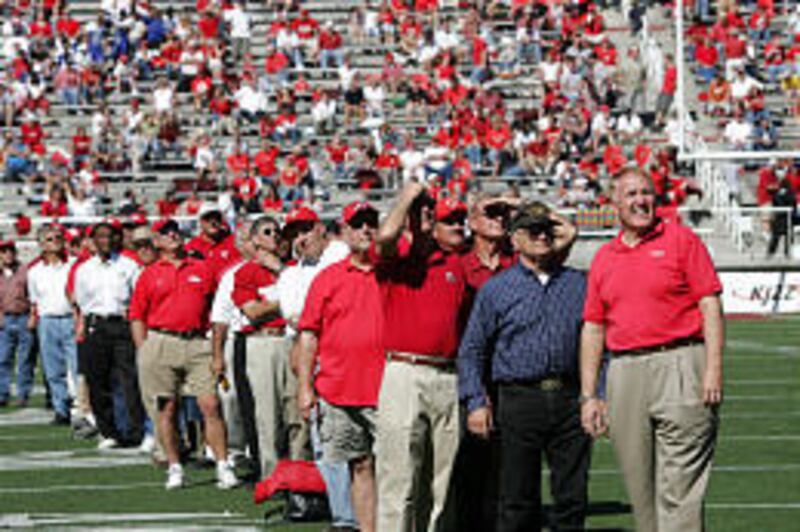
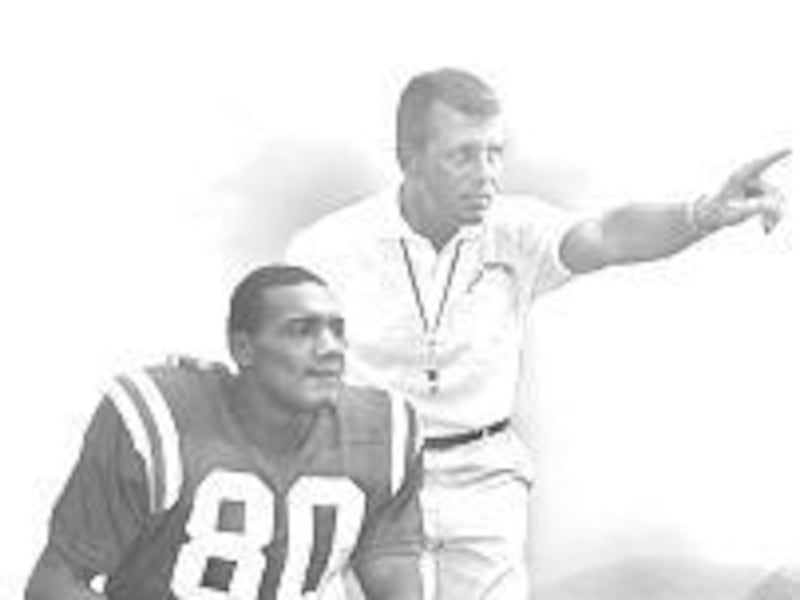

Forty years ago, just a few months after Urban Meyer was born, the Utah football program captured its greatest victory ever — in Atlantic City, N.J., of all places.
The Redskins as they were called at the time, defeated a highly favored West Virginia team 32-6 in the Liberty Bowl to cap off a 9-2 season.
OK, maybe it wasn't Utah's most exciting football game or best-played victory ever. But in terms of the importance of the victory, it was Utah's greatest.
Some might argue otherwise, but yes, it was even greater than the 1994 Freedom Bowl winning team or last year's Liberty Bowl winning team.
Certainly the 2004 Utah football team can eclipse that accomplishment with a win later this week at the Fiesta Bowl, even if it comes against a Pitt team that is a 16-point underdog. But for now, the '64 Liberty Bowl victory is the pinnacle for Utah football.
The victory capped off a superb season that saw the Utes earn a Western Athletic Conference co-championship, a 14-0 upset victory over a Cal team led by future NFL quarterback Craig Morton, three other shutouts, topped off by a convincing 47-13 victory over rival BYU. The only losses were to a Missouri team led by future NFL star Johnny Roland and a heartbreaking 14-13 loss to Wyoming in Laramie.
Back in '64, there were about 20 fewer bowl games than the glut of bowls today. Besides the Liberty Bowl, there were the Rose, Orange, Sugar, Cotton, Gator, Citrus, Sun and Bluebonnet bowls. No Fiesta Bowl, no Gaylord Hotels Music City Bowl, no Poulan Weedeater Independence Bowl.
So just to get invited to a bowl was a big accomplishment for a major college team, unlike today when nearly every Division I-A team with a winning record is bowl-bound.
In '64, Utah was a relative unknown despite its 8-2 record and was a big underdog going into the game. The Liberty Bowl had started in 1959 in Philadelphia but before moving to its present home in Memphis was played at Atlantic City in what was the first indoor college bowl game.
Forty years later, Ute players remember it like it was yesterday.
"You had to be pretty good to go to a bowl game in those days," said Merlin Driggs, a tight end on the team. "We were supposed to be blown out. I remember the headline after the game, 'Utah Who?' "
"It was like 'Who are these guys from Utah?' " said tackle Gregg Kent. "Nobody knew about us."
"The general national feeling was that we were from the sticks and that West Virginia would roll over us," said halfback Ron Coleman. "But I thought if we played our normal defensive game and if the offense played well, we would have a good shot at beating them."
"I remember their guys looked like playboys, dressed up in their fancy clothes," recalls fullback Allen Jacobs. "They got there first and were making fun of us as we walked by."
With all the disrespect directed at them, the Utes were plenty motivated by the time the game started on that Saturday afternoon in late December.
A crowd of just 6,059 fans was on hand for the game played at the Atlantic City Convention Center where the Miss America Pageant was held every year. Right from the start, Ray Nagel's Utes let the Mountaineers know who they were.
"We hit their all-American fullback hard, and he fumbled," said linebacker Rudy Reschke. "We went in to score after that."
All-American Roy Jefferson, who went on to play in the NFL as a wide receiver for 12 years, got the Utes started with a 29-yard field goal and later added a 32-yard field goal. In between, quarterback Pokey Allen ran in from 11 yards out and later in the half Coleman got loose for a 54-yard run.
"I remember the ease in which our running backs were able to amass a lot of yardage," said Jefferson. "But the big disappointment to me was the dislocated shoulder I got just before halftime, and I couldn't play in the second half."
But Jefferson probably wouldn't have played much anyway.
"I was all-conference but didn't even get to play very much because we ran up the score so much before halftime, they let the other guys play," said Jacobs.
Utah added to its 19-0 halftime lead with a 47-yard run by halfback Andy Ireland. West Virginia finally got on the board with a third-quarter touchdown, but with reserves in the game, Utah added another touchdown in the fourth quarter with backup quarterback Rich Groth hitting Bill Morley with a 33-yard touchdown pass. Jerry Pullman added the extra point.
For the game, the Utah offense piled up 466 yards.
Ireland and Coleman were roommates, and they made a pact before the game.
"We said, 'We're not going to let the MVP trophy get out of this room,' " Ireland said. "We said one of us has got to win this trophy. I was pulling for him and he was pulling for me."
Coleman ended up winning the MVP trophy after running for 154 yards and that first-half touchdown.
"When he won it, I was so happy," said Ireland.
After the victory, the Utah team was able to spend three days in New York City before returning home for Christmas.
"The trip was more memorable than the game," said center Pat McKissick. "It was the first indoor football game. Afterward when we went to New York, everyone recognized us on the subway as the boys from Utah."
Coleman remembers "One of the most heart-warming things was the parade they had when we came home and the outpouring of support from the local community. The whole season was simply wonderful."
"I figure it was one of the best teams in the history of University of Utah football," said lineman Dane Watkins. "It was a great team effort and everything came together on that particular day and we were ready to play football. It was just a great year for Utah football."
Where are they now
Pokey Allen (quarterback), passed away in 1996. At the time he was the head coach at Boise State.
Ron Coleman (halfback), lives in Salt Lake City and is a history professor at the University of Utah.
Merlin Driggs (tight end), is an education administrator in Cerritos, Calif.
Andy Ireland (halfback), lives in Carson, Calif., where he has been a postal worker for 31 years.
Allen Jacobs (fullback), after playing five years in the NFL and winning a world championship ring with the Green Bay Packers, he settled in Midvale, where he works in real estate.
Roy Jefferson (end, placekicker), lives in Annandale, Va., where he is a marketing rep for a title company. He played in the NFL for 12 years.
Gregg Kent (lineman) lives in Alamo, Calif., where he works as a real estate developer and as a rancher.
Frank Mazzotta (end), lives in Cerritos, Calif., where he has been the head coach at Cerritos Junior College for 27 years.
E-mail: sor@desnews.com