

OLVESTON, Montserrat — I finally went home again. Eight years after my last visit, I walked down the gangway of the Opale Express, an Australian-built catamaran, and stepped on the concrete jetty.
My return home was a familiar ritual, to bury family, my father. But on that placid October afternoon, none of that mattered. I was home, even if home was a vastly different place.
Montserrat, the 38-square-mile island where I grew up, had been sliced in two when the volcano rumbled to life in July 1995. It uprooted most of my relatives, friends and former neighbors. Some of them stayed, but most left.
Those who remained inhabit a truncated world of exclusion and safe zones, ash gray and tropical green, fear and hope.
"I have stayed because of the peace and tranquility of the place, the beauty of being able to see the sea and the mountains at the same time, to be free to walk at any hour without fear, but most importantly it is home," said Melissa O'Garro, a former classmate and lifelong resident. She delights whenever old friends return, some for a week, others for good.
Montserratians have been slow to return. The island's population once hovered around 11,000; now fewer than 4,500 people call the British colony home. Less than half are native; most are a mixture of white British and American expatriates coexisting with a blend of Guyanese, Jamaican and Dominican transplants seeking steady work.
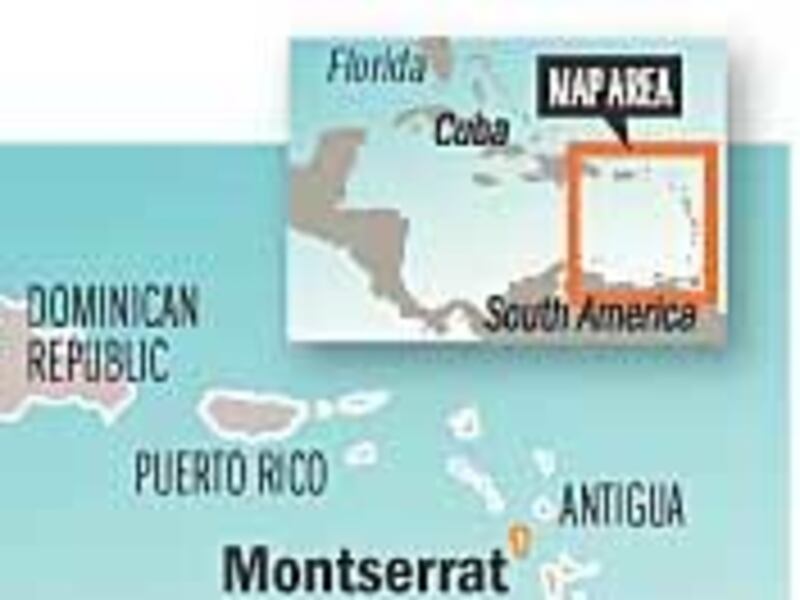
They journey north and south to reach Montserrat, which lies in the northern part of the Lesser Antilles, a volcanic arc of islands formed like a necklace along the junction between the Atlantic tectonic plate and the Caribbean plate.
I saw some of those islands as I flew from Tampa, Fla., to Puerto Rico and then hopscotched in a 28-seat puddle-jumper to St. Maarten, Tortola and then to Antigua. There I caught a ferry for the hourlong boat ride to Montserrat, an avocado-shaped volcanic rock, about 10 miles long from north to south and a little more than 6 miles wide east to west.
Despite the proximity of active volcanoes, in St. Vincent, Guadeloupe, Martinique and St. Lucia, I was raised on the myth that the Montserrat volcano was dormant. I was ignorant of the volcano's 30-year cycle of restiveness. And like most of my fellow expatriates and residents, I knew nothing of the seismic swarms, thousands of small earthquakes, that geologists began to monitor in 1992. Those rumblings foretold trouble.
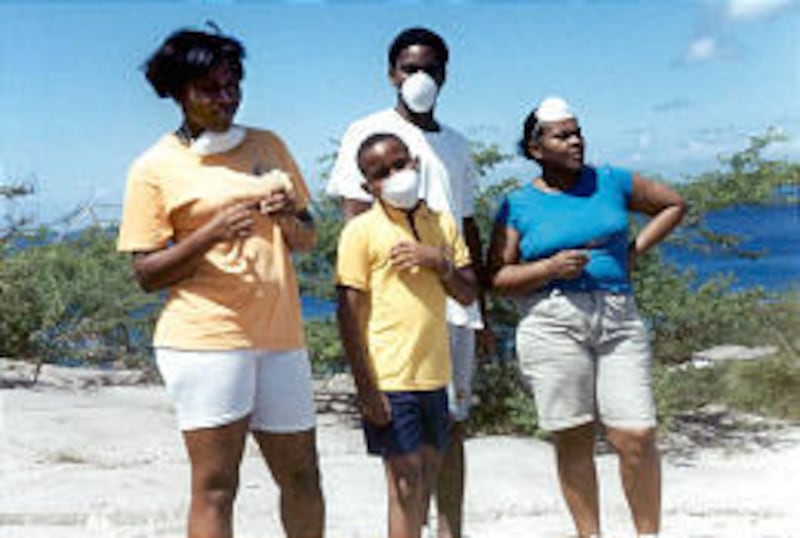
On July 18, 1995, Montserrat's Soufriere Hills volcano erupted. Two months later, I flew home to see for myself. Back then, Plymouth, the historic capital, sat shuttered and deserted except for wandering sheep, goats and dog packs.
The beleaguered populace endured one temporary evacuation after another. Then in 1997, when scientists could no longer guarantee the safety of residents from the 500-degree avalanches of ash, mud and boulders traveling 60 mph, they evacuated the capital and villages south and east. Evacuees lived in makeshift shelters, church halls, tents, schools, rented rooms, even wood houses devoid of indoor plumbing.
Successive ash falls and mudflows buried more and more of Plymouth. For almost a decade, I viewed the carnage at a distance — on the Internet. As fascinated as I was by the volcano's destruction, I stayed away. I pretended that not seeing the destruction in person enabled me to preserve my memories, unretouched.
In my memory, a whitewashed war memorial stands at the center of the doomed capital. Built to honor colonial men who fought and died in World Wars I and II, the memorial played host to political rallies, evangelical crusades and the annual Armistice Day remembrance. It was a favorite haunt for my grandfather and me.
But during the last eight years, the memorial's obelisk sank below the ash until the clock tower collapsed, bulldozed by the volcano.
"It's a symbol of the gradual destruction of Plymouth," said Gill Norton, the British-born director of the Montserrat Volcanic Observatory, the agency charged with monitoring the volcano and forecasting its next move. "A lot of people are coming to terms with the fact that they'll never return to Plymouth in their lifetime."
Not my sister, Joycelyn Tuitt. She has been a refugee from her home for close to six years. The volcano forced her to flee with her three younger children to neighboring Nevis for three years. Since her return to Montserrat, she has lived in a succession of rented houses. She steadfastly refuses to buy a new house. She and her neighbors were planning to build a road through the hills to allow them to return to their abandoned houses in the evacuated zone, when on July 12, 2003, ash blanketed the island and put that dream on hold.
Joycelyn remembers the steady drumbeat of pebbles and rocks on her roof and the thunder and lightning that punctuated that Saturday night. "Boy, I thought we were going to be buried alive," she said. "It was the first time I was really afraid."
Since then, the volcano has been silent, its longest period of quiet during eight years of restiveness. Scientists plan to re-evaluate the volcano in March. My sister hopes to get the all-clear so she can go home again.
Meanwhile, she must settle for periodic excursions home, like the one we made one Sunday afternoon during my October visit. The house sits on a hill covered in ash. Its interior looked as if the inhabitants had left on a long vacation. My sister clearly feels that way.
As I drove farther south, toward Plymouth, I saw a landscape dozing under 2 feet of ash, the accumulation of countless ash falls. Occupants were long gone.
As we passed my father's abandoned house, we saw the wrecked shell of his old ice-cream truck. Beneath the ash, "Ray's Soft Freeze" was visible, trumpeting another of my father's business ventures.
Roadblocks prevented a full inspection of the abandoned capital, but in the distance I recognized old landmarks, places in my boyhood memory. Places like Sturge Park, where I used to play soccer, ran track and endured the pain and disappointment of watching the national cricket team lose.
In late December, when the grass grew tall as wheat, my friends and I returned to Sturge Park for cultural festivals. Now the once-lush green field sat blanketed in gray.
Next to the park is the national cemetery, where my grandfather and other ancestors lie buried. The volcano has entombed their graves. After the evacuation, the government opened another cemetery, which has since been filled. Now local churches are asked to provide burial plots.
My dad, a Seventh-day Adventist, was buried in a small Methodist churchyard cemetery. On distant hillsides, as the sun crept below the horizon, the ocean assumed a purple hue. In the foreground, lights flicked on in houses perched on hillsides like a dandy's handkerchief.
Even in death, signs of life, signs of hope.