



- Utahns largely oppose Trump’s monument reductions, with 56% opposing and only 29% supporting the removal of roughly 3 million acres from Bears Ears and Grand Staircase-Escalante.
- Poll results suggest many Utahns may not understand land restrictions, as majorities support grazing, timber cutting, roads and off-road vehicle use on public lands.
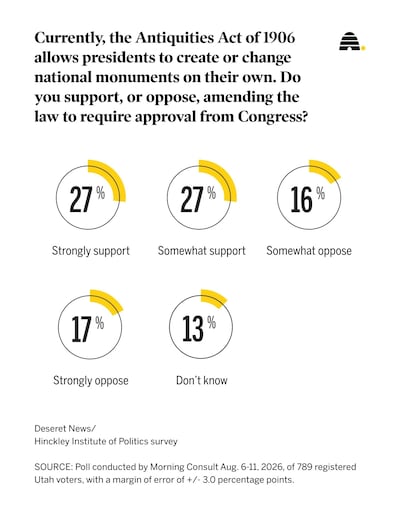
- Utahns favor local and state control of public lands, with 82% saying local or state governments should have the most say, while many also support changing federal law to require congressional approval for new national monuments.
It appears as though Utahns are of two minds about public land.
While they were not supportive of President Donald Trump’s recent reduction of the size of Bears Ears and Grand Staircase-Escalante National Monuments, they do want to see greater local control of public land, according to a Deseret News-Hinckley Institute of Politics poll conducted by Morning Consult.
The two national monuments have oscillated in size through the previous several presidential administrations through the power of the Antiquities Act.
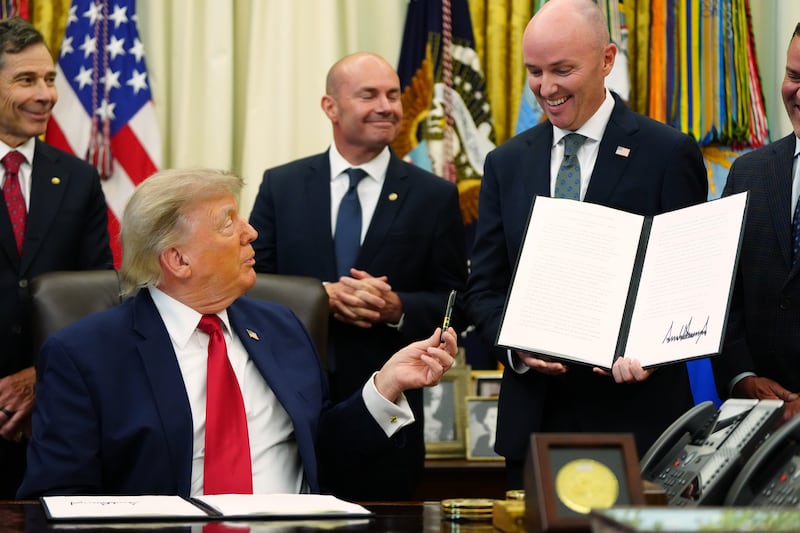
On July 13, Trump removed a combined 3 million acres from the two monuments.
Grand Staircase-Escalante, which is in south-central Utah, now covers 182,000 acres, down from 1.87 million acres; Bears Ears, in southeastern Utah, now covers 121,000 acres, down from 1.36 million acres.
Polling conducted between Aug. 6 to 11 shows 3-out-of-10 (29%) registered Utah voters supported Trump’s decision, 56% opposed it, and 15% were unsure.
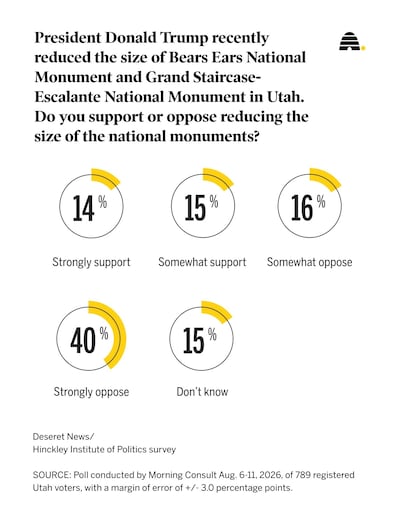
These numbers varied significantly by political affiliation. A full 82% of Democrats were strongly opposed to the move, while a little less than half of Republicans, 47%, either strongly or somewhat supported the reduction, and 36% strongly or somewhat opposed the reduction.
Meanwhile, those who voted for Trump in 2024 were divided: 22% strongly supported the monument reduction, 23% were somewhat supportive, 19% somewhat opposed, and 19% strongly opposed.
Megan Jenkins, a strategic research director for the Pacific Legal Foundation based in Logan, Utah, reviewed some of the data provided by the Deseret News.

“It seems like people really don’t like the idea of the president shrinking a national monument, and that makes sense. It intuitively sounds bad. But when you dial down and ask them about actual management of the land, I was really interested to see that most people actually don’t like the idea of the federal government being in charge of land management,” Jenkins said.
Across political parties, when respondents were asked who should have the most say in deciding how public lands are used, they overwhelmingly said local city and county governments (46%) and state governments (36%). Only 9% supported the federal government having the most say in how public lands are used.
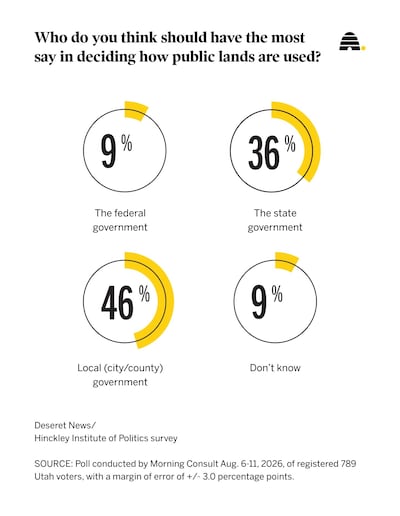
For this question, Democratic men were the only outlier: 30% responded that the federal government should have the most say in land use, while everyone else, including Democratic women, were 7% or less. Gen Z was the least likely demographic (3%) to think the federal government should have the most say.
“People know that having government that’s thousands of miles away be in charge of land management decisions that affect a majority of our state is just not a good idea,” Jenkins said.
There seems to be confusion as to what a monument is and does

National monuments, as codified in the Antiquities Act, are legally obligated to protect the smallest area compatible to protect the relevant artifacts. The law was signed in 1906 to protect historical artifacts against looting as Americans moved West.
“When you think of a national monument, you think of maybe the monuments in D.C., which are a specific historical monument to an event or a historical building or artifacts. That’s what the Antiquities Act was supposed to protect, so it makes sense that your mind goes there,” Jenkins told the Deseret News. “When people think of Bears Ears, maybe they’re thinking more of a national park, which is a totally different way of managing land.”
In former President Joe Biden’s use of the Antiquities Act, he outlined what would and wouldn’t be allowed on roughly 5,190 square miles in southern Utah.
On Grand Staircase-Escalante, for example, the final Bureau of Land Management report prohibited the following:
- All commercial and non-commercial forestry and woodland harvesting.
- Off-highway vehicles from traveling on 1.2 million acres in the 1.87 million acre area.
- Cross-country travel.
- The felling or destruction of live or dead old-growth and mature trees.
- Nonstructural range improvements aimed at increasing forage for livestock.
- Utility-scale renewable energy development.
- Oil and gas drilling.
The Deseret News asked poll respondents what activities they would support or oppose on public lands.
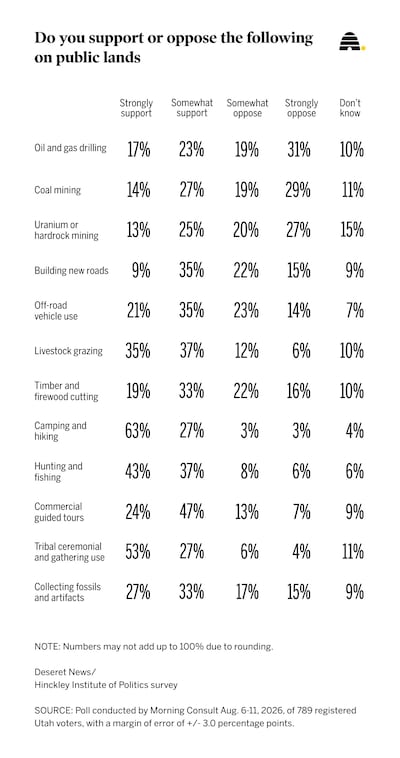
Respondents overwhelmingly supported (72%) livestock grazing on public lands. About half of respondents supported timber and firewood cutting (52% supported, 38% opposed), building new roads (56% supported, 37% opposed) and off-road vehicle use (56% supported, 37% opposed).
Respondents were less enthused about coal mining (41% supported, 48% opposed), uranium and hardrock mining (38% supported, 47% opposed) and oil and gas drilling (40% supported, 50% opposed) on public land.
“A higher percentage of Utahns seem to be open to land being used for energy, grazing, timber production — and a lot of those things actually would have been prohibited under the national monument designation,” Jenkins said. “I think it shows people don’t understand what’s actually at stake here and what these decisions mean.”
Restrictions on forest management and a summer of raging wildfires
As of mid-August, more than 536,000 acres of Utah’s land have burned in 820 fires.
In a previous conversation with the Deseret News, U.S. Forest Service Chief Tom Schultz described the vicious cycle of litigation and regulatory processes causing a buildup of decay, causing bigger, hotter and more expensive burns across the country.
“A majority of your respondents support timber or firewood cutting. I think that’s especially interesting, because we’re in such a bad wildfire year,” Jenkins said. “We know that responsible timber production, forest thinning and prescribed burns can all help prevent these catastrophic wildfires from happening in the first place. And yet, these really restrictive management regimes, such as national monuments, make all of those activities more difficult.”
Across political affiliations, poll respondents also largely supported amending federal law to require approval from Congress on national monument designations.