



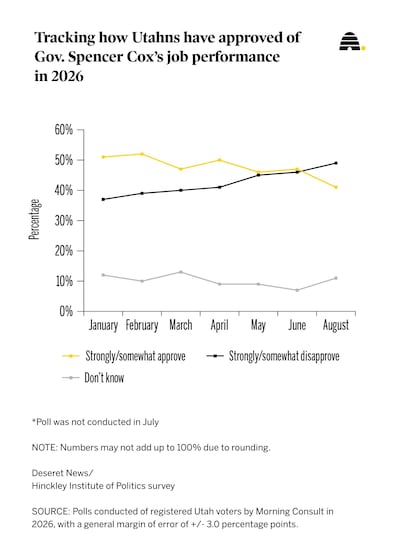
- Gov. Spencer Cox’s approval rating fell from 51% to 41% since January, putting him 8 points underwater.
- Sens. Mike Lee and John Curtis also moved into negative territory amid broader anti-incumbent sentiment.
- Utah voters who are independent shifted away from Cox more than other political identifications.
Utahns handed statewide leaders an overall negative approval rating in August, continuing a downward trend for Gov. Spencer Cox that put his approval rating underwater for the first time, a Deseret News/Hinckley Institute of Politics poll found.
The poll of nearly 800 registered Utah voters revealed an anti-incumbent mood that left no one untouched. The state Legislature and Sen. John Curtis dipped into negative territory, while Sen. Mike Lee and Cox took a plunge.
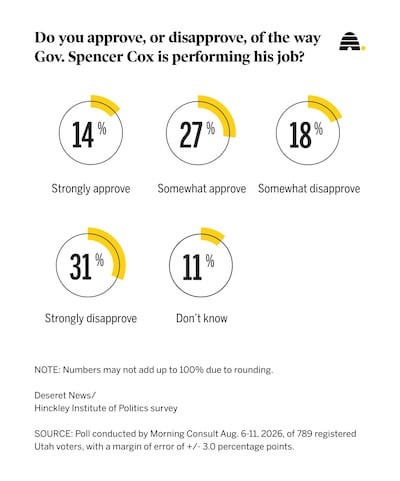
Since January, Cox’s approval rating has dropped 10 percentage points from 51% to 41%, with 14% saying they strongly approve and 27% saying they somewhat approve. Meanwhile, total disapproval has risen from 37% to 49%.
Growing dissatisfaction is not isolated to Cox. Among Utah voters, President Donald Trump flipped from a 5-point positive approval in January to a 7-point negative rating, and Congress fell further from negative 21-points to negative 30-points.
At least some of this can be explained by an unstable economy, high gas prices, expensive cost of living and the ongoing war in Iran, according to Jason Perry, director of the Hinckley Institute of Politics at the University of Utah.

“There is clearly broader frustration among Utah voters right now,” Perry said. “Gov. Cox’s decline stands out because we’ve seen it continue over several polls, but I’d be cautious about attributing it to any one issue, including Disagree Better.”
The 8-percentage-point spread between Cox’s disapproval and approval marks the first time that Deseret News surveys have found the governor below water. The data confirms a broader trajectory for the governor in the middle of his second term.
Between April 2023 and April 2025, Cox’s job approval fell from 64% to 52% of Utah voters, driven by a 26-point collapse in Democratic support as Cox made more explicit overtures to the Republican Party of Donald Trump.
This pattern continued from earlier polls conducted by HarrisX and more recent polls conducted by Morning Consult. Over seven months, the share of Utah voters who strongly disapprove of Cox has nearly doubled from 17% to 31%.
During that time, Cox’s approval among self-identified Democrats dropped from 26% to 18%, while his Republican approval held more steady, sliding from 69% to 61%. By far the largest change came from independents.
Data center and Disagree Better
After a legislative session where Cox secured Trump’s support for the Great Salt Lake, and after months of public backlash surrounding a proposed data center, Cox’s approval rating among independents tumbled from 45% to 26%.
The Stratos Project in Box Elder County sparked public outcry after Cox and outgoing state Senate President Stuart Adams, R-Layton, helped investor Kevin O’Leary accelerate project approval with military economic development authorities.

If he had to point to one thing, state Sen. Todd Weiler, R-Woods Cross, said he would attribute Cox’s drop in job approval to the way the data center debate developed in the state with the governor’s comments front and center.
“I think it’s the data center,” Weiler, who is CEO of Sutherland Institute, told the Deseret News. “Just people feeling like that they weren’t heard and that the process was rushed and that public input wasn’t allowed, or sufficiently allowed.”
At the onset of the pushback against the massive site north of the Great Salt Lake, Cox argued that states “have an obligation” to develop AI infrastructure, despite what “people-against-virtually-everything” might have to say.
He later acknowledged the project’s rollout “wasn’t great.” The unpopularity of the data center contributed to Adams being ousted in his June primary election, and eventually led to O’Leary making a televised apology earlier this month.
AI is one place where Cox has chosen to use up some of his “political capital,” according to Weiler. The governor’s political capital has also been expended on his personal mission to bridge partisan divides since he entered office in 2021.
Initially, this appeared to give the governor a broad coalition of support from voters across the ideological spectrum in the state. This has waned as the governor has taken stands on polarizing issues, from transgender sports to immigration enforcement.

For some conservative Utahns, Cox’s Disagree Better initiative has been misguided from the start.
“It really causes unreliability with the public where we never quite know what we’re going to get,” St. George city council member Michelle Tanner told the Deseret News. “When you try to appease everyone, you end up appeasing no one.”
The governor, who has said he will not run for a third term, continues to lead out on depolarization efforts, writing a forthcoming book on how to avoid political violence, as well as leading a bipartisan task force on legal immigration reform.
Lee and Curtis not spared

Utah’s senior senator also saw his approval rating decline in the past half year. In February, Lee enjoyed an overall approval of 47% and disapproval of 37%. By August, those numbers had reversed to 39% approval and 46% disapproval.
In 2019 and 2022, Deseret News surveys conducted by different polling firms found Lee slightly underwater. But the 7-point gap revealed by the latest poll is well outside of the poll’s margin of error of plus or minus 3 percentage points.
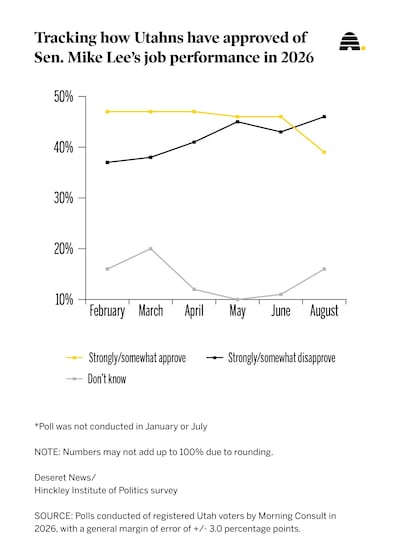
The shift since February was caused by Lee’s slim Democratic approval dropping from 23% to 10%, and his Republican approval taking a surprising turn from 73% approval to 63% approval in the latest poll conducted from Aug. 6-11.
“Sen. Lee has consistently been the most popular and highest-rated Republican within his Party in Utah, whether in statewide or local polling,” Lee’s political strategist, Dan Hauser, said. “As Democrats swing wildly to extremism in their support of socialism, it is no wonder that his approval rating suffers with the left.”
As an outspoken conservative willing to halt Senate procedures to make himself heard, Lee has waged a campaign in recent months to pass the SAVE America Act, which would require voters to show proof of citizenship and photo identification to vote.

Persistent messaging on this topic may have tired out voters who do not fall into the segment of the GOP Lee “caters” to, according to Weiler. He may also be the victim of voter “fatigue” over GOP infighting on foreign wars, Tanner said.
As one of Utah’s newest statewide officials, Curtis also saw his overall approval rating fluctuate downward. A positive margin of more than 10 percentage points from early 2025 closed in recent months, disappearing in the August polling.
Curtis now stands at 37% total approval and 38% disapproval among Utah voters. However, more than a quarter of Utah voters did not have their mind made up about Curtis — around double the share who said “don’t know” for Lee or Cox.
Meanwhile, the Utah Legislature, which is typically judged more harshly than individual elected officials, lost a 6-point positive approval rating over the course of the year, ending up with 44% of voters approving and 45% disapproving.
None of Utah’s statewide officials, including Cox, Lee and Curtis, are up for election in the upcoming November midterms. Historically, the party in the White House has fared poorly in midterm races for Congress and governorships.