

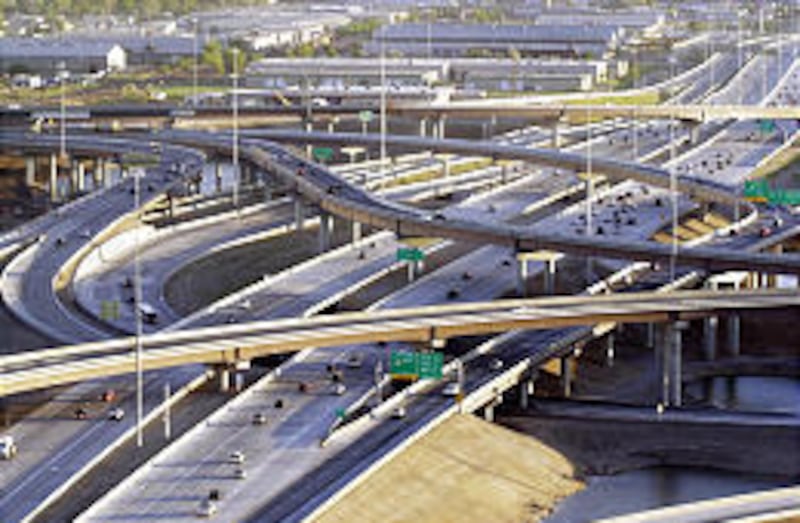
WASHINGTON — Two Utah freeway interchanges are among the nation's 100 worst traffic bottlenecks, according to a new study.
The American Highway Users Alliance says that the interchange of I-15 and I-80 in South Salt Lake is No. 53 on the list. The study says it caused 3.53 million hours of delay in 2002 for frustrated drivers of the 194,661 cars that pass there daily, for an average of 18 hours per car per year.
At No. 99 was the Davis County interchange of I-215 and I-15. The study says it caused 2.48 million hours of delay among the 179,510 cars that use it each day.
"This is a little like Mr. Blackwell's 'worst dressed' list — this is a list you do not want to be on. It is not an honor at all," Federal Highway Administrator Mary Peters said.
The study identified 233 bottlenecks in 33 states where drivers experience at least 700,000 annual hours of delay. The number of such large bottlenecks is up by 40 percent since the last time the alliance made a similar study five years ago.
Infamy as the nation's single worst bottleneck goes to the Los Angeles interchange of the Ventura Freeway (U.S. 101) and I-405, which causes an estimated 27.1 million hours of delay a year among 318,000 cars that use it daily.
Utah Department of Transportation officials said they were somewhat surprised that the "spaghetti bowl," as the I-80/I-15/U-201 interchange in South Salt Lake is known locally, was ranked as high as No. 53. The interchange was reconfigured during the I-15 reconstruction project (completed in 2001) and runs fairly smoothly relative to how it was.
"We watch the congestion every morning, and I wouldn't have listed that as one of our heavily congested areas," UDOT spokesman Nile Easton said.
There is an evening backup on westbound U-201 from I-15 to Redwood Road, Easton acknowledged, but UDOT soon will begin a design-build project to widen that stretch of the 2100 South freeway.
With regard to the Davis County interchange, ranked No. 99, "the bottleneck we see, where I-215 comes in and where the Beck Street onramp is, that's one that we're going to address this summer," Easton said.
UDOT plans to add an extra lane of travel, in each direction, on I-15 between Beck Street and I-215. Currently, the freeway briefly transitions from three lanes in each direction to two and then back to three, causing the bottleneck.
Another area of heavy congestion that didn't make the list but has been a major concern since the completion of the I-15 rebuild project is the I-15 interchange at 10600 South. There, the freeway narrows from five lanes to three and is typically backed up for a mile or more during the evening commute.
But UDOT, with the help of the state Legislature, plans to fix that problem this year as well. The Legislature two years ago approved the use of $35 million in local tax dollars to add two additional lanes in each direction on I-15 from 10600 South to Alpine in Utah County. One of those lanes will be for high-occupancy vehicles.
"Getting that HOV lane extended all the way to Alpine, we think that will really help," Easton said.
"It's still relative," he added. "Our congestion and delays, compared to Los Angeles or Denver, are substantially different."
Los Angeles had four of the nation's 10 worst bottlenecks: In addition to the No. 1 Ventura Freeway, No. 5 was I-405 at I-10, No. 8 was I-10 at I-5 and No. 9 was I-405 at I-605. Los Angeles also had 16 of the nation's 233 worst.
Other nasty bottlenecks in the West, possibly familiar to Utahns, include:
The Phoenix interchange of I-10 at state routes 51 and 202 (No. 4 nationally);
The Phoenix interchange of I-17 and I-10 (No. 12);
The Las Vegas interchange of I-15 and U.S. 95 (No. 22);
And San Diego's interchange of I-805 and I-15 (No. 24).
The alliance released the study — funded by such groups as the Alliance of Automobile Manufacturers, Portland Cement and the National Stone, Sand & Gravel Association — as Congress is debating a new highway bill to authorize federal construction over the next six years.
Current authorization expires at the end of the month, unless Congress extends it or passes a new highway bill.
"Let me say this to all those who are stuck in traffic somewhere," Alliance President Diane Steed said. "If you can't get over to the side of the road — and in a bottleneck you might not be able to do that — then put your car in park, pick up your cell phone and call your congressman. It's time to act. Let's get rid of congestion."
Steed said the study predicted that even modest improvements made to bring traffic flow to minimum acceptable levels at all 233 major bottlenecks nationally would:
Prevent 449,500 crashes, 1,750 fatalities and 220,500 injuries during a 20-year life span of improved projects;
Cut pollution at the bottlenecks in half;
Conserve more than 40 billion gallons of fuel over 20 years;
And reduce rush-hour delays by an average of 16 minutes per trip — or 32 minutes a day total for commuters caught in morning and evening rush hours.
Steed noted seven of the top 18 bottlenecks identified nationally five years ago fell off the list this year because of construction and improvements.
E-mail: leed@dgsys.com; zman@desnews.com