


John Kerry breezed to a win Tuesday in Utah's Democratic primary — as he was also expected to do in Idaho's and Hawaii's primaries — and gained even more momentum heading into next week's critical Super Tuesday.
With a majority of voting locations reporting late Tuesday, Kerry won Utah with more than 50 percent of the vote compared with his nearest competitor, John Edwards, who received about 30 percent.
"Thank you, Utah. With outstanding turnout tonight, you've shown that Democrats in Utah are alive and well and ready to kick George W. Bush out of the White House," said Kerry from Ohio. "You've shown that what is uniting Americans from all walks of life, and from every region of the country is much more powerful than what has divided us during this president's term and in the years past. I thank you for standing with me today."
Dennis Kucinich registered less than 10 percent of the vote in Tuesday's primary despite being the only candidate to step foot in the state recently.
Utah had 23 delegates to the Democratic National Convention up for grabs in Tuesday's vote. Candidates had to obtain at least 15 percent of the overall vote to garner any delegates, and they are then proportionally allotted according to votes received. They will be apportioned officially at the Utah State Democratic Party Convention in May. Six other uncommitted "super delegates" not tied to this election's results will also be sent to the Democratic convention this July in Boston.
The biggest election story in Utah on Tuesday, however, might not have been who won. It might have been who — and how many people — voted.
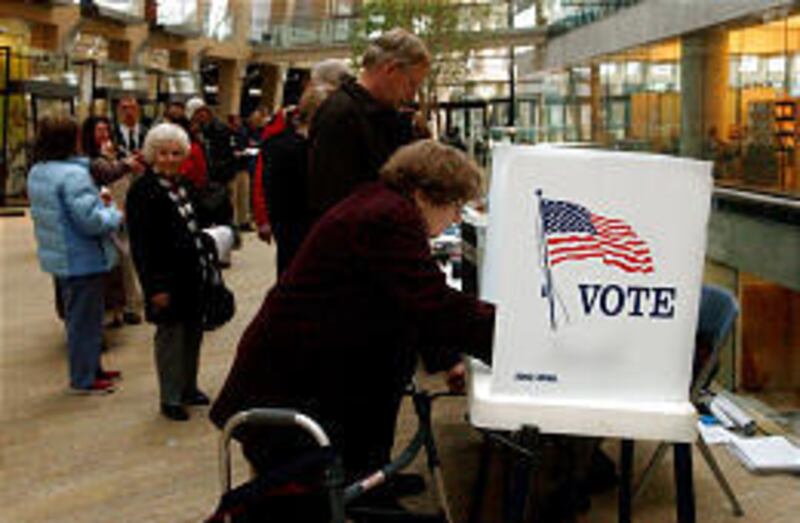
From St. George to Logan, many voting booths were hopping all day. All totaled, more than 20,000 Utahns participated in the primary — significantly more than what local party leaders anticipated.
"The turnout has just been overwhelming," said Utah Democratic Party chairman Donald Dunn. "It's great. It's absolutely great."
The party had to print 5,000 extra ballots for the 111 polling places at libraries all over Utah. Officials had to restock ballots all over — from Moab to South Jordan to Weber County, and even three times in Provo. A number of libraries photocopied ballots and marked them with identification numbers for control purposes while waiting for refills.
In Salt Lake City, volunteers decided to open voting before the scheduled noon kickoff at the Main Library because 20 voters arrived early and some became restless. A half-hour later, the line stretched about 100 yards across the library lobby and out the door.
In West Valley City, some voters left before casting a ballot because lines were so long and voting officials were so few. Dunn received a phone call from a Cedar City election official who reported similar circumstances, and in St. George, traditionally a Republican hotbed, some voters had an unexpected half-hour wait. But Dunn said they apparently didn't mind the inconvenience.
"They were delighted No. 1," he said, "that there was a line to wait in."
So, why all the fuss over a Democratic primary in a conservative Republican state in the country?
Dunn, whose Democratic committee footed the $30,000 bill because Republican lawmakers refused to appropriate state funds for the election, says it boils down to one thing.
"I think people in Utah are sending a message that they want anybody but Bush," said Dunn. "I just think there's a strong feeling that George Bush is bad for the environment, bad for the economy and bad for education, and it's time for a change."
Interestingly, the state's highest-ranking Democrat didn't even vote in the primary. Rep. Jim Matheson, Utah's lone Democrat in Congress, didn't cast his ballot in person Tuesday or fill out an absentee ballot as voters in Daggett, Piute and Rich counties did. Matheson had to catch a flight to Washington before polls opened, spokeswoman Alyson Heyrend said.
At any rate, she said Matheson has not yet decided whom he will support for the Democratic nomination.
Russell Lallman likes them all. The Salt Lake City resident and avid Democrat was thrilled to see the library lobby packed. He believes Utahns have "a sense of urgency" to defeat Bush.
"I think this gives them (Democrats) a really good shot in the arm," he said. "I haven't seen this many people come to vote even in November. It's one of the most important elections in many years."
Brett Losee, a Democrat from Salt Lake City, also gave his nod to Kerry. "I feel that he's got what it takes to go against Bush," he said. "He has a connection with the people and he's not a bureaucrat."
Losee is hopeful Tuesday's large voting crowds is a sign of things to come in a state that hasn't voted for a Democratic president since Lyndon B. Johnson in 1964.
"It kind of makes you feel like a small fish in a big pond. But I feel this gives me a voice," he said. "Who knows if we'll be a Democratic state one day."
Though they called themselves "independently leaning Republicans," co-workers Jim Robson of Salt Lake City and Lisa Mekeel of Saratoga Springs, Utah County, both voted. Robson liked Joe Lieberman even though he is no longer in the race. MeKeel checked Edwards' box, even though she'll likely vote for Bush this fall.
The election was an open primary, allowing for any resident who will be 18 by the Nov. 2 general election.
"I thought it would be good for me to participate," Robson said. "I just think primaries are an important process. I just feel a duty to vote."
That said, Robson didn't feel the primary fervor outside of the library. "I don't know of that many people who are really all that interested."
Only 61 delegates were at stake in Tuesday's primaries in Utah, Hawaii and Idaho, compared to 1,151 in next week's Super Tuesday involving 10 states from California to New York.
Utahns didn't get a chance to vote for two candidates in the running. Rev. Al Sharpton didn't register to be included on the state's ballot. And local party leaders refused to put presidential hopeful Lyndon H. LaRouche Jr. on the ticket. That fact didn't stop LaRouche, a perennial candidate for the nation's top post since 1976, from sharing his viewpoints in Utah on Tuesday.
At a news conference at the Sheraton Hotel, LaRouche said he believes Vice President Dick Cheney should be ousted, if not impeached, for pushing the war in Iraq. He also voiced fears the world's monetary structure will soon disintegrate, producing the planet's worst-ever financial crisis.
The 81-year-old LaRouche is a convicted felon — for mail fraud and conspiracy — and as a result has lost his ability to vote. Because he's not registered, he doesn't meet Utah's Democratic Party requirements for candidates and therefore could not appear on the ballot. LaRouche and his supporters believe the requirements are a conspiracy to cover the fact that Democrats are simply afraid of him.
Contributing: Lee Davidson, Lynn Arave, The Associated Press