

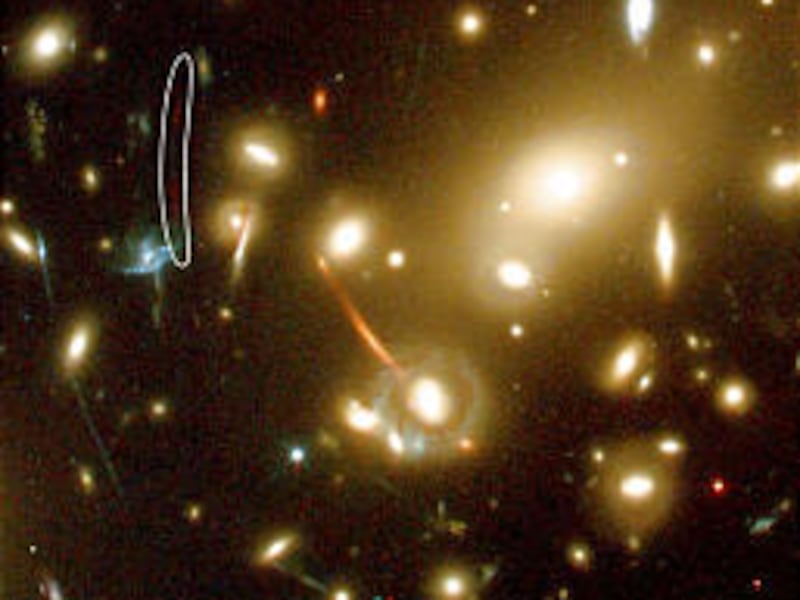
PARIS — French and Swiss astronomers say they have detected the farthest galaxy ever observed, a glimmer that dates back to when the universe was still in its infancy.
The galaxy, dubbed Abell 1835 IR1916, is 13.23 billion light-years from Earth — beating another galaxy that until now was believed to be the farthest known object, said France's state-funded National Center for Scientific Research, a major European research organizations.
Because light from the new find took 13.23 billion years to reach us across the vastness of space, astronomers are seeing the galaxy as it was back then. The universe, believed to have started with the Big Bang some 13.7 billion years ago, would still have been in its infancy.
"It is as if we are seeing the childhood of the galaxy," Roser Pello, a member of the team that found it, told The Associated Press on Monday. "It's a galaxy that is starting to form."
The galaxy is in the Virgo constellation and, in space terms, is tiny. It is at least 10 times smaller than our own galaxy, the Milky Way, and has one ten-thousandth of its mass, said Daniel Schaerer of the Geneva Observatory, another member of the team.
He said the find lends weight to theories of how galaxies and stars first formed after the Big Bang, when space is thought to have exploded in a fraction of a second from a speck to an immensity bathed in heat and radiation. It took an estimated 300 million years for the universe to cool and for the stars to form from hydrogen and helium.
Theory holds "that at the start of the universe, galaxies were small, like a kind of basic building block," Schaerer said in a telephone interview.
"Afterward they started to fuse together," he added. "The universe was still quite compact, and there were frequent meetings between different galaxies; the biggest swallowed the smaller ones and grew into big galaxies like our own."
Previously, the farthest-known galaxy, whose discovery was announced in mid-February, was roughly 13 billion light-years from Earth. That means light observed from there was emitted about 750 million years after the Big Bang, compared to a mere 470 million years for the new discovery.
To better understand that concept, try imagining the age of the universe in human terms. If the universe is a person aged 75, then the newly found galaxy dates back to when the universe was just "a baby aged two-and-a-half," the French national research center said in a statement.
Richard Ellis, a California Institute of Technology astronomer involved in the previous galaxy discovery, called the new find "potentially very exciting" but said he did not find the European researchers' evidence as convincing as his team's findings, which were made using the orbiting Hubble Space Telescope.
"If they are right, they found the earliest object," Ellis said. But he added that the European research was "not as secure as the measurements made with the Hubble."
"They don't have that clinching image," he said.
The new discovery was made using the European Southern Observatory's Very Large Telescope, in Chile, with other images also coming from the Hubble Space Telescope and Canada-France-Hawaii Telescope on Mauna Kea, a dormant Hawaiian volcano, the center said.
Nature also played a magnifying role. The newly found galaxy lies behind a cluster of galaxies, named Abell 1835, whose gravitational forces helped to deflect the distant galaxy's light toward Earth and amplify it by at least 25 times. The magnification process, first predicted by Albert Einstein's theory of general relativity, is known as "gravitational lensing."
"There is so much mass, galaxies, gases and dark matter gathered together in this cluster of galaxies that it deflects the light, acting as a lens," said Schaerer.