


The calm routine at a carwash in Chicago was shattered this past summer when a Jeep Grand Cherokee suddenly accelerated, killing a woman and seriously injuring her mother.
Several months before, in February 2003, a 37-year-old carwash employee was critically injured in Fort Worth, Texas, when a Jeep Grand Cherokee driven by a fellow employee struck her and three vehicles before coming to a stop.
Two months earlier in Paris, Texas, a former Texas state legislator's 1991 Grand Cherokee also lurched forward.
No one was hurt, but the incident jolted the lawmaker into calling for a formal investigation into the Cherokee line of vehicles by manufacturer DaimlerChrysler.
Then, 3 1/2 weeks ago in Salt Lake City, three Deseret Morning News staff members were hurt, two critically, when a 2003 Jeep Grand Cherokee suddenly shot forward while the driver attempted to parallel park on Regent Street, pinning pedestrians Chuck Wing and Gary McKellar against a concrete wall and crushing their legs.
Seconds later, a third Deseret Morning News staff member, Keith Johnson, suffered injuries, including a broken ankle, when he threw the vehicle into reverse to free his co-workers. He was dragged by the out-of-control Jeep 10 to 15 feet. Johnson was released from the hospital the same day and returned to work a week ago.
One of Wing's legs was amputated. Having spent several weeks in the hospital, enduring surgeries and therapy, both Wing and McKellar were released to go home Friday afternoon.
The driver of the Cherokee told the Deseret Morning News a story similar to accounts by drivers in several other Jeep incidents: His foot was touching neither the gas nor brake pedal when the car jumped.
Such tragedies are rare, yet they are common enough to have a name in the automotive industry: "sudden acceleration incidents." SAIs are in the news again, and despite engineering studies and books detailing the phenomenon the past decade, the exact cause of why some vehicles lurch violently remains a hotly debated mystery.
Common problem
The Jeep Grand Cherokee is not the only vehicle connected with sudden acceleration. In the late 1980s, Audi was receiving reports of car jumping when idling. The federal government is now gathering reports of Toyota's Camry, Solara and Lexus ES300 models for sudden acceleration incidents that have injured at least five people.
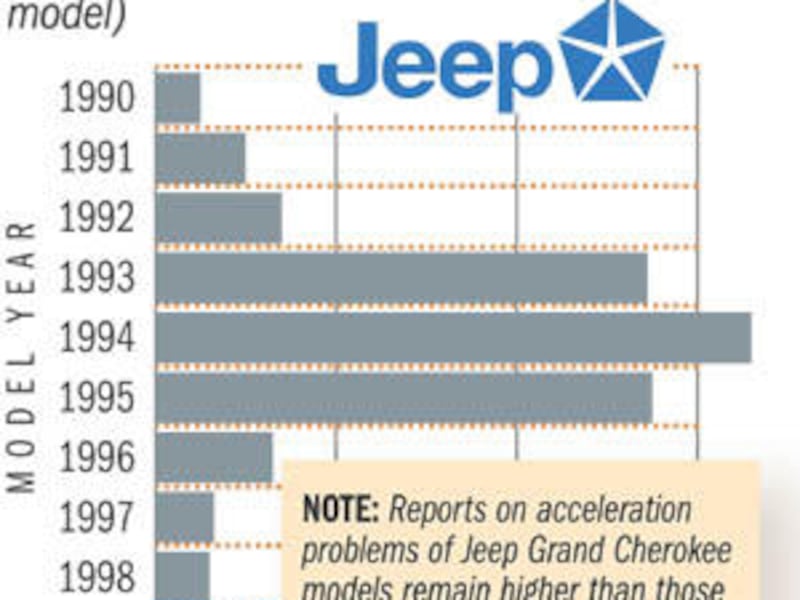
From 1991 to 1996, DaimlerChrysler received more than 300 reports of Jeep Grand Cherokees suddenly accelerating. At that time the company concluded that in many of the cases, driver error was involved.
To address the problem, DaimlerChrysler conducted a voluntary recall of Jeep Grand Cherokees, installing brake shift interlock devices to prevent a running vehicle from being shifted out of park without the brake pedal being pushed in.
By 2001, DaimlerChrysler had made shift interlocks standard in Cherokees, as well as redesigned the seat position to address concerns that a startled driver could inadvertently push both the brake and the gas pedal simultaneously.
According to the National Highway Traffic Safety Administration, the number of complaints of sudden acceleration in Jeep Grand Cherokees dropped significantly from 1997 to 2000. The NHTSA found that there were 210 reports in 1997, but they fell to 20 in 2000.
Sporadic reports continue, however, and have raised enough concerns that workers who spend significant time around idling cars, especially carwash workers, have reissued a safety warning specifically addressing Jeep Grand Cherokees.
"Over the years, the International Carwash Association has tracked and reported on many incidents of 'sudden acceleration' by Jeep Cherokee models (Grand, Laredo and Sport) in professional carwashes," reads the group's January 2003 statement. "This problem has caused a considerable amount of damage to both our businesses and other vehicles. In some cases the most unfortunate incidents involve our employees or innocent customers."
'Lack of interest'
Crystal Degen of South Jordan said she experienced sudden acceleration in a Jeep Grand Cherokee firsthand just days before the incident in Salt Lake City. Degen, who works at Platinum Carwash in West Jordan, said she climbed into a customer's Grand Cherokee, "turned it on and put it into drive and it just took off."
Degen said she had one second to notice to her shock that her foot was not on the gas pedal before the vehicle plowed into a pole. She was shaken up when the air bag deployed but wasn't hurt.
International Carwash Association spokesman Jeff Mitchell said his organization has documented incidents over the years and forwarded them to DaimlerChrysler.
"It's a very hot-button issue in the carwash industry," Mitchell said. "We've gone back and forth with DaimlerChrysler on whether it is a mechanical problem or driver error."
The reason SAIs remain a mystery is twofold, said Clarence Bitlow with the Center for Auto Safety in Washington, D.C.: lack of adequate police reporting and the federal government's apparent lack of interest.
"There's no real good reporting mechanism for sudden acceleration crashes," Bitlow said, adding police reports do not tend to focus on sudden acceleration as a cause. "There's also no mechanism to collect these reports."
Bitlow said the Center for Auto Safety, among other groups, has filed over a dozen petitions with the NHTSA, asking for but so far not getting an investigation of Cherokees.
New theory
A new theory ha arisen the past few years to explain sudden acceleration in even newer vehicles where the problem has ostensibly been fixed: Water could inadvertently activate a Cherokee's cruise control system.
A three-year study conducted by two private engineering groups, Infospace of Texas and Romualdi, Davidson & Associates of Pennsylvania, reported that such events "could only be explained by a malfunction of the cruise control or a depression of the accelerator pedal. . . . The vehicle's speed control system utilizes a 'stand alone' servo, which if inadvertently energized, would create a wide-open throttle condition," the study concluded.
The study was done as part of a lawsuit stemming from a 1996 SAI incident on Mercer Island, Wash. A woman in a 1993 model was at a bank drive-through when she shifted into gear and the Jeep suddenly accelerated, slamming into a wall of a gas station, striking a customer coming out of the station and seriously injuring her. The driver said she was pushing on the brake pedal as hard as she could.
The study was later submitted to the NHTSA for an investigation into the Jeep Grand Cherokee. In declining to investigate, the NHTSA noted that because of DaimlerChrysler's recall there had been a significant drop in complaints.
The NHTSA stated that of the 476 total complaints of sudden acceleration in more than 10 years, between 2000 and 2002 there had only been 36.
While the NHTSA acknowledged that water in the powertrain control module could activate the cruise control, "such activation would not lead to a sudden acceleration incident unless there was also a malfunction of the switch that shuts off the cruise control upon application of the brake pedal," the decision states.
Seeking a cause
DaimlerChrysler spokesman Max Gates said his company has tried to reproduce the electrical claim in their laboratories, with no success. "We have contaminated connectors with various strengths of contaminants, and we have run computer simulations of the entire electrical engine management and cruise control systems and can find no support for any of these theories," Gates stated in an e-mail response. Further, their tests showed such contamination results in normal engine activity or that it sputters and dies.
So far, the NHTSA has sided with DaimlerChrysler's claim that the predominant cause of SAI has been operator error.
The Salt Lake City Police Department has not yet decided whether it will try to determine the cause of the Feb. 24 accident.
Investigators continue to say that such an investigation would cost the department thousands of dollars in a case that resulted in a $75 traffic ticket. If police decide not to investigate, they said they will preserve the vehicle for third-party inspection.
Gates said DaimlerChrysler representatives are waiting for their chance to inspect the vehicle, adding his company takes allegations of any defect very seriously. Experts, Gates said, will concentrate on the vehicle's mechanical and electronic systems related to the brake and throttle functions.
"We haven't had a chance to look at the vehicle yet," Gates said. "It's still to early to say. We don't have any information to indicate that there was anything wrong with the vehicle to have something like this happen."
E-mail: gfattah@desnews.com