

When he's not on the ice at the Oval, 2002 Olympics speedskating champ Derek Parra can often be found working the floor at Home Depot in West Valley City.
Home Depot sponsors Parra through its Olympic Job Opportunities Program, and when Parra works in the store as a sales associate.
"I cut tile, cut carpet, demonstrate blinds and answer general questions," Parra said during an interview in the Deseret Morning News offices. "I often spend some of my time in the hardware department.
"Home Depot is a great company. I would not have had a chance to go to the Games without it. I needed a constant income. My wife was nicer to me because I could pay the rent.
"We're trying to get more athletes involved in the Home Depot program. You sign a contract and you have to do your 1,040 hours per year, whether in summer or winter. I work all summer as much as I can. They really support us."
Parra lives in Salt Lake City from mid-March to May each year. Most of the rest of the year is spent on the public-speaking circuit.
Lately, he has been out promoting his autobiography, "Reflections in the Ice: Inside the Heart and Mind of an Olympic Champion," which is available at Harmons markets, the Olympic Oval in West Valley City and the E Center . . . but not at Home Depot. (Parra's agent is currently negotiating with other booksellers to carry the book.)
He also tries to get in some skating on "different ice" each year, such as Calgary and Milwaukee, and very soon he'll try Norway.
His wife and daughter, however, live in Florida.
It's tough, but he knows it's only temporary. He's on the countdown now. Two more years and he'll be through.
Parra will stop skating after the 2006 Olympics and go into a business leadership program with Home Depot. Skaters usually quit before or while they're in their 30s, and Parra will be 35 in 2006.
Besides, he says, he's a family man. He'll be happy when he can move from Salt Lake City to Orlando to be with his family.
When he rented his Salt Lake
City duplex, Parra thought his wife, Tiffany, would be living there, too. But she was lonely in Salt Lake City, because her family lives in Florida and Parra is gone so much for training.
"Derek is very busy," Tiffany said during a telephone interview from their Florida home. "He travels a lot. Not having any of my family around was difficult. I would love to be with him in Salt Lake, but it's not just 9 to 5 — he's gone from 7 a.m. until 9:30 p.m. We didn't even get weekends."
Tiffany is a roller skater, and she said she encouraged her husband to go for the Olympics one more time. "I wanted him to be satisfied. I didn't want him sitting in front of the TV wishing he had done this."
Parra gets emotional when he refers to Tiffany and her strong emotional support for his Olympic goals. "She put her own life on hold for me. She has a lot of fire in her. She's kicked my behind a few times to jump start my life. I hope to do as much for her."
While Tiffany freely admits to being lonely in Florida without him, she adds that their daughter Mia has reached "the terrible twos," which keeps her busy most of the time just being a mom. "Ninety-five per cent of my conversations are with my daughter."
She looks forward to the day when their relationship will be "a little bit normal — like going to the movies and attending birthday parties. But in the grand scheme of things, what is four years in a 60-year marriage? It isn't that long of a time."
Parra says he visited his family three times last year — for about a week each time, and Tiffany and Mia visited him here once. Tiffany plans to visit again, "just as soon as he is going to be there longer than three days," she said. (The last time they were together was Christmas week.)
Parra says he never thought about writing about his life until last year. "After doing a lot of speeches especially to young people, some of my listeners suggested I put my experiences in a book. So I talked into a microphone at home and while driving, and pretty soon I had a bunch of tapes. I gave them to Pat Quinn, my friend and agent, and he started writing it up."
The first Mexican-American to compete and to win medals at the Olympics, Parra is very personal in the book. He accepts his image among young people as a role model. "I was a dreamer. I wanted to see what was out there in the world. I just wanted to succeed. I never went into the Games thinking about being first in anything. For me, it was a dream of being better than the day before."
Growing up in a Mexican barrio in Southern California, Parra never really considered himself a minority. "We weren't poor, but money was tight. We had hand-me-down clothes, but I was not in rags."
The worst challenge, he said, was coming from a broken home. After his parents divorced, he lived with his dad, but he connected better emotionally with his mother. "My mom supported my dream, and my dad didn't get it. My mom, a marathon runner, is a dreamer; my dad is a doer. She called me all the time, but my dad never asked me any questions."
Parra began roller skating in 1984 at the age of 14, and by 1996 he was the most decorated athlete in the history of the sport. Having won everything but an Olympic medal, Parra switched from in-line skating to ice skating in 1996.
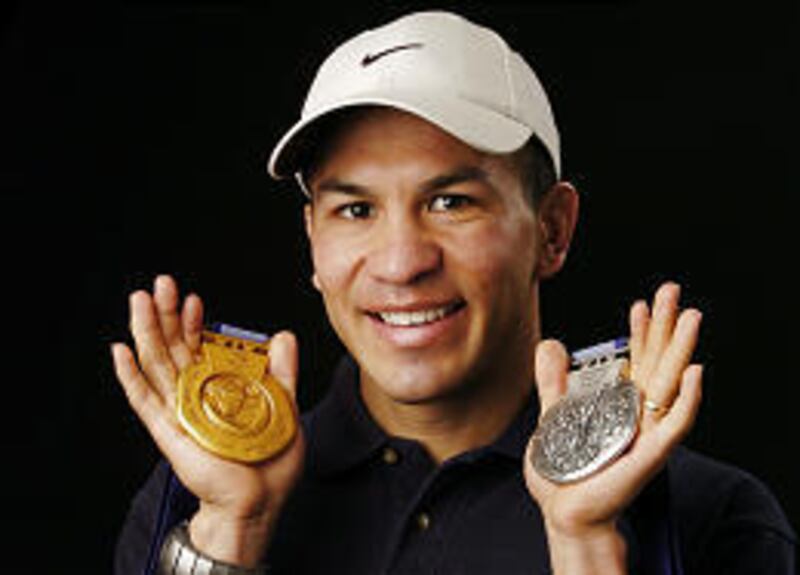
Two years later, he earned a spot on the U.S. Olympic Team. In 2002, he won both a gold and a silver medal at the Salt Lake City Olympics.
Parra thinks he was "in great shape from in-line skating. My quads were well-developed and I had great aerobic ability. But on ice and in-line, the push to the side is different. With in-line, you pull the skates across because of friction. On the ice, you land the skate and wait until your body weight falls in — then you can push even longer.
"But there is early pressure in a long push, so I was pushing too soon on the ice. It was difficult coming from being No. 1 in the world in roller skating to a new sport where everyone else could do better. I had a good technique with in-line and knew what to watch for, but on ice I had to think about everything I was doing."
His small size is not an advantage in either sport. "Bigger guys catch more wind and a longer stride. If the air is calm, it evens out. Technique is the most important thing. Indoors, I focus on technique, pushing the right spots, trying to figure out my best distance. Outdoors, I get blown around like a Volkswagen on the highway compared to 6-feet-2-inch guys who are more like Mack trucks."
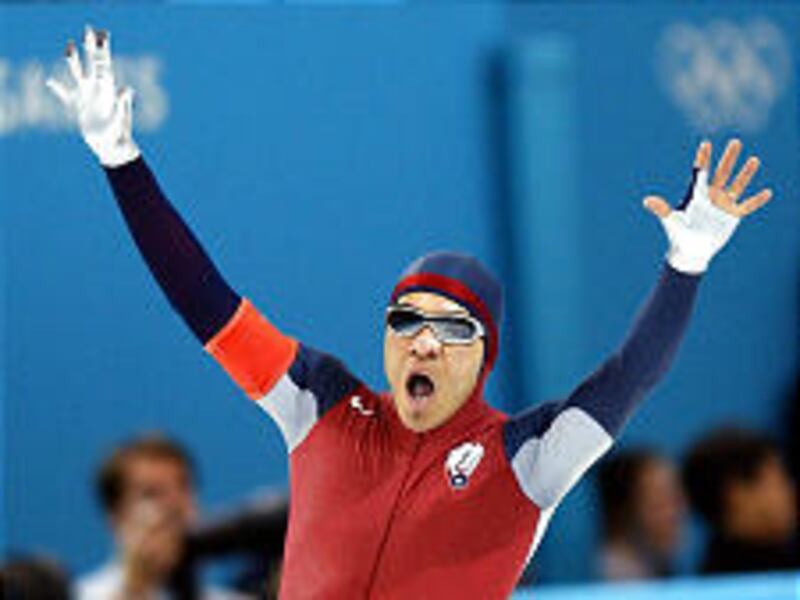
Parra says that when he won the gold, it didn't sink in at first. "The competition was picture perfect. I was excited but still in disbelief. Then there was chaos — with interviews and rushing around. When I heard the national anthem and the crowd started singing, it was like you could see it coming. I saw everyone's faces. It was a fantastic feeling.
"I was thinking about the people who helped me get there. Seeing the faces, hearing the music, feeling the crowd's energy, knowing I'd accomplished what I'd set out to do. I tell kids I wish I had a plug I could plug into their hearts to help them feel what I felt on that podium."
E-mail: dennis@desnews.com