



Millions of invaders are creeping along Utah's rivers and streams, threatening unpredictable damage.
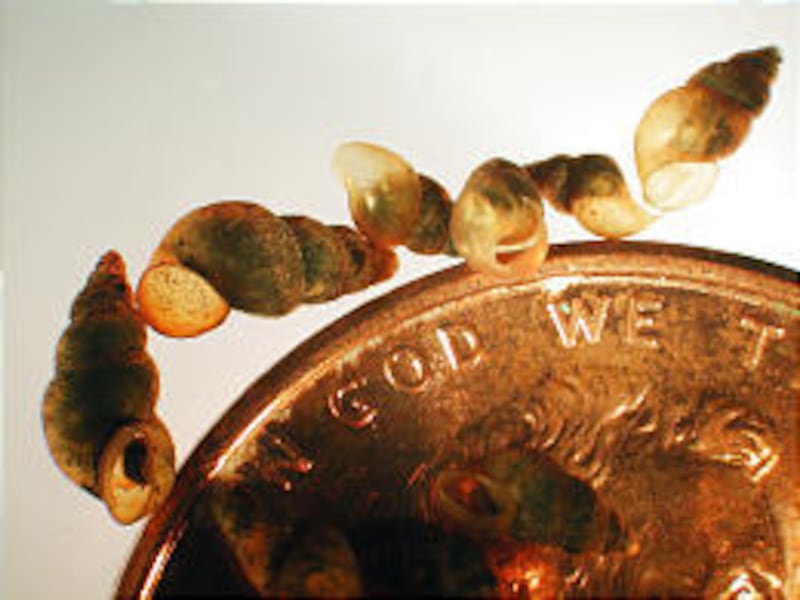
The invaders are tiny aquatic New Zealand mud snails (the scientific name is Potamopyrgus antipodarum), which reproduce at an alarming rate. They out-compete native snails and other invertebrate species and might not be readily digested by our trout.
A somewhat analogous invasion of nonnative mollusks has been taking place in the East, where the zebra mussel has been jamming intake pipes and dam works, damaging watercraft and muscling out native species.
Apparently Utah fishers are inadvertently spreading New Zealand mud snails, as they are found "all along the favorite trout waters," said Mark Vinson, Utah State University assistant research professor.
Vinson, with the National Aquatic Monitoring Center, has been monitoring the snail invasion since it began in Utah probably three years ago. The center, nicknamed the Bug Lab, is a cooperative research facility funded by the Bureau of Land Management and USU. Many of the aquatic habitats threatened by the snail invasion are on BLM land.
"None of the native species have grown up or adapted to living with something like this," Vinson said. The snails are small and hard, so may not be good food for larger animals. But they out-compete and out-reproduce native snails and other invertebrates, with the possibility of killing off the Utah animals.
According to a March 20 update he wrote, if they stay moist and are not exposed to excessive heat, the snails are able to live several weeks out of the water, protecting themselves by closing a tiny flap at the end of the shell. At Polecat Creek near Yellowstone National Park, New Zealand mud snails can reach population densities greater than 100,000 per square meter.
He wrote that the snails can comprise more than 95 percent of the invertebrate biomass in some river sections.
As their name indicates, the snails are native to New Zealand. How they got to the United States nobody knows, but they showed up in the Columbia River around 1970.
Throughout the 1990s, researchers found no mud snails in Utah. They were collected in this state on Sept. 18, 2001, near Swallow Canyon on the Green River, downstream from Flaming Gorge Dam. Since then, he wrote, they were discovered at 20 out of 477 locations checked throughout Utah.
"They moved quickly from the Green River to the Great Basin Drainage, as we found them in the Little Bear and in the Provo River in October 2001," Vinson wrote. "In 2001 they were found in three basins, in 2002 they were found in eight basins, and in 2003 they were found in 12 basins."
Since that first appearance they spread in "fairly high densities from Flaming Gorge Dam downstream to the Colorado state line."
The "Bug Lab" is continuing its statewide survey and is monitoring mud snails below Flaming Gorge Dam and on the Bear River near the Utah-Idaho border, Vinson told the Deseret Morning News on Sunday.
He and research assistants travel to the Green River every three months and to the Bear River monthly.
"We collect them and we count them to see if the populations are up or down," he said. They are unbelievably numerous in places. One photograph shows a net filled with black material like mud — the material is actually thousands of minute snails.
Nearly all are female. They usually reproduce asexually. "All it takes is for one individual to get to a new spot to start a new population," he said.
Mud snail numbers seem to yo-yo on the Bear River. "We don't really know why yet," he said.
"And at the Green River they have been continuing to go up since 2001."
Trout can eat the New Zealand snails, "but we're a little unsure they can digest them, because they're about the size of a BB, and the shell is very hard. The thinking is they may just pass right through the digestive system."
An experiment is going on at USU to see whether trout can assimilate nutrients from the snails.
Trout numbers haven't crashed near Yellowstone, but the ecology is complicated because trout can cruise to other river stretches if they aren't able to digest the snails. On the Green River, Flaming Gorge Dam blocks upstream migration and the water becomes too warm for trout a bit farther downstream. Trout might become trapped in a nutrient-poor zone, assuming they can't digest the snails.
Meanwhile, more is at stake than the blue-ribbon trout fishery, as valuable as it is.
Lake Bonneville once covered much of western Utah. When it drained off around the end of the last ice age, a plethora of springs and ponds became isolated. Snail populations that evolved there eventually became separate species.
These native invertebrates are found nowhere else, Vinson noted. "Utah's a very rich fresh-water snail fauna." If the New Zealand snails show up at the scattered desert springs, whole species may go the way of the dodo.
The invasion is scary from an ecological perspective.
"We don't know the outcome, and we don't know if the outcome is going to be played out in a year or two or if it's going to be played out in 30 to 50 years," he said.
Meanwhile, areas where the snails are known to be could be posted, so recreationists will know to take precautions. Then, Vinson suggests, fishers can make certain their waders are dry and free of snails before heading to a new river stretch.
Not much else can be done. No known poison could be poured into our streams and rivers to knock out the snails while keeping the other aquatic life safe.
Vinson summarized: "There's no quick fix."
E-mail: bau@desnews.com