

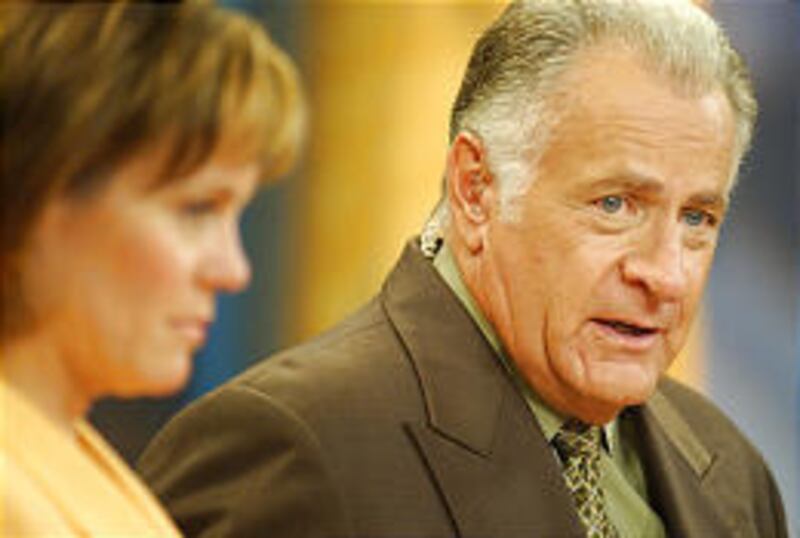


Dick Nourse is staring into a mirror, getting ready for the six o'clock news, just one more night out of thousands on the air. First he traces the yellow concealer over the dark circle under one eye, then comes a swipe with white concealer, and then he blends them with a practiced rub of his finger.
"Never thought I'd be putting on makeup," he says, leaning into the mirror. "At 64, some things don't stay the same. Every time I do this I wonder what . . . am I doing this for. I must love it 'cause I'm still here."
Won't he always be here? For 40 years he has been the face and voice of news in Utah. He has become Utah's Walter Cronkite, a stately, handsome, warm man who delivers the news in a voice so deep it sounds like it's rumbling off the mount or straight from the theater, as it once did.
Nourse is now into his third-generation audience. When KSL does audience surveys, the feedback often is something like this: "My grandfather watched Nourse, my dad watched Nourse, and now I'm watching Nourse."
Some believe Nourse might have the longest active anchor career in the country right now. "I know it's up there," says Brink Chipman, the KSL news director who has known Nourse for three decades. "I can't think of anyone who's gone longer. . . . Dick is considered one of the most dominant local anchormen in the entire United States."
When people meet Nourse on the street, they ask him the inevitable question about retirement, followed by, "You can't quit. It wouldn't be the same without you." Nourse is as much a part of Utah's evening as dinner. He originally came to Salt Lake City on his way to somewhere else and never left.
"He is an institution in the best sense of the word," says Chipman. "He has transcended his field. He has found a niche here in a very honest way. The research shows that people not only respect him but like him. . . . People think they know him and they do. He has shared a lot with his viewers."
He shared his bout with cancer years ago and, more recently, he has shared his young son Dayne's fight with his own disease.
There are other things he hasn't shared but only because there wasn't a forum. He readily notes for a reporter that he is a three-time loser in marriage, now happily well into his fourth marriage. He blames himself for at least one of those failed marriages, saying he was "a bad husband" and "a jerk." There have been other behind-the-scenes struggles — family members with drug problems, his own days as a hell raiser early in his career. By his own admission, there was a time when he didn't handle success well, despite a personal vow to guard against it.
Co-workers might flinch at his honesty and openness, but Nourse shrugs it off. "I think people relate to me more that way. I've got problems just like they do. It puts you on a level with them. And people want to know. They're curious."
Overhearing Nourse call himself a jerk from an adjacent cubicle, co-anchor Nadine Wimmer jumps at the chance to correct the record after he leaves the room. "I heard what he said about himself, but he's a good guy. He is what you see. He's a great example of how you should stay (yourself). He has no pretenses."
After Nourse puts the finishing touches on his makeup he places one contact lens in his right eye, which he uses to read the teleprompter, and none in his left eye, which he uses to read the script — another concession to the years, like the makeup. He leaves the dressing room and heads toward the set for the evening newscast. He has done at least two broadcasts five days a week for 40 years. Do the math. That's about 21,000 broadcasts.
"I don't know when to quit," he says again as he takes a gulp of bottled water and runs a cable under the back of his sport coat from his waist to his ear. "My contract's up this summer. I'll be 65 next March. I don't know what they (KSL) will want to do then. Brokaw retired Dec. 1 at this age. There are things I want to do. Forty years of nights takes its toll. I'd like to go to a Jazz game on a Wednesday night or take in a baseball game. I'd like to spend a whole evening with my family."
He was going to be an actor. That was his original plan. Growing up in Grand Junction, Colo., he discovered a love for the stage. He won the lead role in "You Can't Take It With You" in the junior class play. He won the lead role again in the senior class play "Beggar on Horseback" and directed another school play. Later, at Mesa College, he played the part of the boyfriend in "Diary of Anne Frank" and won a lead role in "Solid Gold Cadillac." After transferring to Brigham Young University, which awarded him a theater scholarship, he was the Duke of Cornwall in "King Lear."
"When I went to college, I dreamed of Hollywood," he says.
But there was another passion he had discovered years earlier. As a boy, he was an avid radio fan. He listened to the Mutual Radio Network, Mystery Theater and The Met, but never thought it could be a career. "Radio was completely out of the realm," he says. "Everyone was a doctor or a lawyer or a teacher. Who went into radio?"
He began hanging out at the local radio station. He rode his bike to the station every afternoon and watched the DJs and newscasters through a window. "They got to know me," he recalls. He used to write his own news stories and then read them as if he were doing a newscast. As fate would have it, he was blessed with that booming voice, which he inherited from his father.
Nourse was the youngest of three children but virtually an only child, arriving 10 years behind his sister and 13 behind his brother. He played sports. He played the trumpet from grade school through college, playing for big bands in high school and college. His father, Harry, was a jack of all trades, working as a plumber, sheet metal worker, warehouse manager, accountant — "He could do anything," says Nourse. His mother, Sarah, was a housewife — "a hard worker, very smart and streetwise."
About the time Nourse's voice changed, his sister told him one day that he had a good voice and he should try radio, which was about the first time he considered it as a career. As part of a journalism class project, he asked the local station if he could do a radio show. They gave him a half-hour spot on Saturday afternoon to play music and read high school news.
"I thought, 'Man, this is it; I love this,' " he says.
About this time, radio got one-upped. "My parents got their first TV when I was about 17," he says. "I was fascinated with it. I watched Walter Cronkite feverishly. I watched everything about him — how he did it, how he said it."
He took a radio class at Mesa College, and following his freshman year he auditioned for a radio job in Delta, Colo., filling in for the regulars on vacation. He wound up putting himself through school with jobs in radio. After transferring from Mesa College to BYU, he worked for the BYU station and later stations in Spanish Fork and Provo. He also began doing some TV work at BYU.
"I thought I'd like to be in the movies," he recalls. "But I liked what I was doing. I thought I could do this and be perfectly happy, and that's exactly what happened. But TV was in the back of my mind when I was doing radio. I knew it was going to be big and that it was coming on fast."
He dropped out of BYU just 27 hours short of a degree and joined the Army for six months of active duty, plus a six-year commitment of reserve duty. After completing active duty and returning to Grand Junction, he resumed his radio career and began writing and performing live TV commercials at the same local station he used to hang out as a boy. Then one day, in 1964, he decided to quit and try a bigger market.
"I didn't know anybody," he says. "I didn't know how to do it. A friend told me to come to Sacramento."
He was en route to Sacramento when he stopped in Salt Lake City to see his brother. He never did make it to Sacramento. "While I was here I knocked around town to see what was available. (Channels) Two and Four wouldn't talk to me. Five didn't really want to talk to me."
But Channel 5 — KSL — did invite him to audition for a weekend news slot. A couple of news directors named Grant Clawson and Merrill Dimick saw potential in the kid. They helped him cut a tape and urged the station to hire him. Nourse got the job. On weekends, he did the newscasts; during the week he did the noon newscast, interviews for a women's show, and what they called booth announcing — every half-hour he would tell the audience, "This is KSL-TV, Channel 5." He also did the voicing for commercials, which featured still pictures.
After only a few months at the station, KSL's weekday anchor quit and Nourse began doing the news seven days a week. He's been a mainstay since.
This is how long he has been here: His co-anchors, Wimmer and Bruce Lindsay, were kids when he began at KSL. One day after Nourse made a presentation to a journalism class at Granger High, one of the students asked him how to break into the business. They talked for a half-hour and then, as the young man turned to leave, he said, "Who knows, maybe one day I will be standing beside you." Nourse laughed and asked his name: "Bruce Lindsay."
Nourse met Wimmer when she was an intern and she helped him do a documentary on rodeo cowboys. "I was just coming out of my third divorce, and I needed a break," says Nourse, "but every day she'd call and say, 'Come on, the best thing for you is work.' "
Settling into his desk, Nourse is still preparing for his six o'clock newscast. He edits copy on a computer screen. The news has already been written for him, but he makes changes that suit his style.
Besides reading the news on the air and doing a little editing, there isn't much else to the job for Nourse these days. "I'm not that busy," he admits. "In the old days there were six of us, now there are a hundred."
It was a different job when he began his career. He'd shoot film of an event or an interview, drop the film at a lab to be developed, race to the station to type the story, race back and pick up the film, edit the film, then place the film on a master reel with all the other stories, and then someone would tape all the various films together onto one big reel. The film was black and white and had no sound. Later, the station bought two sound cameras. There were no cameramen; the reporter did the camera work and the interview at the same time.
"News hasn't changed, but the way we cover it certainly has," says Nourse.
He worked seven days a week for two years before he signed his first contract in 1967. He had some leverage by then, with offers to work elsewhere, and he used it to get his schedule cut to five days a week, plus a three-week trip to Vietnam, which would be one of the highlights of his career.
"I'm always finding myself again reflecting on Vietnam.," he said. "Most of the memories are vivid. Guys in hospitals. The body bags. Soldiers questioning why they were there. . . . It's still an emotional thing for me — about as emotional as my bout with cancer."
On the set, Nourse is handed a stack of yellow papers — his script — and Lindsay is given a stack of pink papers. "Two minutes!" someone yells. "Two minutes!" Nourse repeats. Two minutes later, he is on the air with that Shakespearean voice making the microphone almost pointless.
Trading back and forth with Linsday, the kid from Granger High, he runs through the day's events: car accidents, molestations, war, kidnapping, political campaigns. Throughout the newscast, Nourse, personable and avuncular, makes asides: "That's a sad story." "That's too bad."
"When he says on the air, 'That's a sad situation,' he feels that way," Chipman said. "That's not scripted. He voices what the audience feels."
"Undeniably, he has managed to connect with his audience," says Lindsay. "You don't stay on the air with the kind of acceptance he's had without forging some kind of bond. There's something about him that people relate to. Dick's persona on TV is his persona off TV. That's part of his secret to longevity and success."
Not every moment for Nourse has gone smoothly, of course. He had a coughing fit on the air once that forced the station to go to a commercial; when they came back to Nourse, he was still coughing, so they went to another commercial.
He and his former co-anchor, Shelley Thomas, used to break into laughing fits. "Once we started laughing during the first story on the air and laughed through the whole newscast," he says, laughing at the memory. "It was a story about a drug bust, and for some reason the only video they had showed a dog with one of those lampshades around its neck that they wear after surgery. We couldn't stop laughing. Every time we looked at each other we started all over again. That used to happen to us a lot."
After the evening newscast, Nourse takes a break or returns to his desk to begin preparing for 10 o'clock. His routine is sleep in late, catch up on the news with newspapers and CNN, lift weights at the gym, go to work late in the afternoon, do the evening and night newscasts and be home by midnight. It's been this way for decades.
The demands of the job earlier in his career, and the celebrity that came with it, took its toll, he will tell you. He was gone a lot, on the job or making appearances — or carousing.
He married his high school sweetheart while attending Mesa College. Their only child died after only three days. A subsequent pregnancy was terminated after his wife became ill. The marriage lasted 13 years.
The second marriage lasted two years; the third marriage lasted seven. He has been married to Debi for 13 years. "This is the one," he says. "She's great."
Nourse has a 19-year-old daughter, Giana, by his third wife, and 7-year-old son Dayne by his current wife.
"The nighttime took its toll on the marriages," he said. "Now I have a wife who understands fully and loves what I do. . . . The first divorce was my own doing, my fault. I was not a good husband. I was a jerk. There were other women. I got excited about my career and got a little big-headed and cocky. . . .
"The second two marriages were a lot of misgivings and jealousies and disrespect and not understanding my obligation."
Nourse was raised a member of The Church of Jesus Christ of Latter-day Saints but was largely inactive, like his father. He went to BYU because that's where his mother wanted him. A talk about his tastes in music turns revealing when he says, "I got into country (music) a few years ago. So many of the songs paralleled my life. I've been on the bar stool complaining. I've been there with those old guys, and almost gotten in fights and actin' like a durn fool. . . . I was just having fun, drinking my troubles away. The thing you learn is the problems are still there when you wake up."
These days Nourse is an avowed family man and churchgoer. He returned to his church roots years ago and married Debi in an LDS temple. "I don't believe I could've gotten through all the things I've been through without my Father in Heaven," says Nourse. "He helped me through a lot."
He and Debi have lived for years in a large house in Bountiful, but they are moving to a condo in Salt Lake City, within walking distance of the studio.
Debi is 42 years old. "I was 2 when he started work," she says, saving you the math. Debi grew up in Logan and watched Nourse on the air like everyone else. "Before I knew him I just liked watching the news, but after I dated him I watched him," she says.
They actually met years before they dated, although Nourse didn't realize it. Her father had a country band — the Peterson Brothers — and she was in an Ogden club watching them perform when Nourse got up and sang a song with the band. She got his autograph afterward. Years later they met at a party when both were married to other partners. After enduring messy divorces, they met again at a cancer fund-raiser. They had a dinner date on a Saturday night "and we haven't missed a Saturday since," he says. "After 13 years," she says, "I thought it would have gotten comfortable at this point, but he still acts like we just got married. He wants to have dates. We go out every Saturday night; we vacation together. He still likes it to be like the first year of marriage. He likes to go out with me rather than with his friends. I like that."
They are a balancing act. Nourse, a former Army drill sergeant, is organized and impatient; she is the opposite. He likes a certain orderliness. He hangs his shirts in the closet according to color, all facing the same direction. Once, after she put away several pairs of his cowboys boots, he saw the closet and said, "You put them in the wrong spot. The eel skins (boots) are not next to the other eel skins." When she tells this story, Nourse laughs at himself. "It's true," he says.
It hasn't been all valentines and presents, of course. They brought a lot of baggage to the marriage — messy divorces, children with serious problems, the problems of trying to meld two families, court battles, debt.
And then there's Dayne, who was born with osteogenesis imperfecta — a brittle bone disease — and a mild case of spina bifida. Doctors believe Dayne will outgrow his health problems, but so far he's had 10 surgeries. KSL broadcast a story about the boy's plight. He has recently had metal rods inserted into the bones in his arms, and he wears braces on his legs. He yearns to play Little League sports like his friends.
"He is the light of our lives," says Nourse.
Hearing all this, Debi notes, "People think we've got it made, that it's been easy. It's been a roller coaster."
Ask Lindsay about his co-anchor's life and he says, "I think the last 13 years on balance have been, hands down, the happiest time of his life. He has been more focused on his life and the things that brought him happiness."
In some ways his life has come full circle and tied up some loose ends. A few years ago, Nourse and Debi ran into his first wife at a high school reunion — they hadn't seen each other in 20 years — and he did something he had wanted to do for years: "I apologized," he says. "She is a sweetheart. I still love her. Not like Deb. But there's still love for Sharon. I was a jerk to her. I said I was sorry. She was fine with it. We sat with her and her new husband at dinner."
Over the years, Nourse flirted with opportunities to move to bigger markets. He was offered a job in San Francisco, but when he weighed the station's record with anchors — six in six years — he decided it wasn't stable enough. He turned down a job offer in Buffalo. He tried to land jobs in Portland and Los Angeles but lost out to a rival.
"I'm not sorry I stayed," he says. "I love Salt Lake City."
His fondness for the city was probably cemented during his fight with cancer. In 1982, he began to experience flu-like symptoms. He underwent a cancer test, and it came back negative. A second test revealed a cancerous tumor in his chest. A lymphoma. By then the cancer had spread to his neck, chest and abdomen. He was given a 50 percent chance to live.
Nourse responded so well to the first chemotherapy treatment that doctors upped the odds to 70 percent. He endured eight treatments over 24 weeks. Unlike most, he wasn't debilitated by the chemotherapy, and he continued to work most of his broadcast slots — albeit with a wig. It became a public drama unfolding on the screen. Sacks of mail arrived daily from viewers expressing their care and support for Nourse.
Nourse hasn't had a recurrence of cancer since then except for a cancerous spot he had removed from his prostate in 1996. He has never forgotten the way viewers rallied behind him.
"That was when I decided, I think, this is home," he says. "If people were that warm and welcoming, why go anywhere else?"
Nourse certainly hasn't hurt his relationship with the community with his frequent guest appearances and charity work. He is a favorite of Vietnam vets, who ask him to appear at various functions. He also served as president of the Utah chapter for the Muscular Dystrophy Association and played a big part in starting a local summer camp for kids with the disease. And he has done frequent work for the Cancer Society. He receives an average of three requests a week to speak or appear at various functions from Nevada to Beaver to Wyoming and all parts in between.
"I enjoy the charity work as much or more than anything I do," he says. "I might grumble about having to get there, but once I'm there . . . the gratitude of these people. You can tell from the looks on their faces that they are glad you're there and that it means a lot to them. It's important, or I wouldn't do it."
The question now is how long will he continue on the air? It is a source of much inner conflict. There are days when Nourse will walk into Brinkman's office and grumble, "I gotta retire. I can't keep this up." Then a few days later he's back in Brinkman's office — "I don't want to quit doing this."
Says Brinkman, "I think he'll always be a part of KSL in one form or another. Walter Cronkite retired and you still hear from him. At this point, it will be his choice. Our plans are to continue."
When the subject is broached, Nourse says, "The bottom line is people still watch, and they still say hi and ask if I'm going to retire. They tell me it won't be the same, then I feel guilty. So I don't know what to do. But I'm close. I want to do other things — TV, radio, writing, something in the business, I don't know what."
For now, he will continue to be the man who brings us the news, which is not the worst news for his longtime viewers. Forty years of nights is reaching into the next decade.
E-mail: drob@desnews.com