

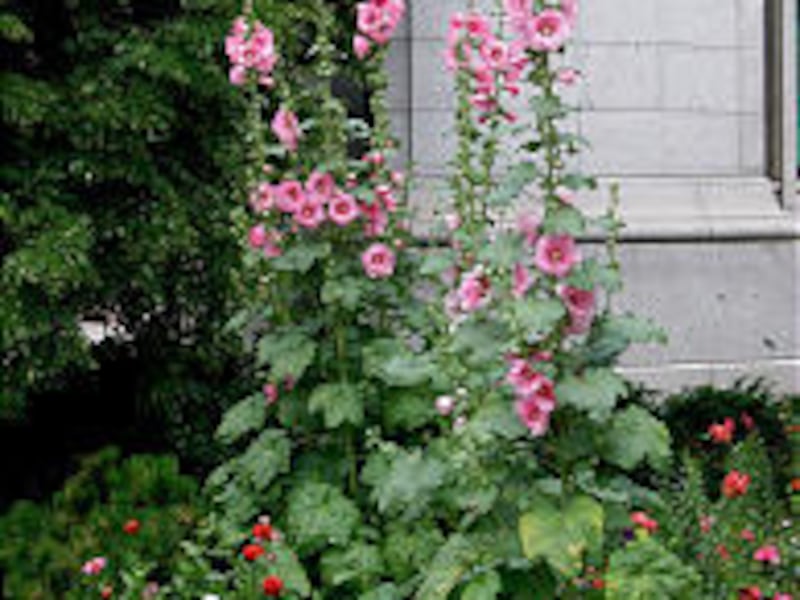
As you continue your quest to find the perfect plant for the garden, add hollyhocks to your list. These easy-to-grow plants, which are old favorites, are garnering more attention as gardening trends evolve.
Renewed interest in cottage gardens, a desire for flowers that are drought and heat tolerant and the introduction of many new varieties are all helping fuel hollyhocks' popularity. (Although hollyhocks are drought tolerant, they bloom better in moist soils.)
The old-fashioned hollyhocks most people are familiar with likely came from western Asia, where they thrived on rocky sites and in dry grassy wastelands.
When I was growing up, hollyhocks were popular choice for many gardens because they were easy to care for. I remember "bottom-up" views of hollyhocks in my grandmother's garden — colorful spires of funnel-shaped flowers rising above huge clusters of leaves. They were more than just showy flowers: To the delight of many children, hollyhocks made delightful dolls, using one blossom as the skirt and another as bonnet.
The scientific name is Alcea rosea, making it a member of the Malvaceae family, which includes hibiscus, okra, lavatera and cotton. All have funnel-shaped flowers. Older varieties have five petals with large floral parts in the center, but many new cultivars have double flowers.
The botanical classification is simple, but the growing habit is not. Many books classify hollyhocks as perennials. In truth, most are biennials that appear to be perennials because their seeds germinate and grow in the same place.
A few hollyhocks are annuals that germinate and flower the first year from seed. During the first year, flowering is sparse, but the second year they show their glorious flowers from May until August.
The rainbow has serious competition from these lovely plants. Hollyhocks range in color from white to true black. In between are pinks, reds, purples, yellows, coral and almost any other color except true blue.
The height range is just as amazing, too. Some of the newer dwarfs grow less than 2 feet high, while some of the old-fashioned varieties will grow to 9 feet or more. That makes them perfect background flowers in borders, along fences or walls.
Several perennial hollyhocks are available. Although these plants may live and flower for several years, these rarely flower as much as new plants started from seed. Fortunately, the seeds are easy to start. The plants thrive in all areas of Utah. Plant them in full sun, as the plant dislikes shade of any kind.
The easiest way to establish hollyhocks is from seeds. The old-fashioned varieties produce viable seed you can collect in the fall. Seeds germinate in 2-3 weeks at 60 degrees F.
Try spring sowing, or plant them in August to produce flowering plants the following year. If you have the right growing area you can, start seeds indoors. You can also find hollyhock plants at your local nursery.
Hollyhocks do best in moist, well-drained areas. They prefer a rich soil with abundant organic matter. Add fertilizer as needed in early spring to help the plants flourish.
While hollyhocks have a lot of virtues, there are a few downsides. Like most plants, they can suffer from insects and disease.
Hollyhock rust is the most common disease in Utah. The fungus first appears on the undersides of lower leaves as yellow to orange pustules that darken with age. Later the top of the leaf shows bright orange spots with red centers that may finally destroy large parts of the leaf.
If this happens, pick off infected leaves in the spring and destroy them. When plants stop flowering, cut them back to the base. Provide good air circulation and avoiding overhead watering to reduce the severity of the disease. Some varieties are rust resistant.
If such sanitation procedures don't control the disease, apply a fungicide such as chlorothalonil (Daconil), sulfur or copper in the spring as new growth starts. Several sprays may be necessary.
Hollyhock weevil, a small beetle, will chew holes in the leaves, flower buds and seeds. Apply insecticides as needed to control this pest. Spider mites, caterpillars, slugs and snails also plague hollyhocks. Use insecticidal soap, Bt and baits to help reduce these pests.
In spite of your best efforts, pests will often make the leaves unattractive, even though the flowers still look good. Sometimes the best options is to plant hollyhocks far enough away so you cannot see the leaves, or plant something in front of them to hide the leaves.
Larry A. Sagers is the regional horticulturist, Utah State University Extension, at Thanksgiving Point.