

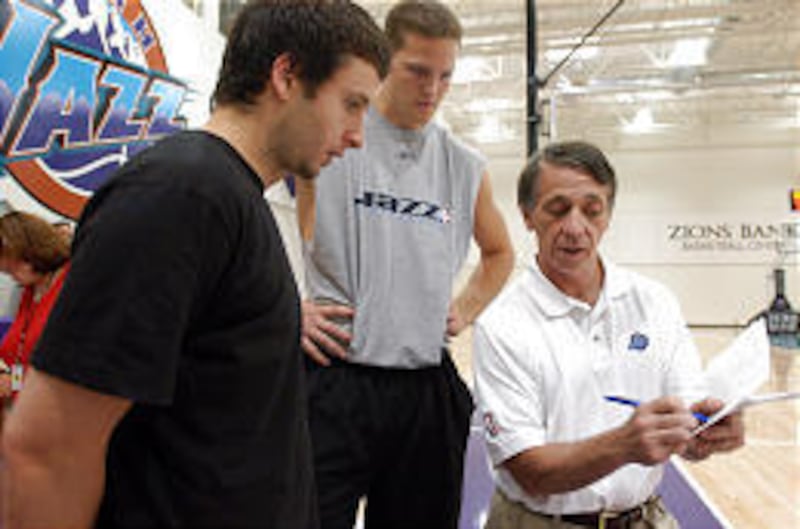
This time of year — the NBA offseason — Utah Jazz assistant coach Gordon Chiesa is everywhere.
He's on TV and sports radio, and quoted in newspapers, explaining draft picks or free-agent strengths and how they'll all fit in. Or he's asked about coach Jerry Sloan and top assistant Phil Johnson, who both contemplated leaving the team this summer.
During the Jazz season, Chiesa is the media favorite to explain what happened in the game or might happen next game.
Going into his 16th season as a Jazz assistant, Chiesa will be quoted daily for the next few weeks as coach (with new assistant Ty Corbin) of the Jazz team in the Rocky Mountain Revue that will run today through July 24 at Salt Lake Community College.
"I enjoy it," Chiesa says of coaching the Jazz Revue team, knowing that for the team's rookies, like 2004 draftees Kris Humphries and Kirk Snyder, he'll be their first "voice" of the NBA.
But how much do Jazz observers or fans know about the always-upbeat former point guard from a small Eastern college who's become so visible in Utah?
Do they really know who he is?
Do they know, for example, that this New Jersey native had never met transplanted New Yorker Frank Layden when the former Jazz coach heeded the advice of Georgetown's John Thompson, Seton Hall's P.J. Carlesimo and St. John's Lou Carnesecca to pick the brain of Chiesa? He'd just been fired after one season as head coach at Providence College trying to follow Rick Pitino and a Final Four team that graduated four starters.
Most Jazz fans think Layden's Eastern roots included Chiesa, but they never knew each other until they met at the Salt Lake Marriott in September 1988. Scott Layden had invited Chiesa to observe the Jazz's 1988 training camp in St. George and offer some ideas on how to teach individual skills to Jazz players and how to deal with trap defenses.
Frank Layden and Chiesa drove home from St. George, talking basketball, and Layden offered him a scouting position with the team. A year later, he was on the Jazz bench.
Do Jazz fans know that this "behind-the-scenes guy" — who cheerfully does so many thankless tasks for players, coaches, staff and media — quietly burns to be an NBA head coach some day, even though he doesn't employ an agent to help make that happen?
"I am ready for the challenge. I'll get my chance. Just let nature take its course," says the man who became a head college coach at age 24, running the team he'd just played for at St. Thomas Aquinas.
Do Jazz watchers know that Chiesa's wife, Nancy — also a former basketball player at St. Thomas Aquinas — is an accomplished watercolor artist who gave up the art gallery and gift shop that she operated for 15 years on the Jersey shore so he could become a coach in the NBA? "My better half," Chiesa says of Nancy, who scored 34 points in a basketball game against Marist College and still paints in her home studio and sells ocean scenes and golf watercolors. She added mountain scenes upon moving to Utah.
Do season-ticket holders know that Chiesa, a workaholic's workaholic, successfully balances passion for his job and passion for his family that includes two athletic teenage boys whose games he regularly manages to attend? And that he still finds time to work out at the Sports Mall at 5 a.m. almost every day? "I have a lot of energy. I don't need much sleep," he says.
Though his wife and sons (Matthew, 17; Craig, 14) are basketball and Jazz fans, Chiesa doesn't "bring the game home. Don't let the game become a meat-grinder with your family," he says.
Do Jazzaholics know that this teacher of the game and teacher of life, this eternally positive self-described "natural encourager" and "world-class listener," credits his crowded childhood Jersey neighborhood, his parents and his Catholic-school upbringing with classic no-nonsense nuns with giving him the love for the game and the love for people that prepared him for the NBA? He proudly calls himself a product of the "University of the Streets."
If most people don't know a lot about him, Chiesa doesn't mind. The players know just how much he means to them and the team as he gently influences them. "Let me help you develop your game," he tells them, rather than just telling them what to do when. "My credo is, I don't know a thing," he says, though he's always doing his best to learn.
"He's concerned with the players and team, not himself," says Jazz senior vice president of basketball operations Kevin O'Connor, who often observes Chiesa staying long after practice to work with players and has noticed the improvement in those players. "He's consistent, organized, spontaneous and has a very dry East Coast wit," O'Connor says.
Richard Smith, Jazz director of scouting services, works closely with Chiesa and marvels at just how much film he'll watch and time he'll spend on the job. Smith concurs with a statement he once heard Jazz basketball operations assistant Marie Spence make about Chiesa: "I have never worked with anyone more passionate about their job."
"I like work," Chiesa says. "I always say, 'Thank God it's Monday.' "
"He is the consummate basketball junky," says Smith, noting that Chiesa is always talking to others in the business, picking their brains. Smith says that sometimes in the summer, Chiesa makes phone calls to other NBA people and can't understand if they're not at their desks. It's called "vacation," but vacation for Chiesa includes running his own one-day, invitation-only coaching clinic each August in New York.
For the past 15 vacations, he's brought some 35-40 coaches to a hot gym in the Bronx to exchange ideas for work. He invites friends and asks them to bring another person. Beforehand, he asks invitees to submit topics for the forum. He does it to give back to the profession, and because "I have a huge curiosity streak," he says.
The youngest of four children, born in 1950 in Union City, N.J., Chiesa grew up in a multi-ethnic neighborhood that encompassed some 70,000 people in two square miles — but no one locked their doors. Basketball was the game of choice, "my first true love," he says, though there was also football and other sports.
His father was a World War II army staff sergeant who worked two jobs and spent seven years going through night school for a degree in accounting. "He could figure out how to get things done," Chiesa says, remembering his dad, who died in 1997, as a mixture of psychoanalyst Sigmund Freud and 1950s Phil Silvers sitcom character Sgt. Bilko.
It was an "old-fashioned" upbringing, complete with traditional Catholic-school discipline, that taught Chiesa respect for authority and for others. He was a good student but admits to daydreaming of basketball during school. When he was 16, his mother died at age 45 from congenital heart failure. "She was a big influence," he says, remembering learning compassion and empathy through her illness and learning how to be on his own after she passed.
He focused more on school in college, "planning on teaching so I could coach," he says. His first job was at Luther College in Teaneck, N.J., where he taught social studies and history. He was assigned to teach China's Ming Dynasty. "I knew nothing about the Ming Dynasty," he says. But the job included an assistant coaching position that paid $300 for the season.
Soon, he went back to St. Thomas Aquinas as head basketball coach because he "fit the pay structure." He had no coaching philosophy in mind and was coaching former teammates, but he stayed five years until he got an assistant's position at Dartmouth, then was named head coach at Manhattan College in 1981 and soon was Metro Atlantic coach of the year.
On Good Friday 1985, Chiesa got the first of two unexpected phone calls from strangers that changed his life. Pitino had observed him and offered an assistant's spot at Providence, which went to the 1987 NCAA Final Four. Chiesa took over the '87-'88 Providence team but had lost four starters to graduation and didn't live up to Pitino's legend, so he was fired. But Big East coaches had taken note of him, and when the Laydens called them about Big East players they might be interested in drafting, they spoke well of Chiesa.
The Laydens made that other unexpected call and job offer in '88, and 10 years after being in the '87 Final Four, Chiesa was assisting for a team in the NBA Finals.
E-mail: lahm@desnews.com