

At 19, Ethel Mecham was excited to get married, but just a bit sad, too. Never again was she forced to say good night to her sweetheart Roy, but never again would she ring the schoolhouse bell to start her busy day as a teacher.
Back in 1926, when Mecham — then Ethel Warnick — decided to get married, it also meant giving up teaching, despite how much she had enjoyed her year at the one-room Fairfield District School.
"I just loved it," Mecham said. "I enjoyed every minute of it. But married women couldn't teach back then, because men had families and they needed the jobs."
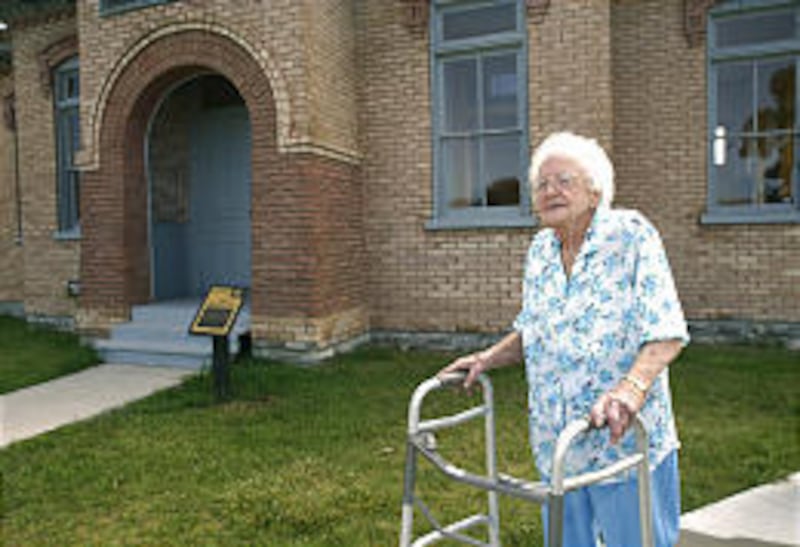
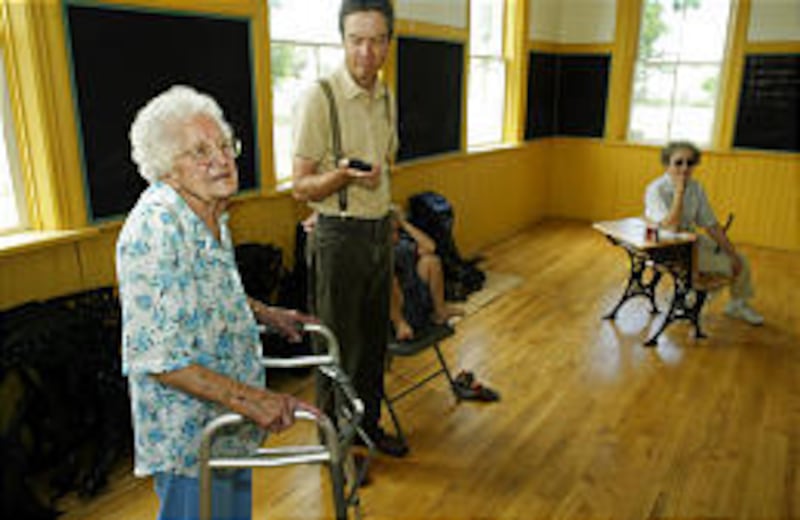
Mecham, now 98, returned to her old schoolhouse on Tuesday for the first time in nearly 80 years to share what it was like during her tenure. The building, part of the Camp Floyd Stagecoach Inn State Park in Fairfield, has recently been restored and has already welcomed students on class field trips.
Park manager Mark Trotter has been working for the past four years to make the schoolhouse a haven for youngsters learning about Utah history. He estimates that about $40,000 worth of materials and labor has gone into resurrecting the schoolhouse — and fourth-grade teachers in Alpine District have taken notice.
"All of May, we were completely booked with school groups, and it's starting to spill over into April and June," Trotter said. "It's become very popular — it just caught on by word-of-mouth, really."
Part of the reason for that popularity is the educational program the park presents to the students, who learn about Utah history during their fourth-grade year.
"We do it first-hand; I've got the uniform I put on and we come out and it's 1861, and we get the kids in that time frame," Trotter said. "We have several activities that they do such as making an adobe brick and a candle, and butter, and writing with a quill pen."
The park is rich with historical significance, having once been home to nearly 3,500 soldiers sent by President James Buchanan to stop a non-existent Mormon rebellion. Little remains of the camp's buildings, but an inn built in 1858 — where Mecham boarded — still stands.
Using Mecham's recollections, Trotter hopes to create an all-day schoolhouse program. Teachers would bring their students out, learn about the park and hold class in the schoolhouse, experiencing how students might have been taught there.
Mecham said some things weren't too different — the 9 to 3 school day, and boys always "rassling." But a few of the details she recalled might have today's teachers thanking their lucky stars, like the fact that her 20 students were in five different grades, the only water available was a wash basin, and the room was heated by a coal stove.
Mecham said the school has improved since her time. "It didn't look this good when I was here," she said. "The floor was just boards, and it wasn't this bright, cheerful color." When asked what color the school had been, Mecham replied, "Dirty," with a laugh.
Trotter had a tape recorder on hand to catch all of the details Mecham related, a "treasure trove" for him as the park's manager. He'll incorporate the activities she described into the schoolhouse program, from the stories that started each day to the games her students played.
But Mecham's rich store of information isn't limited to just the schoolhouse. While at Camp Floyd, she also walked through the historic Stagecoach Inn, a former Pony Express station and her home while at the Fairfield school. She described the daily fare served by the inn's matron — "Granny" — as simple.
"Potatoes and meat, nothing frivolous, maybe a piece of cake once in a while," she said.
The former schoolteacher said she's pleased to know that the history of the area won't be lost. "I think people need to know what happened years ago," she said.
Mecham said she was glad she came back. "This has been a treat for me," she said. "Lots of memories."
E-mail: mdecker@desnews.com