



When he was a kid, Kent Lott cherished hearing about how his great-grandfather left Sweden as a young boy and then walked and walked and walked and walked across the Plains with the Mormon pioneers in the mid-19th century.
Lott's grandmother used to beam with pride when recounting how her father hoofed almost the entire route to the Salt Lake Valley, only hitching a wagon ride for one day because of a leg injury.
Andreas Anderson's cross-country trek — which thankfully doesn't include any mention of being uphill in the snow both ways — was one of the first stories Lott, now 69, remembers being told. And it made a lasting impression.
The same goes for Louise Huefner, who grew up hearing how her great-grandmother picked berries as she traveled with pioneers. Huefner, 74, listened with wide eyes and ears as her mother and grandmother described the scenes her ancestor witnessed as she watched Nauvoo burn and mobs push her family toward Utah.
Orson Wright, 76, was enthralled learning about how his great-grandpa migrated here from Philadelphia in the early '60s — the 1860s, he clarifies with a chuckle — and became a bodyguard for Brigham Young and how another great-grandfather headed West and helped design the Salt Lake Temple, the Tabernacle and the ZCMI facade.
These direct descendants of Utah pioneers now are among those who over the years have assumed the roles of storytellers and are sharing their precious heritage heirlooms with younger generations.
"It is absolutely vital to pass down these histories," Huefner said, "because we don't understand ourselves or our own worth until we know about our ancestors."
But keeping the pioneer past alive is the ongoing trial facing the two biggest pioneer organizations in the state — the International Society of Daughters of Utah Pioneers and the National Society of Sons of Utah Pioneers.
Recruiting members
The biggest challenge of late for these daughters and sons is trying to attract a few more grandsons and granddaughters to join their aging organizations.
"I think the farther and farther away we get from the pioneer era, the less interest there is on the part of younger people coming up," said Lott, national SUP president. "I think it's important for us to understand and realize the heritage we have because of what the pioneers did for us and to preserve that (heritage) and maintain an interest in whatever way we can."
Huefner, a historian for the DUP, whose mother and grandmother also were members, agrees.
"I know the stories and my children know some, but their children aren't going to hear it unless we tell it to them," said Huefner, whose daughter is now getting ready to join the group that was first organized in 1901 for direct female descendants of Utah pioneers.
While current membership is growing , the long-term membership goals for both groups is to recruit new members with fewer wrinkles and less seasoning.
"We are realizing that many of our grandchildren are forgetting. We really want that unbroken line of mothers and daughters," said Mary Johnson, the DUP president who is a third generation society member and whose three daughters also are members.
Thinning enrollment
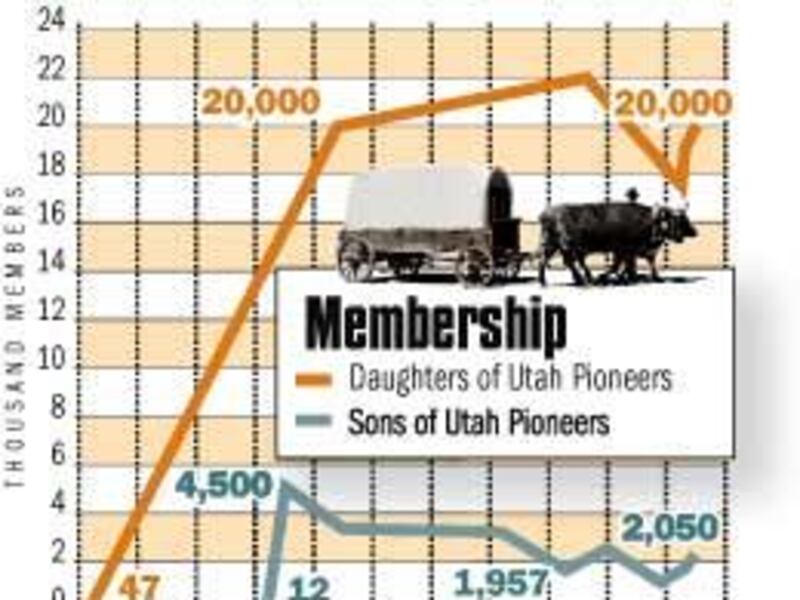
Starting with just 47 members in 1901, membership in the organization skyrocketed into the 1990s, reaching 22,000 members in 1986. That number, however, started to decline during the following decade as older members began to die and the interest of younger generations began to wane.
With new emphasis on enrolling younger women, Johnson said, the society now has a steady membership of about 20,000 and is able to compensate for the loss of older members. The group usually gains about 100 new members a month, but the median age of the members remains high.
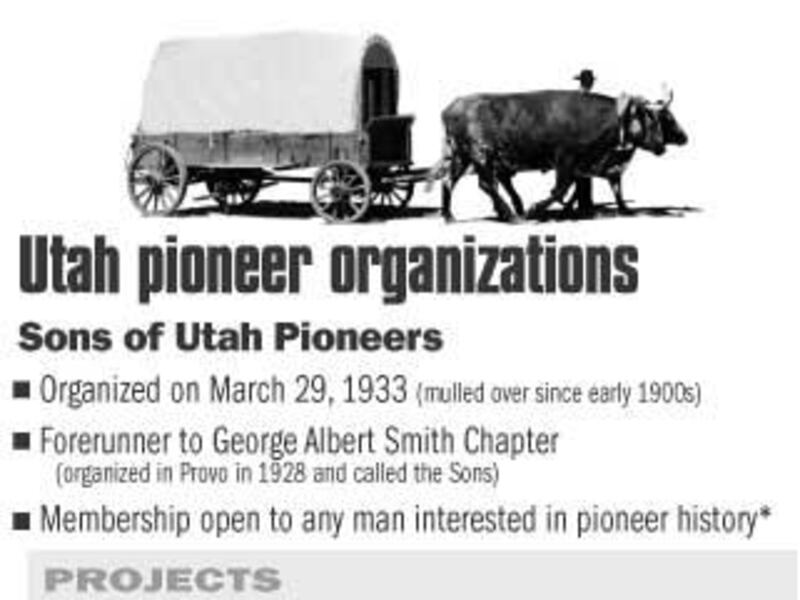
Following the lead of their sibling organization, the Sons of Utah Pioneers officially began in 1933 with about a dozen members. Enrollment peaked during the Depression and World War II eras, fluctuating between 3,500 and 4,300 members. The idea to retrace the original pioneer trek on the 1947 centennial anniversary became the chief stabilizing force that held the organization together in its early years, according to the group's Web site, www.sonsofutahpioneers.org.
But, as was common among many men's social clubs in the second half of the 20th century, membership started thinning like many members' hair, eventually dipping to an all-time low of 1,650 dues-paying members in 1999. Part of the reason it bottomed out there, Lott said, is because leaders took the nonpaying "deadwood" off the membership rolls.
Lott credits an emphasis on recruitment for lifting those enrollment numbers up to 2,050 as of the end of June 2004, which is up 150 from last year's roll count. SUP members are scattered throughout the country in 40 chapters — from Pennsylvania to California, with members ranging in age from 30-somethings to near-centenarians. The average age, Lott says, is between 65 and 70.
Age gaps
The SUP most likely will never have as many members as the DUP, Lott admits. Women, he said, not only are more apt to join groups and be interested and involved in genealogy-type activities, but they also generally live longer. Father Time continues to steal SUP members on a regular basis.
"Because of the age of our members, there are people departing on the other end," Lott said.
And younger men, he added, are often too preoccupied nowadays with family, work and church obligations. Then there are those who just aren't hogwild about their pioneer past — not that that's going to discourage the SUP from trying to lure them to carry on the tale-telling torch.
"There's a lot of competition nowadays," Lott said. "Lots of younger people aren't interested in their roots. We are, and we think they ought to be."
Although women as young as 18 can be admitted into the DUP society, Johnson said the group ranges from women in their 30s to women in their 90s. Belinda Kerig, 38, is the youngest member of her Salt Lake chapter of the society by about a decade.
"I think it's kind of an old woman thing to do, but I thought they needed some young blood," Kerig said. "I don't think you need to be old to learn about pioneers."
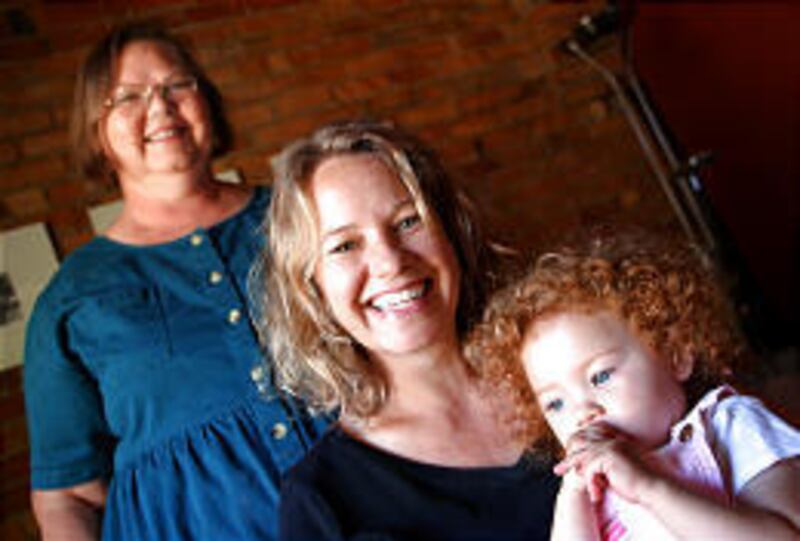
Despite the age difference, Kerig said she enjoys the society, especially since she had her first child two years ago and felt the need to understand her heritage. Kerig also grew up with her mother being involved in the DUP and even hopes her 21-month-old daughter will one day join the group.
One of the main reasons Kerig did not get involved when she was younger was because she was too busy to attend meetings. That time commitment is one of the main obstacles to getting younger women in the society, Johnson said.
Same goes for the younger men who are more likely to play video games or coach little-league teams than make a memorial to their direct ancestors.
"We wish there were more," Lott said. "It's a lot harder with (younger) men who are working with families and other commitments to devote themselves. It's easier to get middle-age and older."
Group policies
All members of the DUP are expected to compile the genealogy of their ancestors for the society's history department and give lessons at monthly meetings about their families.
"It's not just a social club. If they want that, they can go somewhere else," Johnson said. "We have a responsibility to research our ancestors."
Another stumbling block to recruiting larger numbers of young women is the strict admittance policy to the society. Each applicant must prove her lineage through documents, showing she is directly descended from a pioneer who was in Utah between 1847 and 1869.
The SUP has expanded its membership to include nondescendants. They also encourage members to prompt their sons/grandsons to come or suggest they give them a gift subscription to their quarterly magazine.
"Anybody is welcome to join," Lott said. "You don't have to have pioneer ancestry. You just have to have an interest in the history aspect of the pioneers that came to Utah."
They also throw out the welcome mat for anybody who's interested in learning how the West was settled and to those who might have an interest in helping preserve the history and heritage of Utah, Lott said.
The SUP hosts dinner meetings, holds history symposiums, takes treks to historical sites (Lott's Mills Chapter, for instance, recently traveled to Martin's Cove in Wyoming), erects plaques and monuments honoring pioneer landmarks and works on projects. Bigger projects include moving Pioneer Village from Connor Street in Salt Lake City to its current location at Lagoon, putting up a monument on Brigham Young's grave site on First Avenue and building a Mormon Battalion monument in Old Town San Diego.
Wright joined when he was 30 and has thoroughly enjoyed what he calls a "great program" and a "wonderful thing." At the very least, it might help younger people "understand what the 85,000 pioneers who came before the railroad went through . . . (and) what they've done."
Wright, a former president, thinks the group needs to really go after fresh faces. "We need to get younger men, to encourage younger men and younger families," he said. "A lot of people wonder why we can't get the younger members, but I think if we keep working toward it, they will come. As time goes on you'll find some will join."
Nondescendants
While Johnson has received suggestions that the DUP should follow the SUP in allowing nondescendants to join, she said the group does not need to change the requirement to keep up its membership.
"We've had a reputation of being snobbish, but we're not," Johnson said. "We're selective, but we want everyone to have the benefit of learning."
To extend that benefit, the DUP created a program three years ago for nondescendants. The associates program allows women without pioneer ancestors to participate in all the society's activities except elected leadership. Associates also do not receive a certificate of ancestry. The program, Johnson said, is attracting many younger women who are married to men with pioneer ancestries and want to ensure their children learn their lineage.
The society also is eyeing women as young as 18, sponsoring activities like the Days of '47 royalty pageant that entices women to get involved as soon as they are eligible for membership.
"The society offers the young women the ability to tie themselves to their heritage, to learn the stories of trials and triumphs to bolster their lives," Johnson said. "They can say, 'If they can do it, I can do it. The same blood flows through our veins.' "
Living history
For Jennifer Dolan, one of this year's Days of '47 royalty, the Daughters of Utah Pioneers has helped her better understand her ancestors as individuals. Dolan, 22, spent hours uncovering stories of her pioneer relatives in the days before the pageant and was particularly excited to find the story of her great-great-great-grandmother.
Dolan's ancestor was only 20 when she crossed the Plains with an LDS handcart company, leaving behind her home in England and burying her bother along the trail.
"It's great to know that I have actual blood ties to someone that courageous. It gives me hope that I can be just as courageous," Dolan said.
Dolan said she plans to join the society eventually when she is not so busy and can dedicate her time to genealogy. Dolan also said she was a little hesitant to join the group because most members are so much older than she is.
"The young women look at these old people and think they can't relate to them," she said.
That attitude, Johnson said, is exactly what the Daughters of Utah Pioneers is trying to fix by showing younger women that they can benefit from knowing both their pioneer ancestors as well as the older generations that are still alive to tell the stories.
"Young people struggle with their identity," Johnson said. "Knowing their ancestors helps them find themselves."
E-mail: jody@desnews.com;