

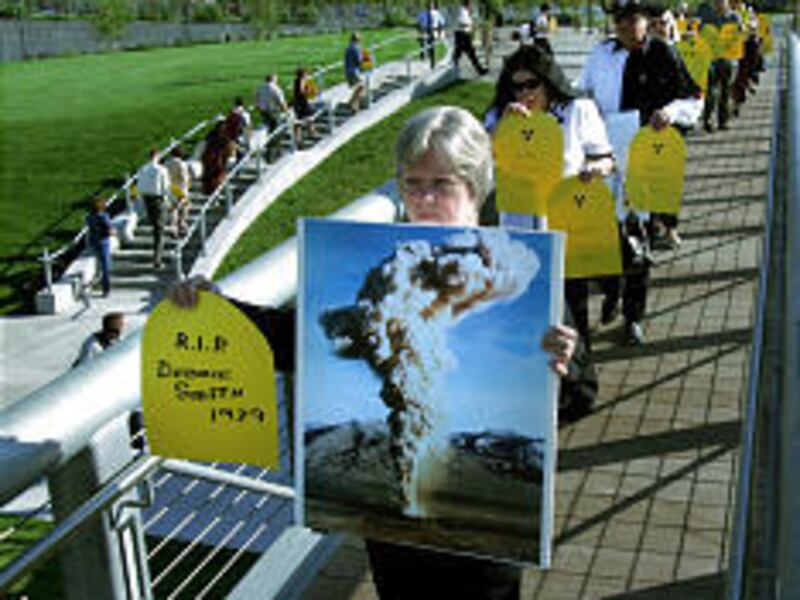
Darlene Phillips is convinced her cancer was caused by drinking "radioactive milk" while growing up in Bountiful in the 1950s. Yet she is one of thousands of people who say they were harmed by nuclear testing during the Cold War but have not been compensated under current law.
On Thursday morning, Phillips stood outside the Salt Lake City Library holding a yellow cardboard tombstone bearing the name of the late Utah Gov. Scott Matheson, himself a cancer victim of downwind radioactive fallout. Phillips was joined by about 25 others in a vigil calling attention to the death toll of Americans who have died due to nuclear fallout.
Inside the library, Matheson's son, Rep. Jim Matheson, D-Utah, was before a panel of scientists testifying that more research and more money is needed to compensate people who were exposed to the open-air nuclear testing at the Nevada Test Site between 1951 and 1962.
"As downwinders, Utahns paid a heavy price for trusting their government and for being in the wrong place at the wrong time," Matheson told the National Academies' National Research Council, meeting in Salt Lake City at the behest of Congress to hold hearings on whether to expand the law for those eligible to receive compensation under the Radiation Exposure Compensation Act of 1990.
"They have seen loved ones suffer and die from cancer and other devastating diseases. They live with the uncertainty that a hidden time bomb in the form of radiation damage to cells could go off inside them at any time," Jim Matheson said.
That message was not lost on Eve Mary Verde, who has watched family and friends die of cancer.
"I was diagnosed at 45 with breast cancer," Verde told the panel. "In 1999, my mother died of colon cancer and two months ago my brother was diagnosed with colon cancer."
Currently compensation is limited to a handful of southern Utah, northern Arizona and southern Nevada counties.
But Dr. Gene Childress suspects the effects of nuclear fallout were felt as far away as northeast Missouri, where he treats a large number of patients for breast and colon cancers.
He said he was convinced all Americans were affected by fallout after reading Richard Miller's book, "The U.S. Atlas of Nuclear Fallout 1951-1962."
Miller was in Salt Lake to testify before the scientific panel.
"Fallout occurred everywhere across the entire nation," he said. "Fallout and cancer are related."
Matheson and Sen. Orrin Hatch, R-Utah, are both calling on Congress to expand compensation to cover new people with additional types of cancer. This plea comes at a time when the compensation fund has a projected $72 million shortfall.
Matheson is also sponsoring legislation to make it more difficult for the federal government to resume nuclear testing (he wants environmental studies and a congressional vote before such tests could be conducted). The legislation appears targeted at the Bush administration's $96 million request to study new nuclear weapons program and resume testing in Nevada.
"The irony is just astounding," said Venessa Pierce of Healthy Environment Alliance of Utah and coordinator of Downwinders Opposed to Nuclear Testing. "The government has yet to compensate the victims of the first round of nuclear testing, and yet it is funding studies for new nuclear weapons, which, if tested, could create a second generation of downwinders."
Preston J. Truman, director of Downwinders, summed it up with a message to the federal government.
"This is about two things: Clean up your mess and make sure you don't do it again."
E-mail: donna@desnews.com