

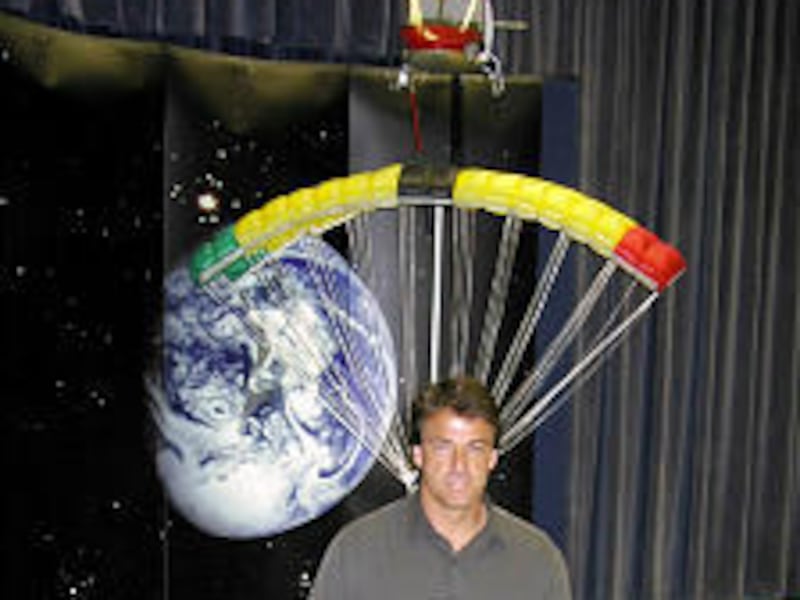

On Sept. 8, Dan Rudert will put on the flying performance of his life, piloting a helicopter above Dugway Proving Ground. But unlike his flights for Hollywood movies, this time it's for real — and there will be only one take.
Rudert's flying prowess will be essential to the safe return of the first space probe to bring back samples from far beyond Earth's orbit. The Genesis capsule houses treasures never before seen, minute bits of the material that blows off the sun at 1 million mph.
A resident of Salt Lake City for 39 years, Rudert moved to Los Angeles six or seven years ago. But he comes back to Utah two or three months a year, continuing to fly for Classic Helicopters in this area during the summer months.
Among highlights of his career so far were flying for films like "The Incredible Hulk," "We Were Soldiers Once . . . And Young" and "Charlie's Angels." He placed Britney Spears on a 900-foot cliff above Lake Powell and flew close by for a music video. He chased Lance Armstrong, buzzing a few feet over the cycling champion as he pedaled through city streets for a car commercial.
But the most thrilling experience may come on Sept. 8. "It's really a privilege and it's an honor, to be a civilian helicopter pilot and to work with the likes of NASA, JPL (The Jet Propulsion Laboratory) and Lockheed-Martin and all their brilliant scientists and engineers," he said in a telephone interview.
He is amazed that these specialists could launch the Genesis probe into deep space, use it to gather particles from the solar wind and send it back to Earth.
After its three-year cruise, Genesis will enter Earth's atmosphere over northwestern Oregon. From there "to where it gets to where we catch it there at Dugway, takes 80 seconds," he said.
"Can you believe it? This thing is going 24,700 miles an hour."
At an altitude of 20 miles, he noted, a parachute will slow the descent of the capsule, which weighs 452 pounds. A 35-foot parafoil will open at 20,000 feet above sea level.
Meanwhile, Hill Air Force radar, based about 100 miles to the north, will identify the capsule as it glides above Dugway. Controllers will radio instructions for the two helicopters to fly in formation to a rendezvous.
The helicopters fly in formation about 300 or 400 feet apart. Their crews should be able to spot the capsule when it is at 13,000 or 12,000 feet feet above the harsh desert ground, assuming the day is clear.
"Then we'll try to fly in formation with Genesis" about 6,000 feet above ground. At 4,500 feet above the desert, the lead helicopter will make an attempt to snag the parafoil with a hook on a long line.
The helicopter piloted by Cliff Fleming of Santa Barbara, Calif., will make the first pass. If it fails to catch Genesis, the capture will be up to Rudert and his chopper.
But, he quickly adds, on 11 retrieval trials since 1998, the pilots had a "100 percent success rate on the first pass. So I have great faith Cliff will do it on the first pass."
From life-size mock-ups captured in midair, he offered this description: "It's a bit akin to flying in formation with a giant floating or flying jellyfish . . . like aerial ballet."
At that heighth, the pilots see no visual references like horizons, trees or structures that could help give them a sense of distance. They have to depend on their skill and knowledge.
When they hook the parafoil, "we feel a slight tug," he said. Spooling off a boom contraption something like a gigantic fishing rig, the line plays out until the capsule is 120 feet below the helicopter.
"Looking down, the Genesis capsule looks to be about the size of a large dinner plate," he said. Meanwhile, the parafoil is tugging the capsule toward another direction.
"This is really one of our greatest challenges, to land it gently and on a precise spot," he said. The helicopter moves at around 9 mph, lowering the capsule at about 200 or 300 feet a minute.
Assuming the most likely outcome, that Fleming does capture the 5-foot capsule on the first try, Rudert and his crew still have a vital role in the project.
One helicopter will snag the parafoil with a large hook on a line, and the other will land to prepare a temporary landing site. The first helicopter will ease the capsule toward Earth on the end of a 120-foot line, and the crew of the second will guide it down and remove the parafoil.
"My crew gets out and they stake down a temporary landing pad, and then when Genesis is put on that, they strip off the parafoil." The choppers then fly the capsule about 30 miles to a clean room at Dugway's Michael Army Air Field. The parafoil has to be removed because otherwise, on the trip from the capture point to Dugway's Michael Army Air Field, it would catch the wind and cause problems with transport.
A special cradle has been prepared for the capsule at the airfield in the remote western Utah base. Scientists will work on it there. Eventually they will truck the capsule to a laboratory where they will extract the microscopic particles of the solar wind embedded in the capsule's collector plates.
But once Genesis reaches the airfield, Rudert said, "Cliff and I are done. We can celebrate, knowing we caught a $260 million payload."
E-mail: bau@desnews.com