




In 1964, volleyball became an Olympic sport.
Volleyball originated in the United States, yet its popularity on a global basis ranks behind only soccer among participation sports. Today there are more than 46 million Americans who play volleyball and 800 million players worldwide.
In 1895, William G. Morgan, a YMCA instructor in Holyoke, Mass., decided to blend elements of basketball, baseball, tennis and handball to create a game for his classes of businessmen which would demand less physical contact than basketball. He created the game of volleyball, which at the time was called mintonette. Morgan borrowed the net from tennis and raised it 6 feet 6 inches above the floor, just above the average man's head. During a demonstration game, someone remarked to Morgan that the players seemed to be volleying the ball back and forth over the net, and perhaps "volleyball" would be a more descriptive name for the sport.
During World War I, American troops took volleyballs with them for recreation, helping to spread the sport throughout the world.
Today volleyball is so physically rigorous with its jumping, diving and serving that the sport's original inventor might have a hard time recognizing the gentile sport he conceived more than 100 years ago.
Logan Tom
An outstanding server and outside hitter, Logan Tom makes her second Olympic appearance for the United States in the 2004 Summer Olympics.
Logan was so good coming out of Highland High School in Salt Lake City that the U.S. team wanted her badly, but Stanford University won out. After leading Stanford to the NCAA final as a freshman, she took a semester off to prepare for the Olympics.
At 19, the youngest player on the roster by two years, she made the Olympic team. Her U.S. teammates called her "Doogie" after the TV's Doogie Howser, a teenage doctor.
After the 2000 Olympics, Logan returned to Stanford and won the Honda Award as the nation's top female collegian. The past two years she has played professionally in Brazil and Italy.
Aug. 20 USA v. Russia
Aug. 24 Quarters
Aug. 26 Semifinals
Aug. 28 Finals
The men's hammer throw has been in the Olympics since 1900
Hammer throwing has a long history. In the Strathclyde region of Scotland, hammer throwing is said to date back from the time of King Arthur (c. 500 AD), who not only carried a hammer in battle but was called "The Hammer."
As a sport, hammer throwing can be traced back further than King Edward II, son of Edward Longshanks of England, who banned the sport for safety reasons. In England, the sport was continued mostly by miners and blacksmiths who used a sledgehammer and an underhand throwing style.
King Edward's ban on the sport did not reach Scotland, however, and hammer throwing continued to evolve into the sport as we know it today. The throwers began to turn their bodies to gain distance in the throw. This, however, was discontinued to protect the spectators from any mis-thrown hammers. To gain added momentum, competitors stood backward and turned in a figure eight pattern before releasing the hammer. This style continues to be popular with Olympic hammer throwers. The hammer itself evolved from a large metal ball attached to a wooden staff (helve) to become a 16-pound metal ball attached to a chain with a handle.
James Parker
USAF first lieutenant James Parker, ranked No. 1 nationally in the hammer throw, is looking forward to competing in his first Olympics. A graduate of Northridge High School in Layton and Utah State University, James earned NCAA All-American status nine times during his career. He was named the 1995 Big West Track Athlete of the Year after winning conference titles in the shot put, discus and hammer. James did not compete in 1996 and 1997 because he was serving an LDS mission in Rio de Janeiro, Brazil.
Since joining the athletic program at the Air Force Academy, Parker has split time between Eugene, Ore., where his coach lives, and his home at Malmstrom Air Force Base where his wife, Kami, and son "Little James," live.
Aug. 20 Qualifying
Aug. 22 Final
Ultimate Women's Athletic Challenge
Seven tough events combine to make the ultimate women's athletic challenge. The heptathlon
is a test of strength, skill and endurance with points awarded for best performances in each event. The action starts with 110m hurdles, high jump, shot put and 200m on the first day, and continues with the long jump, javelin and 800m to complete the event on the second day. The rules of each event apply to each individual part of the competition. Failure to compete in an event means elimination for the overall competition.
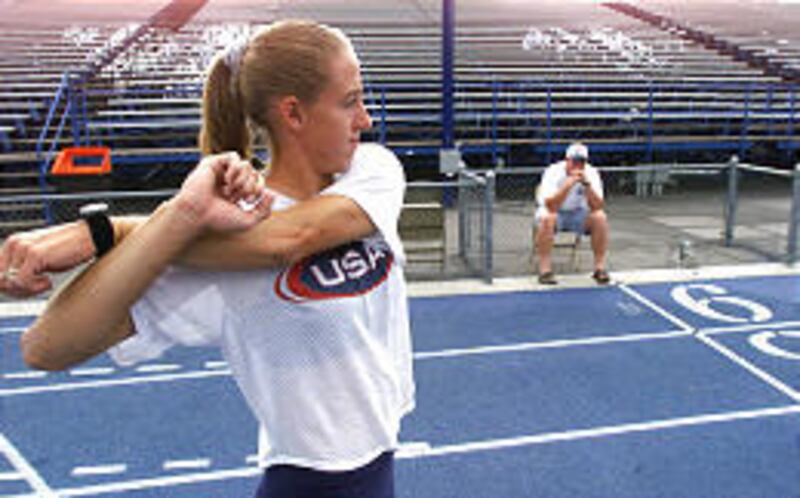
Tiffany Lott-Hogan
Tiffany Lott-Hogan is trying to become the first U.S. woman to win a medal in the heptathlon since Jackie Joyner-Kersee won silver in 1984 and gold in 1988 and 1992. Lott-Hogan qualified for Athens by finishing second in the heptathlon at the 2004 U.S. Olympic Trials. After taking two years off following the birth of her son, Keplar, the Pleasant Grove, Utah resident had a strong 2003 season.
Tiffany began running track when she was 11 years old, inspired by other siblings who were dedicated runners. She attended Pine View High School and graduated from Brigham Young University with a degree in recreation management and coaching. She married Brent Hogan in 1999.
Aug. 20 100m hurdles, high jump, shot put, 200m
Aug. 21 long jump, javelin, 800m
Undefeated NCAA wrestler
Freestyle wrestling appeared as an Olympic event in the 1904 Olympic Games. The first world championship took place in Helsinki in 1951. Under international rules, any fair hold, trip or throw is permitted while kicking, punching, butting with the head and holding the opponent's uniform are forbidden. Wrestlers are cautioned for irregularities, and three cautions mean disqualification.
Cael Sanderson
Cael was born in Provo and attended high school in Heber City, where his father, Steve, served as the wrestling coach. He majored in art and design at Iowa State, graduating in the fall of 2001. His older brothers, Cody and Cole, wrestled at Iowa State, and Cael met his wife, Kelly, there.
While wrestling at Iowa State, he compiled a 159-0 record with four NCAA titles. Sanderson is the only wrestler in NCAA history to go undefeated all four years. He is also the first wrestler to appear on a Wheaties box.
Sanderson enjoys fishing and once caught a 22-pound Arctic Char on a fishing trip to Alaska with his family.
Aug. 27 Qualification
Aug. 28 Semifinal and Final
Taking the scenic route
In 1896, The first road race took place at the Olympic Games in 1896 and covered 87 kilometers, which is a short distance in comparison to some of the grueling courses in later contests. The longest race was in 1912 in Stockholm, where the course ran for 199 miles.
For the 2004 Olympics, the course could have been created by the Athens Tourist Bureau. The cyclists will race past some of Athens' most important and historic sites, starting at Athens' Town Hall and riding past the National Museum, the Greek Parliament building and the Acropolis. Runners will not be doing much sightseeing at an average speed of nearly 30 mph.
Levi Leipheimer
Levi was named to the U.S. road cycling squad after team leader Lance Armstrong removed himself from the competition. Leipheimer recently successfully completed the Tour de France with a ninth place overall finish and was the second highest American finisher after Armstrong.
Levi attended Rowland Hall-St. Mark's High School in Salt Lake City, and while racing for local bicycling teams, attended the University of Utah. He was born in Butte, Mont., and currently resides in Santa Rosa, Calif.
A competitive skier from age 12-19, Leipheimer began cycling in 1987 to train for downhill ski racing. Ten years later he became a professional athlete, not as a skier but as a cyclist.
Aug. 14 Road race