

Dave and Jeanie Sharp had a good life, and they knew it. Healthy and happy kids, a nice home, a good job. It was so good, it was too good.
"What's going to be our trial in life?" they used to muse out loud.
Then their question was answered with the subtlety of a thunderclap. One moment they were enjoying a family outing in a national park, the next moment Dave was holding his son as he lay dying.
If this had been a movie, there would have been some dramatic clue of impending doom — background music, a foreboding scene or some ironic dialogue. Maybe life should offer at least that much when it's about to be turned upside down. But there was nothing. At the climactic moment, they were doing something as mundane as eating a taco salad.
The Sharps were sitting down to dinner at a campsite in Snow Canyon. Then there was running and screaming up the canyon. By the next morning, they were driving back to Salt Lake City with an empty seat in their car, riding in thick silence that was broken only by sobs, the thrum of the road and a feeble discussion of funeral arrangements and obituaries.
Colby, a 16-year-old student at Skyline High School, was gone.
It was only later that they would find irony and foreboding in something Colby had said. In the months ahead, when they would come to know their son more in death than they had in life, they would find more words and more irony that he left behind.
The Sharps have been reeling from their grief in the three months since Colby died from a fall in the cliffs of Snow Canyon. When the kids returned to school this past week, it stirred up the pain of their loss again. A young brother threw a screaming fit — "I want him back! I want him back!"
Jeanie went to school for a parents' meeting, but she was overwhelmed. She was sobbing before she reached the sidewalk and vomited when she reached her home.
"As parents, we automatically overnight became members of what feels like an exclusive club of those who have lost children," Dave says. "It's a club we don't want to be in, and no one who is not in the club can truly appreciate or understand our pain."
The club has grown this summer. It has been a summer of sudden loss and freakish mishap. A father watches his son walk 200 yards back to Scout camp in the High Uintas and never sees him again. A BYU student vanishes. Lightning strikes a 16-year-old boy in a park during a family reunion. A Boy Scout falls in Zion National Park. A high school athlete is hit by a baseball.
This is the second time in six months Skyline High lost a student to a fall on the red rock of southern Utah.
When the Sharps arrived at their home the day after the accident, they discovered a huge banner on their house. WE LOVE YOU, COLBY. The lawn had been mowed and decorated with 16 flags marking Memorial Day. In the house there were balloon bouquets and a newly stocked refrigerator and stuffed animals and sympathy cards. The Sharps took it all in and sobbed.
For five days there was a steady stream of visitors in their house.
For six weeks and two days, the Sharps found gifts on their doorstep or cards in their mailbox every day. Every time they visit the cemetery, they find gifts and flowers on the grave.
But no matter how much sympathy they receive from friends and relatives, the grief-stricken families are left alone to sort through their thoughts and come to terms with what happened and how they choose to deal with it. There is no sparing them the pain. They can't outrun it, they can't hide from it. There is no fixing this problem.
They can't escape the club.
Jasmine, Colby's 14-year-old sister, retreats to her brother's bedroom nightly and closes the door — "I don't know what she does," says Jeanie. "It's her private time."
Jeanie finds Dave in there sitting on the floor, crying, thumbing through photos and keepsakes. "It's where we go when we need to be alone," says Jeanie, looking around the room. "I can usually find someone down here crying."
Says Dave, "Someone told me grief is like a huge boulder you carry with you. You chip away at it one day at a time until it's a small rock you carry with you in your pocket."
"Well, I'm off to bigger and better places." That's the last thing Colby said to his family.
After spending the previous night and that day with his family, Colby was moving to another tent with his friends, Ryan White and Jordan Gisseman, who had just arrived with other members of the neighborhood.
Colby grabbed his belongings from the family tent and then said those ironic words and rushed off to go hiking with his buddies in the nearby rock cliffs.
Off to bigger and better places.
Colby, the oldest of the Sharps' four children, was a charismatic boy who made friends easily. Since he was a young child he talked easily with adults and was comfortable around them. He was an Eagle Scout and a solid student. He placed 12th in the state diving championships.
At 6-feet-1, 200 pounds, he planned to play lacrosse. He wanted to become a chef. He worked two part-time jobs. He liked to read so much that he stayed up late into the night poring over books about the Arthurian legend and "The Lord of the Rings." His parents used to threaten to take away his books if he didn't turn out the light and go to sleep. He liked to write poetry and short stories. He planned to serve a mission for his church.
These are the mile markers of his brief life.
"He was just so loved," his mother says. "He got asked to every girls-choice dance."
"Every morning when I wake up, he's the first thing I think of," says Peggy Ijams, a former FM100 radio personality whose son Dylan was Colby's close friend, as was she.
"He was just so full of life, upbeat, generous, never in a bad mood, never judged anyone. He was always happy, and he was interested in whatever you were doing. He'd come over to the house and I'd tell him Dylan wasn't home, and he'd say, 'That's OK, I want to talk to you.' " Ijams, who describes herself as highly spiritual but not religious, struggles with Colby's death and says, "I want to get what this is about. This has been an amazing journey for me."
For some, there will never be any sense to the tragedy. The Sharps had gone to southern Utah as part of an annual outing their neighborhood church ward takes on the Memorial Day weekend. They spent the day as a family engaged in hiking in the Zion Narrows, water fights, playful teasing, talking.
"We had the perfect last day," says Jeanie wistfully, almost sighing at the memory.
They returned to their campsite late that afternoon. That's when Colby ran off with his newly arrived friends, Ryan and Jordan, to climb the rocky peaks that border the back edge of the campsite. An hour later, about the same time Jeanie was gathering kids for dinner and asking if anyone had seen Colby, Ryan and Jordan showed up at the campsite.
"Where's Colby?" Jeanie asked.
They said he had come down ahead of them, but each had descended the rocks by a different route.
Then Ryan said, almost to himself, "I heard the worst sound when I was coming down, like someone was falling."
"Colby's not here — was it a rock?!" Jeanie asked, panic beginning to take hold of her.
"It had to be," he said, but, after a moment's pause, he took off running toward the canyon without saying a word. Jordan followed and then Dave, who had been listening from the table, gave chase, dropping his salad in the road. All of them were on a dead run, each of them churning in his own thoughts for that quarter-mile sprint, hoping for the best, fearing the worst.
Ryan found Colby first. "Get help!" he yelled back to Jordan. "Colby's hurt!" Dave arrived on the scene and knew immediately Colby's condition was serious.
"He was unconscious but breathing," recalls Dave. "The back of his head was crushed, and it was obvious he had broken bones. He was in bad shape."
For a half-hour he sat in the sand, holding Colby in his lap, rubbing his hair and kissing him. He gave him a blessing and tried to talk to him.
"At first, I was in such a state of disbelief," says Dave. "I thought, this can't be happening. He was already gone, but the body was going through the motions of being alive."
Help arrived and Colby was rushed to the hospital, where he died a short time later.
Off to bigger and better places.
The first thing a visitor sees when he approaches the Sharps' front yard is a volleyball-sized glass "gazing ball" perched on a stand in front of the house. It was a gift from friends in Colby's honor.
So are many of the trees and plants in the yard. The irony is that Colby had recently helped tear out the old yard and prepared new shrub beds. All that was needed was something to plant in them. His death provided flowers, bushes and trees.
There's a Chinese fringe tree with a sandstone memorial at its feet — "In Loving Memory/Colby Sharp/May 2004" — gifts from an anonymous neighbor. There are homemade stepping stones, with colored marbles inlaid in the stone. There are elderberry bushes, rose bushes and a beech tree.
"We spend more time in the front yard than at the cemetery," says Jeanie, taking it all in. She likes to sit in the yard, thinking and remembering and watching the mourning doves that lately come here, but more on that later.
There are other remembrances inside the house. The first things a visitor sees when he steps in the front door are photos and drawings of Colby. A stranger saw Colby's obituary and was moved to make a drawing of the boy. He came to the funeral and afterward knocked on doors in the neighborhood to find the Sharps' home and present them with his art.
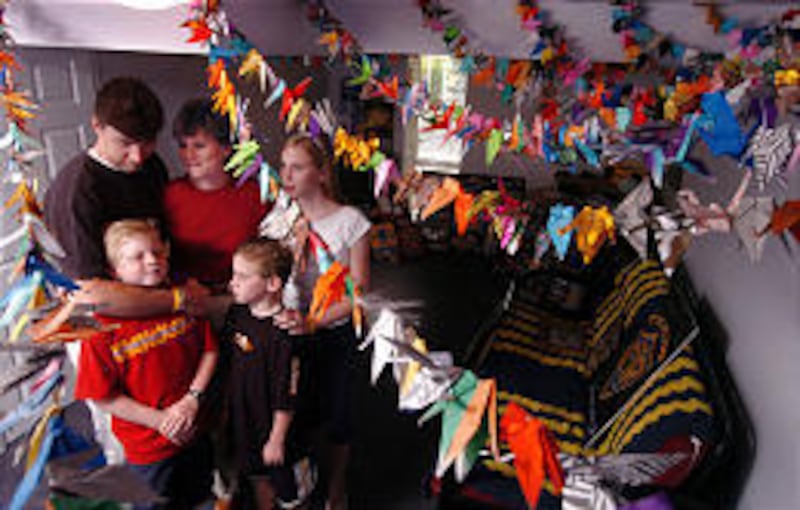
Friends made a sign on the 3300 South bridge over I-215: WE LOVE YOU COLBY. One thousand origami cranes were hung above Colby's locker in the school, a gift from Colby's school judo instructor and classmates. The viewing required 4 1/2 hours to accommodate all the people. The crowd at the funeral overflowed the chapel and filled up the gym behind it.
"Everybody was there," says Ijams. "This kid was so loved!"
"We are finding he was an amazing kid," says Dave. "As a parent, you just see them in a home setting. We have learned so much more about him since he's been gone."
Two weeks before the accident, Colby was visiting with a group of friends who were discussing a near-miss automobile accident and the prospect of death. "If it happens to me, I'm OK with that," said Colby offhandedly. "I'm ready."
After the funeral, Colby's Spanish teacher called and asked Jeanie if she had read Colby's Spanish project. It was a poem he had written in Spanish called "Remember Me."
The Sharps remember, of course, and continue to struggle with their loss. There are reminders everywhere. "Darn it, our family can fit in a Subaru now!" Jeanie told a friend. It's a table for five at restaurants now. There are fewer groceries to buy.
Part of the Sharps' struggle is the reaction of friends and acquaintances. Some acknowledge the loss and console them the first time they meet and then never mention it again. Others never bring it up, even those who knew Colby well. Some go the other way when they see them coming.
"The world outside my front door is still a scary one," says Jeanie.
"The people who call or visit me are there because they want to be, but there are so many who don't — they simply watch or look away. . . . Sometimes I just feel like I wear a scarlet letter: There goes the grieving mom."
Says Dave, "People don't know how to act. They stop bringing up the loss. They think it might be offensive to you. It's not. We love to talk about Colby and our pain. They might ask you how it's going and then they're so relieved if you just say everything is fine.
"Club membership is imposed on you. You have to pay dues every day. Despite everything else that's going on. That's the thing that's hard, too. Life goes on. You've got to put on a happy face for kids and employees. But the grief is still there."
For Dave, it is the second time a freakish accident took the life of someone close to him. His identical twin brother, Hugh, was killed two years ago when a large tree branch broke and fell on his head while he was mowing the family apple orchard. In an account that is chronicled in the book "Pain Is Inevitable, Misery Is Optional," by Hyrum Smith, Hugh's sons prayed to achieve some level of peace with this tragedy, then visited the scene of the accident.
When they arrived in the orchard, a mourning dove was sitting on the broken limb in the tree and remained there for days. The dove became a family symbol. The Sharps bought a Christmas tree in the annual Festival of Trees and decorated it with the dove theme.
"It's a very powerful story in our family," says Jeanie.
Like Hugh's sons, Dave also felt compelled to visit the place where his son died, hoping it would help him to make sense of this madness.
He took his younger son Evan and returned to Snow Canyon. They hiked to the top of the rocks where Colby had climbed and took photos looking over the edge several hundred feet below them. They visited the place where Colby had landed and tried to surmise what happened. They found Colby's blood still on the rocks. They took a photo of a large boulder that Colby had struck on the ground — it was cracked in half.
"Dave was obsessed with returning there," says Jeanie. "I'm not ready. I can barely look at the pictures he took."
Dave hid a few mementos near the spot they found Colby — a letter to his son, Colby's obituary and one of Colby's hemp necklaces. Dave wears another of Colby's blood-stained hemp necklaces wrapped double around his wrist.
In November, the family plans to hold a birthday party for Colby, inviting his old friends, and then they want to put away his room and move one of their younger boys in there.
"If we can actually make ourselves do it," says Jeanie.
After Colby's death, Hugh's sons brought three bushes to the house as gifts in Colby's memory. Jeanie spent an entire day planting them in the yard. That evening, Dave came home and they sat on the lawn together, looking at the bushes and talking about the day. Then they heard a cooing sound. They looked up and saw two doves perched on a wire overhead, staring down at them. They had never seen doves in the yard. Suddenly, all was silent — no kids were playing, no cars were driving by, no dogs were barking.
"We both instantly knew Colby and Hugh were together," says Jeanie through tears.
A short time later, on one of their visits to the cemetery, they saw two doves on a wire adjacent to Colby's grave. After a few minutes, they flew off together, but they're almost always there whenever the Sharps visit the site.
At home, Jeanie likes to sit in the yard, writing letters and thinking and watching those birds. The mourning doves are regular visitors these days.
By Colby Sharp
Remember me
(translated from Spanish)
I am Colby Sharp
I am tall like my father
I listen
Remember me
I am Colby Sharp
I listen to everyone
I am a leader when times are dark
I am strong in more ways than one
Remember me
I am Colby Sharp
I lived my life
I have love for my wife
I have made my goals
Remember me
I am Colby Sharp
I am a listener, I am a leader
I am the only person I can count on
to always be happy
Remember me
I am Colby Sharp
Remember my smile
Remember me
E-mail: drob@desnews.com