

Enter the Utah State Fair from Gate 19 in the north part of the Fairpark and you'll be met by a booth for a service combining satellite TV, the Internet and telephone services.
"Feed your need for speed," a banner reads.
Not far away, other stands promote jewelry cleaning, real estate, mortgages, time shares, weight-loss products, hot tubs, cool sunglasses and sundry videos, including religious ones.
The providers are among 272 commercial vendors listed, many of which hint of home show more than state fair.
There's so much commercialism and hawking of goods (and not-so-goods) going on some might wonder if they've wandered into an "in-fair-mercial." Now there's more advertising than agriculture, more trading post than trade show, more mall than manure.
Calvin and Linnie Stevens, an Orem couple in their 80s raised on Idaho farms, used to attend to the fair annually. They stopped coming about five years ago because, as Calvin puts it, "It got kind of boring." They gave it another chance this year because an RV show hadn't opened yet.
"It got where they didn't have any animals," Linnie said. "They don't have any momma pigs with their little ones. That was the highlight of the fair. They used to have tables of flowers. Now they're very scant."
Calvin says kids nowadays don't want to look at plants and animals, they want to play on the rides while others would prefer buying gadgets. He's fine with that. He just wishes the farming aspect didn't take a back seat.
There are petting zoos and buildings with farm animals, but you have to walk to the outer edges to find the Bambouillet sheep, the billy goats and the pens stocked with large, lounging pigs from Allred Hog Farm, which, as the sign claims, produces the "best pork on a fork!"
"In our time, that's what a lot of people were interested in. . . . People nowadays are more interested in the commercial end of it," Calvin said. "It takes a whole lot of things to interest everybody. No matter how hard you try, you're not going to please everybody."
David Christiansen, a retired electrical engineer from Bountiful, said the mix is fine, but the former 4A and FFA club member comes for the exhibits that end with -culture.
"I look at those things (vending booths), but I just walk by 'em," he said. "I think it has a place for some people, but I think the fair is primarily what we see here." He points around the floriculture room, which includes displays by each county along with the famous butter cow, a 403-pound blue-ribbon pumpkin and the sweetest-smelling plump peaches this side of Brigham City, then adds, "But that's probably because of my age."
Brigham Young might have agreed. He won first prize for the best celery on exhibit and one of his horses took the "best stallion" honor at the first State Fair held back in the fall of 1856.
Or, then again, would he have liked the option of getting an air-brushed tattoo?
Farm focus
That the fair is less farm-friendly and more like a swap meet might be a misperception.
Lorin Moench, chairman of the board for the Utah State Fairpark, believes the agricultural aspect of the fair is among its most important features, especially as much of Utah continues to urbanize. Plus, exhibit participation for agriculture and animals has been steady in number over the last 10 years and has increased over what it was 30 to 40 years ago.
The reason? Overall population in Utah has increased.
However, Moench said, one of his goals is to eventually move the commercial/vendor portion of the Utah State Fair to its own separate area, whereas now that aspect is spread throughout the Fairpark. That's what many other state fairs do.
Barney Cosner, executive director of the Wyoming State Fair and a western area director of the International Association of Fairs and Expositions, said generally the more urbanized a state becomes, the more commercially oriented its state fair becomes.
For example, he said, the Wyoming State Fair is among the smallest of all and is not commercial or food oriented.
"A lot of fairs are very reflective of the state," he said.
That might come as bad news to some considering Weird Al Yankovic is performing here this year.
Cosner, who didn't expound what exactly that means, also believes each fair has its own special flavor. For instance, the California State Fair makes a showcase of the wine industry.
Utah culture
Utah's fair has always mirrored local culture and to a degree what's popular in current American society.
The development of Utah's State Fair during its first half-century mirrored Utah's separation of church and state. Originally, it was organized by the Deseret Agricultural and Manufacturing Society, with the goal of promoting self-sufficiency and independence in Utah from the outside world.
Early fairs coincided with October LDS General Conference, so that people traveling long distances into Salt Lake City could benefit from a two-fold experience, according to the Utah History Encyclopedia.
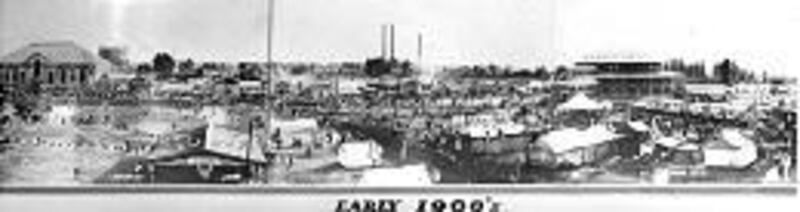
The first fair was at the Deseret Store and Tithing Office, but when Utah became a state in 1896, the shift was on for Deseret Agricultural to become independent. By 1902, the fair had a permanent home at today's State Fairpark, 1000 W. North Temple. Previous sites included Social Hall, various ward meetinghouses and even where Trolley Square now sits.
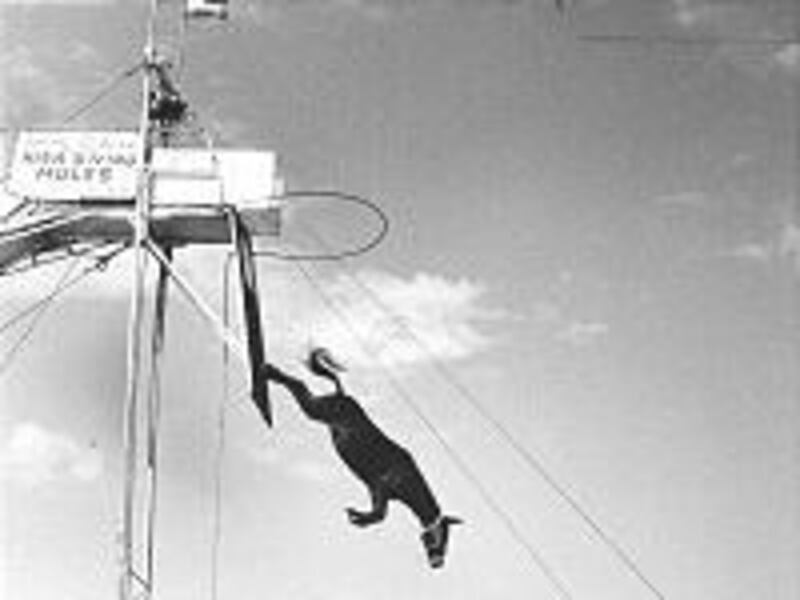
Its attractions were even more diverse than its locations. Utah State Fairs of yesteryear have included skydiving, log rolling competitions, a high-diving mule, fireworks, magicians, hypnotists, freckle contests, melodramas, bubble gum blowing events, quick draw contests, sand castle building, an Evel Knievel motorcycle jump, crazy hat contest, demolition derbies, "Holiday on Ice" performances, auto racing and hot air balloons.
Curiously, auto racing began at the Utah State Fair in 1903, but many weren't impressed that initial year. A Deseret News headline said, "The autos were not fast." By 1917, auto racing was in its heyday, when a newspaper headline stated, "Little Chevrolet feeds dust to cars in speedway contest at State Fair Grounds." Also in 1917, stripped down Model T's competed in an auto polo event at the state fair.
There are personalized license-plate holders available this year, but no auto racing.
When recalling fairs of decades past, Moench remembers the animals and the carnival rides the most during his childhood and not the vendors or sideshows. He does recall the "diving mule" of 1976, though such an exhibition would certainly cause a stir in today's more animal-rights-conscious society.
"It's funny what makes an impression in your mind," he said.
Fairest fair?
Richard Frenette, the new executive director of the Utah State Fairpark, said he is excited about the fair's history and its potential. He also said he can't really compare the Utah fair to other state fairs, because he's yet to see it (he previously ran Ohio's fair). He plans on evaluating it before making big changes.
Moench visited a lot of other state fairs last year — Eastern Idaho, Ohio, Indiana and Iowa — and feels Utah's fair has comparable livestock exhibits but larger and superior home arts displays. Besides not having a good overall exhibits order, Moench also wonders if Utah's has too many franchise food concessions. Many other fairs rely on a more unique lineup of food offerings.
"I didn't feel our fair was inferior," he said. "But it didn't have the size many eastern fairs do."
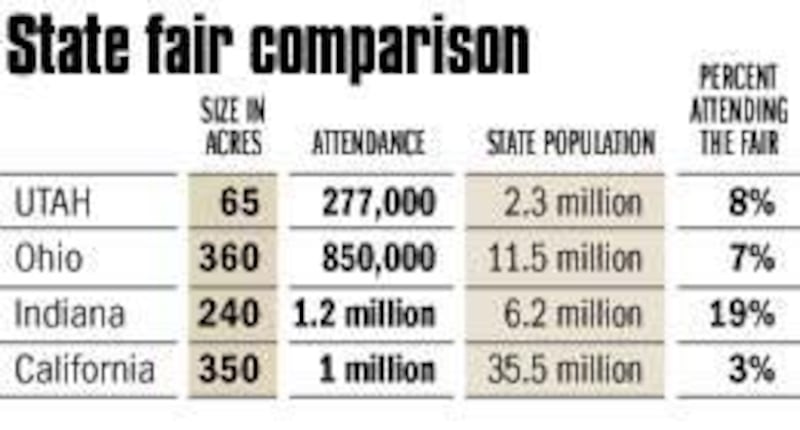
Indiana has 240 acres and attracts 1.2 million people, as compared to about 300,000 for Utah on 65 acres at the Utah State Fairpark. The Ohio State Fairgrounds have 360 acres.
"We couldn't handle that size of crowd," said Denise Stanger, Utah State Fair marketing director. "To illustrate: The attendance at Ohio would be putting 2,361 people per acre. The Utah State Fair would have to put 4,771 people per acre at our Fairpark. We do an amazing job handling the crowds given the space."
Moench said entertainment is also a bigger fixture at some fairs. The Mid-State California Fair has huge concerts, while "their free concerts are ones we charge admission for."
In comparison, Moench lauded Utah's for being "very clean" with "nice grounds and a good family atmosphere."
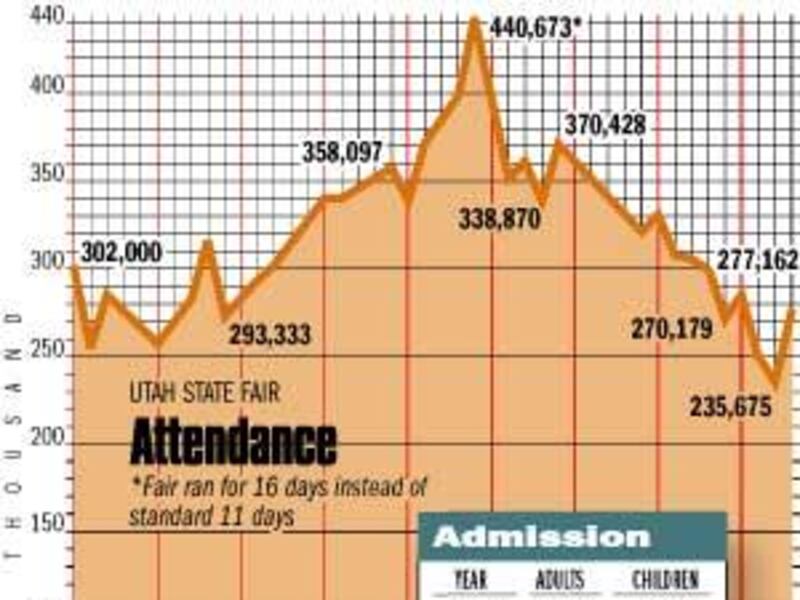
But that hasn't turned it into a must-do event for Utahns as it is in some mid-western states. In 1960, the Utah State Fair attracted some 302,000 people. In 2003, the fair's attendance was 277,162. That means that 44 years ago almost 33 percent of the state's population (890,000) went to the fair. Only 8 percent of the state's almost 2.3 million population visited the state fair last year.
The options of other entertainment and activities along with the increased commercialism might be a couple of reasons for the drop. Other explanations could include the notion that Utahns love bargains and are attracted to them (organizers are hoping daily discounts will solve that dilemma); the lack of star-power entertainment and taste-of-the-town-type food (no offense to Weird Al and Domino's); and the rise of county fairs might lead some to skip the state fair.
Some people also complain the Fairpark seems run down (an expansion and renovations are being considered), while others might be scared off from the neighborhood and the fact a gang shooting happened there a decade ago.
Perhaps local merchants and government leaders can borrow a trick by their early 20th-century predecessors who helped boost attendance. In 1902, most of Salt Lake City's businesses closed down one afternoon during the fair because of a request by the governor and mayor to do so after they declared it an afternoon holiday. Schools also closed on Friday, Oct. 3, for "Children's Day."
"All business suspended this afternoon and about three thousand persons attend the fair" was a Tuesday, Sept. 30, 1902, headline in the Deseret News.
And the lack of free enterprise didn't get in the way of high hopes back then.
"Don't talk about previous fairs to me," J.G. McDonald, chairman of the fair's amusement committee, told the News, "for this one will be so far ahead of the others in the past."
The fair's claim was "A $2 attraction for 25 cents." And kids' admission was only a dime.
You can't even get in to see the smallest horse in the world for that much now — let alone buy a designer hair scrunchie.
E-mail: lynn@desnews.com; jody@desnews.com