

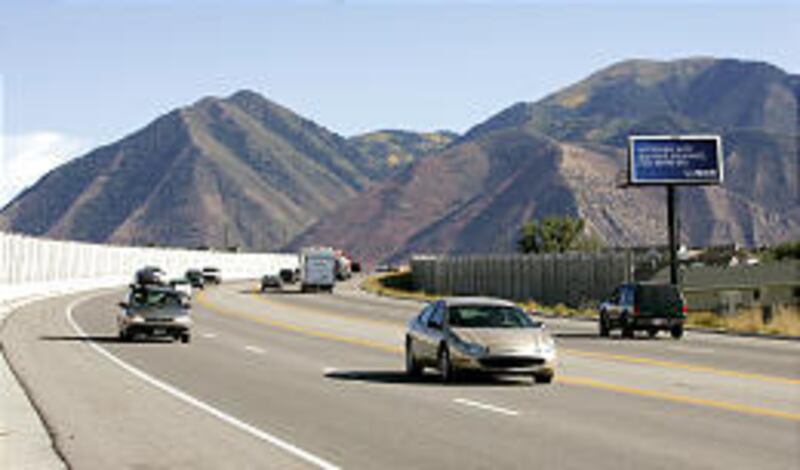
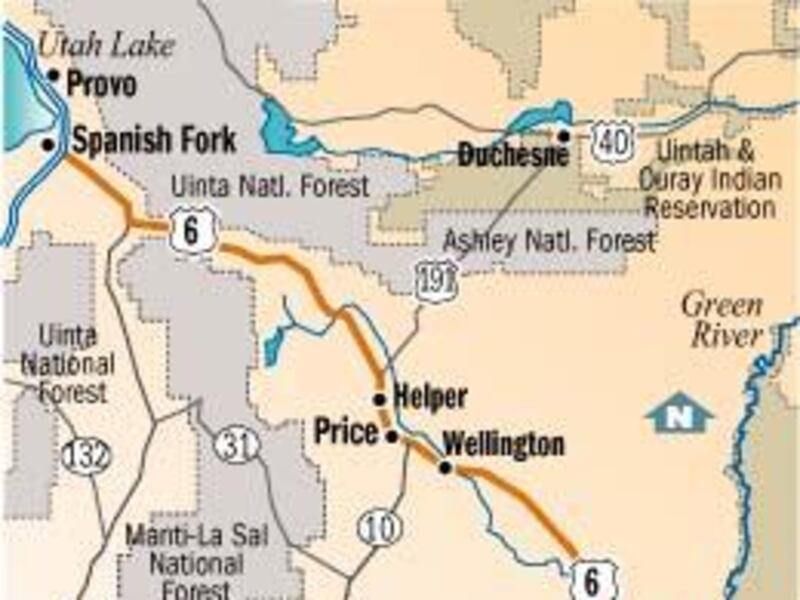
SPANISH FORK — A transformation is gradually taking place along the 128-mile route between here and Green River.
Slowly but surely, a few miles at a time, one improvement after another, the highway with the reputation as Utah's deadliest is being reborn. U.S. 6 is becoming what its frequent users have demanded for years — a much safer road.
The Utah Department of Transportation has spent $115 million on U.S. 6 since 1997, widening certain segments, adding passing lanes, posting warning signs and adding rumble strips in the median and on the shoulders — improvements designed to keep motorists from adding to the highway's chilling death toll.
And that investment is paying off.
In the past four years, there have been an average of 10 fatal crashes per year on U.S. 6. And in the late 1990s, the average was about 12 fatal crashes annually.
So far in 2004, the number of fatal accidents on U.S. 6 has dropped to five. If that trend continues, the year could end with the smallest number of fatal crashes on U.S. 6 in many years.
"They really have made a difference, and those numbers really show that, but there are still some obvious things that need to be done," said House Minority Whip Brad King, D-Price, a longtime U.S. 6 watchdog and advocate, along with Senate Minority Leader Mike Dmitrich, D-Price.
"The rumble strips have helped, and I've had some really positive input from people (saying the road is safer). The first snowstorm of last season was just after those (rumble strips) had been put in, and both Mike and I were coming home after the Legislature on a Friday night and weren't able to see the sides of the road at all. The first time I hit that center rumble strip, I said 'Thank you, UDOT' because you could tell where you were without being able to see it."
This week, UDOT will hold a series of public hearings to present a draft environment impact statement (EIS) for future improvements along the U.S. 6 corridor. If the document's final version is approved by the federal government next spring as hoped, UDOT will proceed with another $40 million worth of improvements to further enhance the roadway.
Eventually, UDOT would like to widen the entire 128-mile length of U.S. 6. But the cost to do that is estimated at $550 million, which could be prohibitive. And the draft EIS has revealed about 20 acres of wetlands that would be impacted by such a project. The U.S. Army Corps of Engineers might not give its approval for all of the proposed work that would disturb wetlands.
Consequently, as part of the EIS process, UDOT is considering an alternative that would widen some of the highway from two lanes to three lanes and leave it at that, with no future plans to extend to four lanes.
About half the highway is now two lanes, with roughly 25 percent three lanes and the remaining quarter — including recent improvements east of Spanish Fork — at four lanes with a center median.
"We can make it better," promised Mike Miles, UDOT's project manager for U.S. 6. "We can get rid of most of that two-lane, if not all, and at least have three- and four-lane stretches rather than two, three, four and five (lanes). We're trying to make it more consistent throughout."
Next week's hearings will include information on proposed safety and capacity improvements, like additional passing lanes, as well as the potential environmental impacts of those projects. The meetings will be held on the following dates:
Tuesday, 4-7 p.m., at the Spanish Fork Senior Citizen Center, 167 W. Center St., Spanish Fork.
Wednesday, 4-7 p.m., at the Green River High School cafeteria, Green River.
Thursday, 4-7 p.m., at the College of Eastern Utah multipurpose room, Price.
Public comments will be accepted through Oct. 29 and can be submitted on the Internet at www.udot.utah.gov/US6. Comments also can be mailed to: U.S. 6 Project Team, 3995 S. 700 East, suite 100, Salt Lake City, Utah, 84107.
The EIS, Miles said, "is going to provide a way for us to improve and enhance the safety on 6 to a level that, I think, people will enjoy and like — and get it out of their minds as one of the most unsafe and scariest highways you can drive. And I even think we've done that already."
E-mail: zman@desnews.com