

NEW YORK — Mrs. Carnegie's century-old boudoir has gone postmodern.
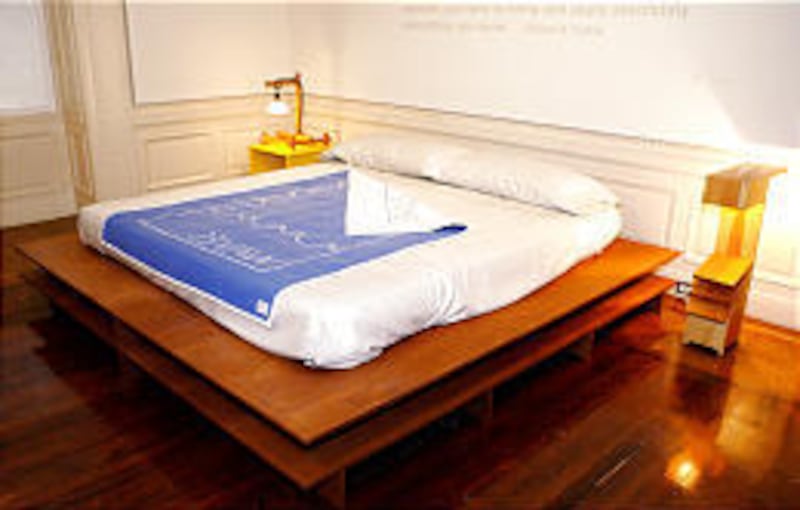
Where Louise Carnegie once slept in a canopied bedstead, now stands a low-slung platform bed designed by the iconoclastic Donald Judd.
A metal side table by Scott Burton replaces her ornate makeup table. A chaise lounge in unfinished poplar and a cylindrical chandelier of blown glass and wrought iron by Richard Tuttle complete this bedroom ensemble.
Such ultra-functional furnishings would have shocked Andrew and Louise Carnegie, whose decorating tastes ran to plush Victorian in their 1902 mansion on upper Fifth Avenue, now at the Cooper-Hewitt, National Design Museum.
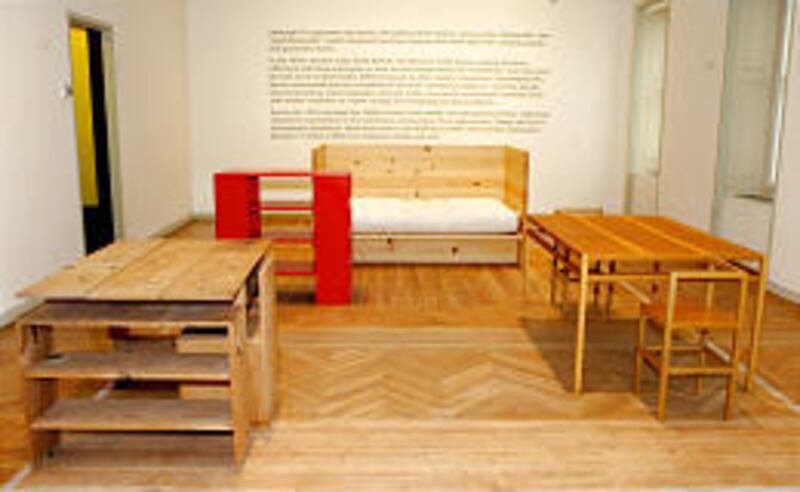
In these Georgian-style rooms still covered in rich wood paneling, the museum is presenting more than 80 contemporary design works — furniture, lighting, rugs and table settings — by 18 prominent artists of the minimalist and post-minimalist movements.
"Design-Art: Functional objects From Donald Judd to Rachel Whiteread," is billed as the first by an American museum to feature these little-known household furnishings by major artists. The show runs through Feb. 27, and Cooper-Hewitt is the show's only venue.
Sol LeWitt, James Turrell, Isamu Noguchi, Robert Rauschenberg, Jorge Pardo, John Chamberlain, Barbara Bloom, Richard Artschwager, Dan Flavin and Robert Wilson are among the artists represented.
Highlights include LeWitt's boldly colored folding screens and coffee tables; Turrell's "viewing chamber" of basalt pottery displayed in a Shaker-style cabinet; Rauschenberg's tire lamp; Noguchi's Akari light sculpture; Artschwager's folding "chair/chair;" Bloom's "Lolita Rug;" and Chamberlain's foam couch covered by a parachute, with an accompanying video showing him carving the piece from a bloc of urethane foam.
Curators Barbara Bloemink and Joseph Cunningham say the show aims to broaden understanding of all the artists' collective works and show the intersection of art and design at a time when boundaries are increasingly blurred.
"A pejorative attitude toward design as a superficial decoration was prevalent for most of the 20th century," Bloemink writes in the richly illustrated exhibition book. "As a result, many artists did not publicly acknowledge or exhibit their more functional, pragmatic furniture and design objects unless they were incorporated as part of an artwork or installation."