

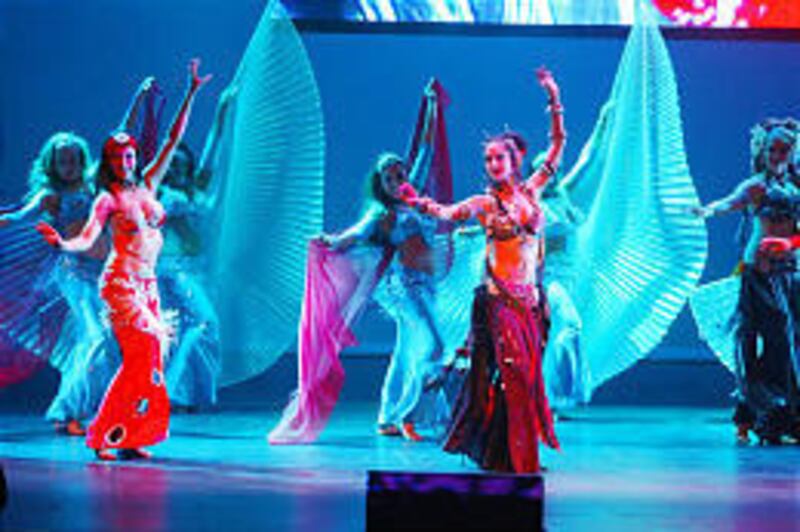
Miles Copeland has a knack for helping struggling artists break into the mainstream.
He did it when he managed the Police, the Bangles, R.E.M. and Wishbone Ash. And now he's doing it with the Bellydance Superstars.
Belly dancing? Well, yes.
But it's not like it was when Copeland was trying to get the Sex Pistols in working order — back when disco was the king of the airwaves in the late 1970s. Here, Copeland has an edge: Belly dancing is very popular in this country.
"There are belly dance schools all over the United States," Copeland said by phone from his office in Los Angeles. "It's used in health clubs, and people are catching on. In fact, belly dance is more popular here than it is in the Middle East, its region of origin."
The older brother of former Police drummer Stewart Copeland, Miles Copeland said he took a trip to Cairo, Egypt, to do some research. He found that of all the belly dance accessories, costumes and music made and produced in Cairo, 98 percent were purchased by American businesses. "Only 2 percent were purchased from other countries. It blew my mind."
Copeland is no stranger to the Middle East. His father, Miles Copeland Jr., was a co-founder of the Central Intelligence Agency and was stationed in the Middle East, where the younger Copeland grew up. However, It wasn't until the younger Copeland resigned as manager for Police frontman Sting that he decided to look a little closer into belly dancing, "The whole thing was a long road. Sting was recording his album 'Brand New Day.' And he had a song called 'Desert Rose.'
"We recorded it with an Arabic singer, Cheb Mami. The record companies didn't want to release it as a single. But the public loved it and that forced the radio to play it."
The song was honored as Song of the Year at the 2000 Grammy Awards and was performed during the 2001 Super Bowl.
Copeland has seen the success and potential of Arabian music, even after the backlash of 9/11, and started up the Mondo Melodia label, which works with Arabian singers. "We used some belly dancers to promote some albums and we got a huge response."
So Copeland decided to created an experience that combined Arabian music with belly dancing — in much the same way that "Riverdance" combined Irish music and Irish step-dancing. "Before 'Riverdance,' Celtic music wasn't as popular as it is now. And that's what we're doing with Bellydance Superstars."
However, there have been some major headaches along the way. "It's been from both sides. First of all, the belly dance community was worried that I couldn't appreciate the aesthetic of the art form because I'm a rock-music promoter, manager and producer. The good people who loved and participated in belly dancing were worried that I was going to lessen the integrity of the art. And that I had named the troupe Bellydance Superstars. I got a lot of flak by people who asked, 'Who is he to rate how good they are?' "
Then Copeland added with a laugh, "The second challenge was that my colleagues thought I'd lost my mind. I called my contacts to promote this show and they were confused. I mean, here I was going from managing the Police and Sting to belly dancers."
But Copeland feels that he knows when something is good. So far the company has performed in 10 countries around the world and even did a show with last year's Lollapalooza. They have been invited to the Glastonbury Festival in England and will be going to France later this year. "We've also been working with the American Embassy to go to Cairo in April, 2006. This is the time when the Middle East and the United States need to bridge the culture gap."
The main choreographer and director of the Bellydance Superstars, Jillina (who uses no last name), said the performance is an eclectic mix of cultural influences. "We have the various styles of belly dancing, but also some Indian and modern-fusion pieces throughout the performance," said Jillina. "It is a two-hour show with an intermission. And we have different levels of dancing. So we make sure we have works that challenge each dancer."
Jillina started dancing ballet and jazz as a child, and she became enamored of belly dancing in her teens. She still takes annual trips to Egypt to study her craft, and she wants to share her education with audiences around the world. "What we do is educational as well as entertaining and artistic," she said by phone from her studio in Los Angeles. "We have different levels of dance throughout the program, so there is something for those who know belly dance and those who have never seen a performance before."
If you go
What: Bellydance Superstars & the Desert Rose
Where: El Kalah Shrine Temple, 650 E. South Temple
When: Thursday, 8 p.m.
How much: $25 and $30
Phone: 801-364-4421
Web: www.bellydancesuperstars.com
E-mail: scott@desnews.com