

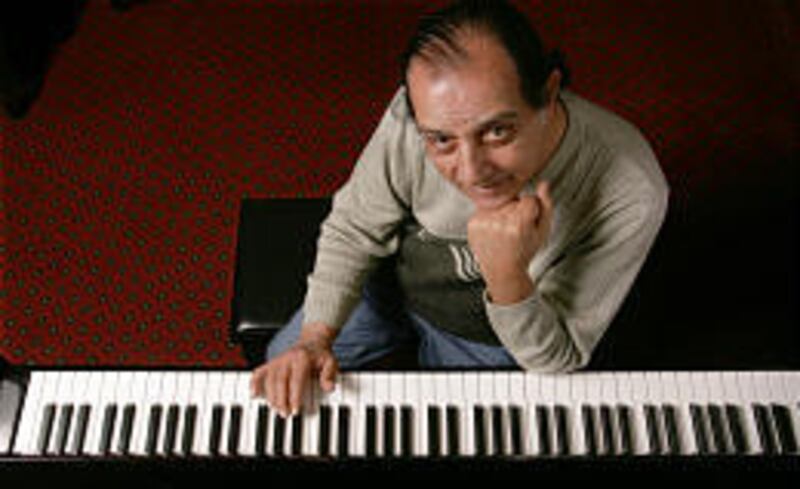

PARK CITY — While mentioning the historical fact that his homeland is where the wheel and algebra were invented, Samir Peter's brown eyes sparkle as much as they do when the so-called "Liberace of Baghdad" tickles the ivories in a sweet melody for a beautiful woman.
But fast forward the topic a few thousand years to modern Iraq, and Peter's patriotic pride quickly turns to disgust and sorrow.
Ask him about Saddam Hussein and he accuses the fallen ruler of robbing the citizens and ruining the country. Ask him about the U.S.-led coalition liberating Iraq and he reserves his thanks, lamenting instead what's happened since the dictator was captured and freedom was supposedly won. And ask him about the impending national elections and his answer reflects the pessimistic view that hype outweighs hope.
Now 56 years old and the subject of a Sundance Film Festival documentary, Peter was once the most popular pianist in Iraq — well-known for his Western-style musicianship, his fondness of romancing women (even during marriage) and living the high life (a $10,000 monthly salary, fast cars, big house, fancy clothes). Those were his "wild Liberace days."
But his Western preferences got him in trouble with Baath Party authorities, and the once-famous musician saw his livelihood reduced to entertaining journalists, contractors and mercenaries in a Baghdad hotel.
When Peter's fame was really rising in Iraq a few decades ago, he was forced to join the army and fight Iranians. His talented hands became war weapons, and in the film "The Liberace of Baghdad" he recalls painful memories of slicing an enemy's throat open with a knife in hand-to-hand combat.
"I was drafted in the army. I became a killer instead of a musician," he said this week at a Park City cafe.
The BBC's Sean McAllister came across Peter shortly after Saddam had been captured. The documentary filmmaker was hoping to do a movie about Iraqis' post-Saddam lives when he found his great story singing and smiling behind the hotel piano.
McAllister spent the next eight months — from January to August 2004 — being Peter's shadow, following him to his bricked-up hotel room, going on nerve-wracking treks to his seven-bedroom mansion across Baghdad where his family lives, accompanying him to scenes of bombings and a blown-apart palace. He experienced the joys of homecomings and the horrors of finding out a neighbor had been killed for being too friendly to foreigners.
The film gives an intimate look at how one man is trying to escape from and cope with his hellish environment. Peter's corner of Iraq is now a place where gunfire and bomb blasts are heard as often as his tunes, and where tanks are as common on the streets as Volvos. It's also a place where citizens who once loathed Saddam ask themselves if they wouldn't be better off with him back in power.
Not unlike many Iraqis, Peter loves America but also blames his dream home country for helping to cause the chaos it was supposed to calm. Now his native land, he says in broken-but-good English, is a "nightmare," "like a zoo" and similar to "a disco without a doorman." By that, he's referring to unguarded, porous borders where so-called "resistance" fighters easily smuggle in explosives and new recruits.
He certainly doesn't want U.S. troops to abort the mission, but he thinks they've made some serious mistakes and need to clamp down on who's coming and going.
As for his family, most of them are out now. He has two daughters living in America, and he's paying for his son to stay in Jordan until they see how the election plays out.
"I think the situation won't be stable for another 10 years," Peter said. "It will be civil war if the Americans leave. Everybody's armed."
The proliferation of weapons is one part of the now-normal Iraqi lifestyle filmgoers learn about. In one scene, Peter's son fires a pistol into the air before entering the front door of their house as nonchalantly as a duck hunter on opening day.
Later, the concerned father admonishes his 34-year-old daughter to not leave home unarmed, causing her to laugh and say, "Where are we, Chicago?"
"It is worse than Chicago," Peter said this week between Sundance screenings. "At least you know who's going to shoot you, who's going to kill you. (In Baghdad) you don't know who your enemy is."
McAllister became so concerned for himself and Peter's family he bought them a Kalishnikov automatic rifle for protection. The process took all of two hours.
Peter's concern grew larger as his relationship with McAllister grew deeper, eventually leading to the Brit's departure and the end of filming. Peter was forewarned by a child at the market that foreigners were about to be kidnapped for ransom, and, sure enough, several of the filmmaker's colleagues were abducted soon after.
The two were recently reunited — and Peter received a two-month visa — just in time for Sundance.
Peter said he agreed to do the documentary because he sees this as his "one last adventure in life," something he hopes will get him closer to reaching his lifelong goal: finding fame and fortune in America.
"My story — nobody knew it," Peter said. "My work was almost stopped (because of Saddam). I want to make my voice reach everywhere."
This film experience has rekindled his hope, and he's already found some of the fame he desired. He's become something of a festival celebrity: People stop him on the street and talk, women ask for his photo, he signs autographs, plays the piano at bars and for audio sound bites, conducts one interview after another and is scheduling concerts and screenings.
For now, Peter only has a non-immigrant visa, so he'll tour the United States for a couple of months, visit daughters in San Diego and Phoenix and return to Iraq until he gains approval for permanent residency here.
"I want to be famous," he said. "I think I'd be very successful."
Peter doesn't at all regret being in Utah, far from Iraqi voting booths, during his country's monumental election.
"I don't believe in this vote. The people who are (running), they don't deserve it," he said. "It doesn't make a difference."
Most candidates are running simply to get money to escape, he believes. And other worthy ones aren't trying because by doing so they'd have an enormous responsibility and an even bigger target on their back. And though he certainly doesn't want Saddam back in charge, he believes the country needs a powerful presence like the former dictator to seize control of the unstable and unsafe situation.
Peter thinks the Americans did Iraqis no favor by showing photos of Saddam's dental checkup and court appearance. That only gave the tyrant sympathy and has led to further discord. The best solution, in his opinion, would have been to execute Saddam (whom he once performed for). Instead, insurgents have risen from the dust and continue to kill innocent people and spread fear like wildfire.
"They (U.S. authorities) made the people of Iraq feel sad for him (and want) to help him," he said. Added McAllister: "They took it personally."
Peter's daughter, Sahar, is among those who are sympathetic toward Saddam. She says Peter has a movie-star-like persona and charisma. He playfully snapped at her in the film, telling her to "shut up, this is going to be on the BBC."
Peter never dreamed it would also be on in America — where his personal dream is finally becoming reality. He can thank Robert Redford for that. His only two problems in Park City: After eating a bacon-and-eggs breakfast, he joked that he's getting fat from American food, and he's being run ragged doing all the festival festivities and fanfare.
"I'm enjoying it too much," Peter said. "It's something unbelievable."
E-mail: jody@desnews.com