


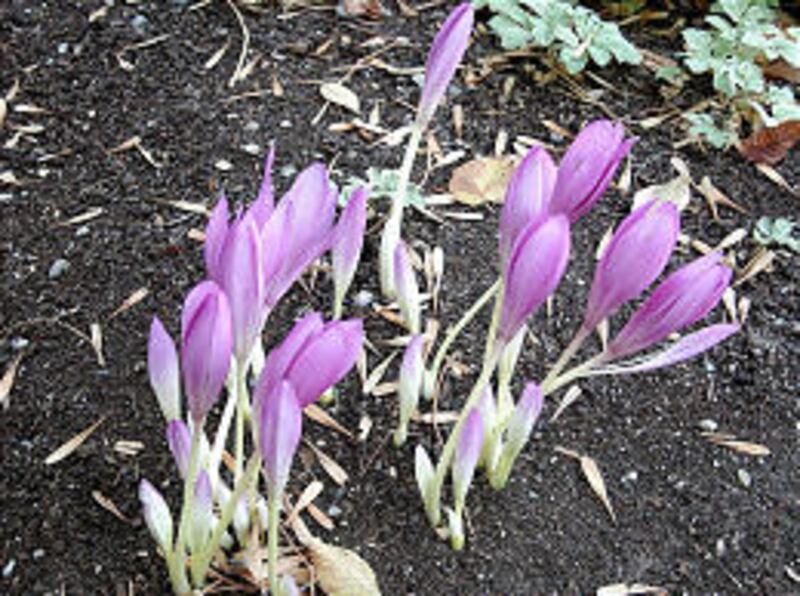
Poking around in my garden this week, I found a less-common plant in full bloom. Under some rather robust perennials were clusters of delicate pink/lavender flowers that almost looked out of place in the fall garden.
This flower, which is often confused with other similar-looking flowers, has a rather unusual and most distinctive style of growth: In the spring, it has abundant foliage that dies back, leaving no evidence of where the plant is growing until the flowers appear in the fall.
So what did I find growing in my garden? It was colchicum.
Colchicum is often called many things, including "autumn crocus," "naked lady" or "meadow saffron" — but the plant is not crocus or naked ladies or saffron.
This is one time that a correct name is critical, because while the other plants are edible, colchicum is poisonous.
Crocuses are from the iris family, and colchicum is a member of the lily family. Although it's hard to tell the two corms apart, the flowers make it easier. Colchicums have six stamens, while crocuses have only three.
The extreme toxicity of colchicum was established in ancient Greece, but in the fifth century, herbalists in the Byzantine Empire discovered it had some medicinal qualities. The plant was used to treat rheumatism and arthritis; Arabs began to use it for treating gout. The active ingredient, a toxic alkaloid called colchichine, is still used to treat gout and has anti-cancer properties. A word of warning: Never attempt self-medication with this — or any other — plant.
Less than two grams of colchicum seeds is enough to kill a child, and no specific antidote exists, so never grow the plant where children might come in contact with it. Poisoning symptoms occur two to five hours after the plant has been eaten and include burning in the mouth and throat, diarrhea, stomach pain, vomiting and kidney failure. Respiratory failure and death often follow.
Colchicums grow from corms that originated in Asia Minor and Europe. They are hardy to at least 10 below zero, so they will grow without problems in all areas of the state, although in colder areas you might want to cover them with mulch.
Plant the elongated corms this fall in groups of three, about 4 to 6 inches deep in well-drained soil with plenty of compost. Occasionally, they flower the first autumn, but most of the time they start by sending out large clusters of white roots. During the spring, the plant will send up clusters of leaves. Don't ever cut the leaves off, because the corms rely on the leaves to make enough energy to produce flowers the following autumn.
Once your colchicums are established, each corm divides and increases yearly, like daffodils. When clusters of flowers begin to look too congested, divide the plants. If you have existing clusters, divide them just after the flowers die back. Dig up the whole plant a few inches away from the flowers to avoid slicing the corms.
One of the most exciting ways to use these plants is in naturalized or woodland areas. Planting colchicum autumnale in drifts is ideal because these plants will increase several fold in just a few years. This variety is the easiest to find in most garden centers, but you may need to look for other varieties in specialized nurseries.
Try planting them with anemone nemorosa, aubrietia, arabis and lacy ferns. Fern leaf peonies, bleeding hearts and other spring bloomers also are excellent companion choices.
Do not crowd the colchicums, as they need room for the foliage to grow. The syncopated rhythm of the spring and fall bloomers will add to the year-round interest of your gardens.
Recommended varieties of colchicum in Utah
C. Waterlily — The most common colchicum with double pink blooms. The variety is free flowering and easy to grow, but the heavy flowers droop.
C. E A Bowles — This variety features larger cups and is named after a colchicum authority.
C. Attlee — Large single-flowered variety has rosy-pink blooms with large white centers that creep up the inside of the petals.
C. The Giant — Huge lilac-pink cups on sturdy stems; it multiplies quickly in rich soil.
C. Lilac Wonder — Pinkish-lilac flowers.
C. Conquest — Violet flowers.
C. Violet Queen — Purplish-mauve flowers and a white center.
Larry Sagers is the horticulture specialist for Utah State University Extension at Thanksgiving Point.