


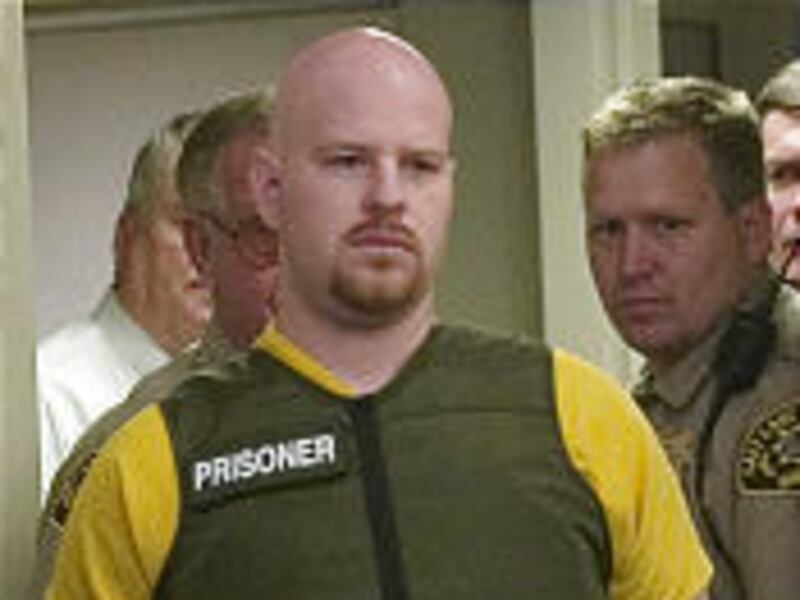
Mark Douglas Hacking murdered his pregnant wife and dumped her body in the trash. Becky Lynn Peacock shot her husband to death during a fight in their kitchen. Roger Martin MacGuire gunned down his ex-wife and her unborn baby in the office where she worked.
All terrible crimes that produced criminal charges.
But instead of going through a trial with a jury, witnesses and evidence presented in court, all three cases end up with a legal resolution that has become a staple in American courts: plea bargains.
Hacking and MacGuire got prison terms, while Peacock's prison term was suspended, and she was ordered to serve a year in jail.
Plea agreements produce mixed reactions from victims: mostly resignation, sometimes satisfaction and, occasionally, outrage. Many prosecutors and defense attorneys say plea arrangements are essential.
"The system is really designed around plea dispositions," said Davis County Attorney Mel Wilson, noting that his office handled about 2,600 felony cases last year and nearly all were resolved through pleas. "If you tried every one of those cases, even if they averaged less than a day per case, you'd never get through them all. Plea dispositions are a necessary and important part of our system."
There are no solid figures for negotiated plea bargains nationwide. However, 95 percent of the felony convictions in state courts nationally were obtained through guilty pleas entered by the defendant, according to a 2000 report by the Department of Justice's Bureau of Justice Statistics.
In Utah, prosecutors and defense attorneys, with support from their client, agree on what a plea agreement involves, and that often includes sentencing recommendations to the judge. Then it must be accepted by a judge before it is official. Prosecutors consult victims on what a plea agreement entails and consider their input, although victims do not have the ability to veto a plea.
While some crime victims breathe a sigh of relief at not having to go through a trial, others struggle with the idea that someone who commits a serious crime gets to cut any deal, no matter what the outcome.
When Elliott Rashad Harper earlier this year agreed to a plea bargain and went to prison for up to five years for his role in killing a man in Woods Cross, most of the victim's relatives seemed relieved the long-running murder case was over.
But at least one person found the plea agreement troubling.
"Both parties are supposed to benefit, and I don't understand what the prosecution gained from it, but I certainly understand what Elliot Rashad Harper got from it," said Rachael Whicker Lindsey, sister of the murder victim, Matthew John Whicker.
Mark Hacking's plea bargain produced a sentence of six years to life in prison — with the possibility of getting parole sometime in the future — for killing Lori Soares Hacking and dumping his pregnant spouse's body in the trash.
Eraldo Soares, Lori's father, was appalled that Mark Hacking could ever get the chance to gain his freedom.
Soares has vowed to attend all Board of Pardons hearings to urge the board to keep Hacking behind bars forever. Soares has also lobbied the Utah Sentencing Commission to recommend that the state Legislature change Utah law so a first-degree felony murder sentence would be 15-years-to-life instead of the current five-years-to-life. (Hacking got an extra year because he used a weapon while committing the crime.)
Weighing benefits
Prosecutors say there are certain times when it's better for victims to work out a plea than go through a trial.
Salt Lake County District Attorney David Yocom said there are situations such as particularly heinous sex crimes, often involving children, where a trial would hurt the victim even more. "You get counselors who say, 'This child would be further damaged by testifying in court.' You try to resolve it with what's fair."
That could result in a sex offender pleading to a lesser charge, but for Yocom the overall benefits may outweigh the value of a trial. "Even though the defendant may not do a long time in prison, that person is a registered sex offender, and that has some benefit to society," he said.
"Practicalities have to come into play," Yocom said.
Prosecutors need a reasonable likelihood of winning a case at trial before embarking on a plea agreement, and that often is affected by things beyond their control, such as a witness not testifying at a preliminary hearing the same way he or she was reported to have described a crime in the original police report.
"We use plea agreements to dispose of it in a fair way — fair to the state, fair to the defense," Yocom said. "Our objective is not just to get convictions but to get justice."
The prevalence of plea bargains in most criminal cases is not always a good thing, especially for low-income defendants, according to Jack King, director of public affairs for the National Association of Criminal Defense Lawyers.
"About 80 percent of the people charged with a crime cannot afford a lawyer and have to rely on public defenders or the indigent defense system, which is underfunded. People don't get the kind of service they deserve — they will be convinced to take a plea deal even when they're innocent because the system can't handle the innocent people passing through it," King said.
Veteran Salt Lake defense attorney Stephen McCaughey disagrees.
"I don't think that's true," he said. "Public defenders get badmouthed, especially by their clients, but I have not seen a lot of instances in which people have been railroaded into plea bargains."
He sees plea agreements as a necessary tool that keeps the criminal justice system working as it should.
Doing justice
Do plea bargains produce justice?
"What is justice? I think so. Everybody has to agree — the prosecutor has to agree, the defense attorney, the judge. These are three people who know the case better than anybody else and they're a check and balance on each other," McCaughey said. "You can always point to cases that don't do justice, but you can get that with cases that go to trial, too."
As a defense lawyer, he's also mindful that defendants who go to trial and are convicted end up with longer sentences than those who enter into plea bargains.
At times, defense lawyers encounter clients who stubbornly refuse a plea bargain even though the facts in the case look like they will almost guarantee a guilty verdict from a jury.
"When you get clients like that you just have to try the case. It is easier to try the case than to reason with some of these guys, although most of them will listen to you," McCaughey said.
McCaughey represented Trovon Donta Ross, who was convicted at a jury trial of killing his ex-girlfriend, AnnaLee Christensen, in a capital murder case. The case was heading into the second phase of the trial where the jury would decide whether Ross was sentenced to death or prison, with jurors seated and ready to hear the arguments on both sides.
At the last minute, Ross agreed to a plea bargain of life in prison with no parole.
"That's a good example of a plea bargain that went well," McCaughey said. "I think they would have come back with the death penalty."
McCaughey also is happy that Davis County prosecutors were receptive to a plea so late in the game.
"I was amazed they were good enough to keep that open," he said. "Most state prosecutors are pretty reasonable. They're tough but they're reasonable."
E-mail: lindat@desnews.com