


More than half of cornea transplant patients need surgery because of eye diseases or conditions that lend themselves to a new, less invasive technique that doesn't require stitches, speeds healing and preserves the cornea's strength.
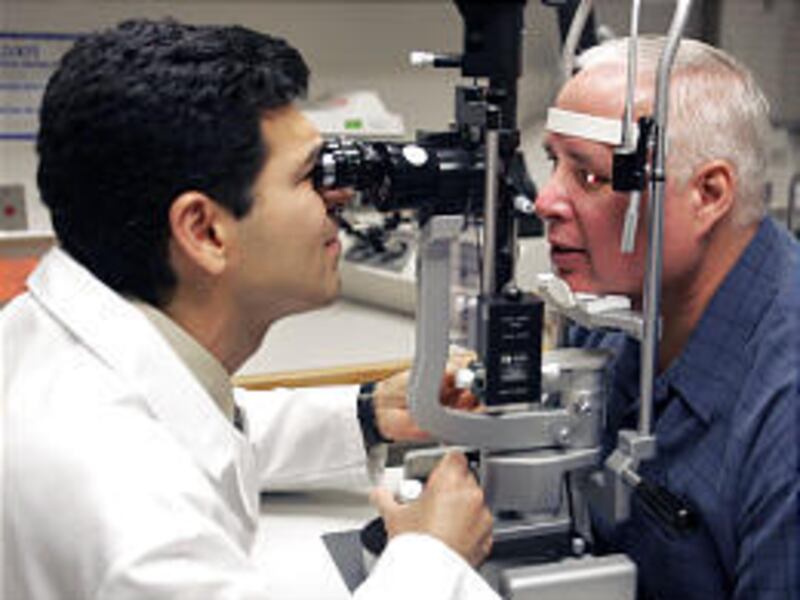
Dr. Majid Moshirfar, ophthalmologist at University of Utah's Moran Eye Center, performed the first Utah surgery using a new, stitchless technique a week ago. Just a few days later, his patient, Allen Maxson, was happy about the differences between the new operation and traditional cornea transplant surgery.
Maxson has had both types of cornea transplants. And there's no contest, he said.
The procedure, called DSEK, takes about half the time — 45 minutes — compared to traditional cornea transplants. Moshirfar believes soon it will be so refined it will take about 15 minutes. Afterward, patients don't usually need a rigid gas permeable contact, a staple of traditional surgery because of the changes that result from the stitches.
The cornea is not removed and a new one sewn in, so healing is faster. Without stitches, discomfort is lessened greatly. And it takes days or weeks, rather than months, to see the improvement in vision, Moshirfar said.
Right now, about 138 patients are on the waiting list for cornea transplants in Utah. About three times that number are transplanted annually in the state.
About 55 percent of cornea transplant patients have endothelial diseases, and it is those patients who are candidates for the newer sutureless surgery. Babies are born with about 4,000 endothelial cells in the back of their corneas, and that layer is responsible for the "clarity of the cornea, the pristine luster," Moshirfar said. With age, as many as half those cells are lost. People with endothelial diseases lose even more. And the condition can't be corrected with glasses or contacts. The cornea has to be replaced.
With DSEK, Moshirfar removed only the endothelial layer of the cornea. Through a tiny 2 millimeter incision, he removed the endothelium, preserving the rest of the cornea. Then an endothelial layer of the donor cornea was folded in half and slipped through the incision, where a very small air bubble was added. The bubble acts as a spacer that helps the new layer unfold and attach to the patient's cornea, then dissipates within a few days.
While younger patients may see well after traditional cornea transplantation, older patients may have challenges, including safety issues, Moshirfar said. Some simply can't tolerate the load of surgery. That individual may have already had cataract surgery, be on a blood thinner and have a cornea that has "decompensated." They're more prone to falls and bumping the eye, damaging the transplanted cornea.
Eye specialists sometimes tell such patients they'll have to live with it. "Nobody is too old to see," Moshirfar said. "That's ridiculous. My thinking is, let's come up with a better way. Why not offer good things to patients?"
After a month, the patient is about where he would be five months into recovery from traditional cornea surgery, he said.
This past week, Maxson's vision was about 20/70. Had his eye not been dilated, it would be closer to 20/40, Maxson was told.
"We couldn't get that in my right eye after (traditional) surgery for at least six months, and that was with corrective lenses," Maxson said. After his first cornea transplant, he had a succession of lenses to reach a good level of vision, which took about 2.5 years. And with the stitches, he always felt like he had eye lashes poking his eye, he said.
At the end of the DSEK surgery, he saw the doctor waggle his fingers, a milestone that took two months with the other eye surgery.
Maxson inherited Fuch's corneal dystrophy, one of the endothelial diseases. He was told he'd be blind. A state tax collector, he went to the Murray B. Center for the Blind and learned cane travel and started using adaptive technology for his computer so that he could continue to work. But blindness seemed inevitable. Four years ago, he went to see Moshirfar, who offered hope in the form of a cornea transplant.
"Don't be discouraged; we'll get through this," he recalls Moshirfar saying.
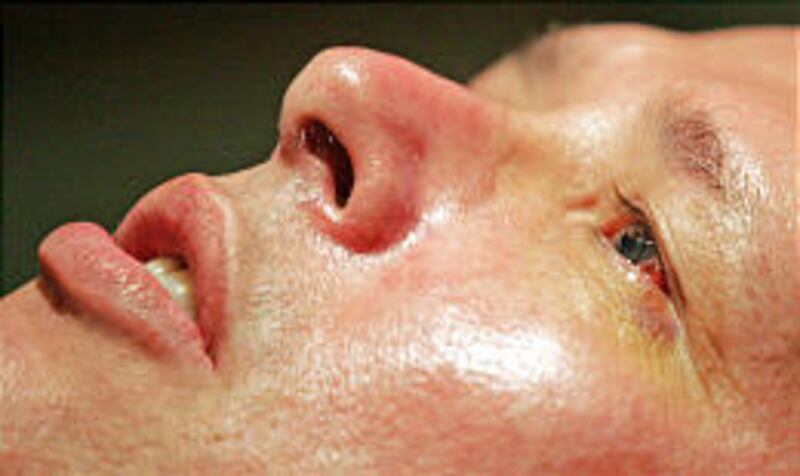
The latest surgery wasn't pain free; he feels a little discomfort in the slit in his eye, he said. But when he looks at something close up, even the cloudiness is gone.
E-mail: lois@desnews.com