



- 18 new wildfires erupted across Utah over 24 hours from Thursday into Friday.
- At 72,000 acres, Cottonwood Fire was the largest wildfire in the nation.
- Response to the fires has already cost the state $20 million.
The Beehive State is ablaze.
A record wildfire year accelerated on Friday with 18 new outbreaks over the previous 24 hours.
On Thursday, Utah Gov. Spencer Cox took the unprecedented step of prohibiting fireworks statewide for the 250th anniversary of the United States of America amid what he called the worst wildfire conditions in living memory.
Cox’s executive order creates a state of emergency, allowing him to suspend the enforcement of existing fireworks statutes so the state forester can ban fireworks within city boundaries from July 2 through July 5.

The order permits mayors to work with fire officials to designate limited safe areas for fireworks. This reverses current code, which empowers city councils to restrict fireworks only in certain “wildlife-urban interface” areas.
In a statement to the Deseret News, Cox clarified that once the statewide ban is in place, city leaders are free to lift the restrictions in coordination with their local fire chief — potentially eliminating restrictions entirely.
“Some are spreading a narrative about removing local control that is completely untrue,” Cox said.
“City officials have complete discretion to manage fireworks within their jurisdiction, including completely removing any restrictions imposed by the state forester. Saying otherwise is disingenuous.”

The order has upset some local officials, who accuse the governor of encroaching on local authority with a one-size-fits-all approach that threatens to upend July 4 celebrations in communities with low risks of wildfire.
Other cities thanked the governor for taking aggressive action to prevent Utah from becoming a site for the kind of suburban wildfires that razed entire neighborhoods in Hawaii in 2023 and in southern California in 2025.
Utah wildfire update
The official tasked with upholding the fireworks ban throughout the state is Forestry, Fire and State Lands Director Jamie Barnes. The decision was difficult to make, she said, but it is not a ban on Independence Day.
“We want people to know that we want them to celebrate the Fourth of July,” Barnes told the Deseret News. “We want to celebrate it also. But celebrating it through starting a wildfire isn’t a celebration.”

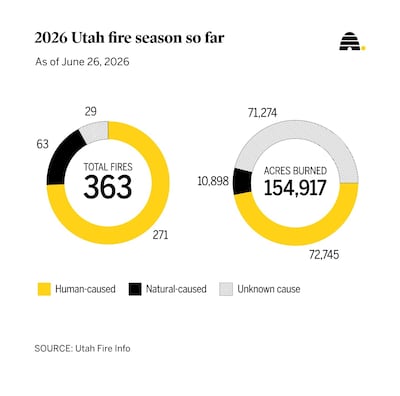
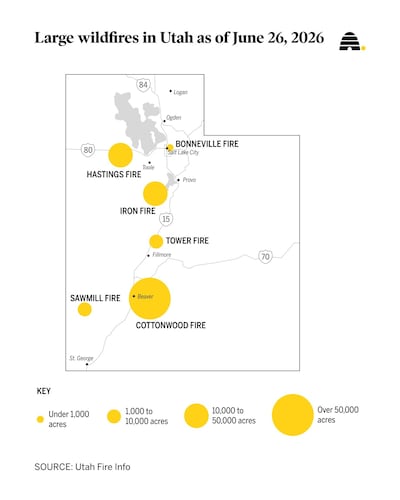
The state is currently host to several large wildfires, including the largest in the country, the Cottonwood Fire in Beaver County. So far, around 370 wildfires this year have burned 155,000 acres, costing $20 million to fight.
Environmental factors — including severe drought in all counties, the hottest March on record and the lowest snowpack in history — created the perfect conditions for wildfires, 80% of which have been human-caused.
And it might only get worse.

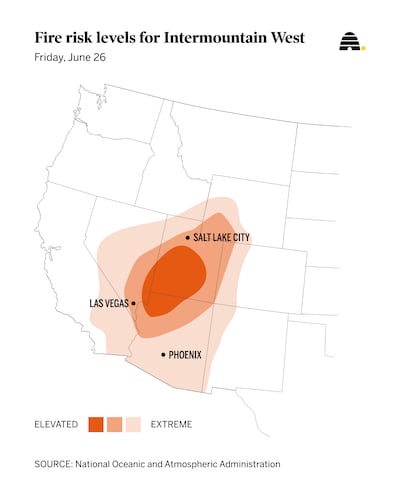
The Salt Lake City office of the National Weather Service issued a particularly dangerous situation, PDS, red flag warning for parts of central and southern Utah on Thursday evening — for the first time ever.
Hot temperatures combined with wind gusts of up to 50 mph are expected to strengthen wildfires, like the Cottonwood Fire, which has burned around 72,000 acres, including several family cabins, and is 0% contained.
Multiple new fires in Juab, Millard and Sanpete County were reported on Friday, while the Bonneville fire above the University of Utah came under control this week after coming within 100 feet of the Huntsman Cancer Institute.
Could Utah become the next Palisades?

Ahead of what many expected to be the biggest July 4th celebration of their lifetimes, these drastic conditions persuaded state officials to flip the default policy statewide by enacting a blanket ban on fireworks.
Before making the decision, Cox consulted with the League of Cities and Towns, including its former president, Draper Mayor Troy Walker, who said he supports the order because without it cities could not restrict fireworks in most places.
“A giant chunk of my community is in the perfect situation should we have some type of catastrophic event where you could burn a neighborhood down like Palisades, California,” he said. “I’m gonna err on the side of absolute caution.”

Thousands of Draper homes up against the mountains are at risk, Walker told the Deseret News. Fireworks, he said, “aren’t essential to the celebration of the birth of the United States.”
Unlike guns, there is no 2nd Amendment preventing regulations on fireworks, Walker said. He believes Cox’s order makes use of his executive authority in a very “limited and a very deliberate, precise manner.”
Is the fireworks ban worth it?

On Thursday, Cox told reporters the fireworks ban wasn’t about politics. “It’s about protecting lives.” But some city officials feel the precautionary measure crossed political boundaries by using a problem to remove local control.
State law already let city councils prohibit fireworks in dangerous areas, according to Riverton City Council member Andy Pierucci. Riverton already did this in concert with local fire authorities, he told the Deseret News.
Thanks to the order there is now a new process that overrides city ordinances. Pierucci believes this is unwise because rural towns in Beaver have a much different “risk calculus” than urban areas in Salt Lake County.

“The Fourth of July is a holiday where our ancestors thumbed their noses at government,” he said. “It’s kind of a joke to assume people are not going to once again thumb their noses at government and light off fireworks to celebrate.”
One lawmaker believes the order may have the opposite of its intended effect.
Rep. Matt MacPherson, R-West Valley, owns PyroCrate Fireworks. In addition to hurting sales at businesses like his, MacPherson said the order could push Utahns to light the fireworks in secluded areas instead of their sidewalks.
Legislative leadership initially suggested that the governor use an order to expand cities’ ability to create restricted zones — instead of implementing an all-out ban, with limited options to sanction safe zones, he told the Deseret News.
The order reminds MacPherson of COVID-19 restrictions that failed to balance economic freedom with public safety.
“They can justify pretty much any turning away from the founding principles of our nation ... if the emergency of the day warrants it,” he said. “And I just think that’s absolutely wrong, especially in light of America’s 250th celebration.”
What’s next for Utah wildfires?

As of Friday afternoon, the wildfire situation in Utah had deteriorated rapidly — with humidity falling, winds rising and evacuation warnings coming out for communities in Lofgren, North Creek, Marysvale, Junction and Circleville.
With conditions changing on a dime, state Sen. Kathleen Riebe, D-Cottonwood Heights, said she is glad the governor took “aggressive action.” Mayors in her district are asking for even more dramatic steps to be taken, Riebe said.
“Everything’s ripe for a disaster,” she told the Deseret News. “My mayors have reached out to me asking us to have a special session so that we could create a law or a stronger executive order. Our mayors are very concerned.”
While the legislature is not considering a special session, the governor said he would consider keeping the emergency declaration through Pioneer Day on July 24. In the meantime, Riebe said Utahns should avoid open fires and even cookouts.
But she recognizes Cox’s course of action is “super unpopular.”
On Thursday, Cox said he would not have instituted the fireworks ban unless it was necessary. The order will “go away” if the state has a wet monsoon season in July, he said. Until then, Utah homes will have to skip fireworks on America’s 250th.
Public displays of fireworks will likely move forward as planned.