

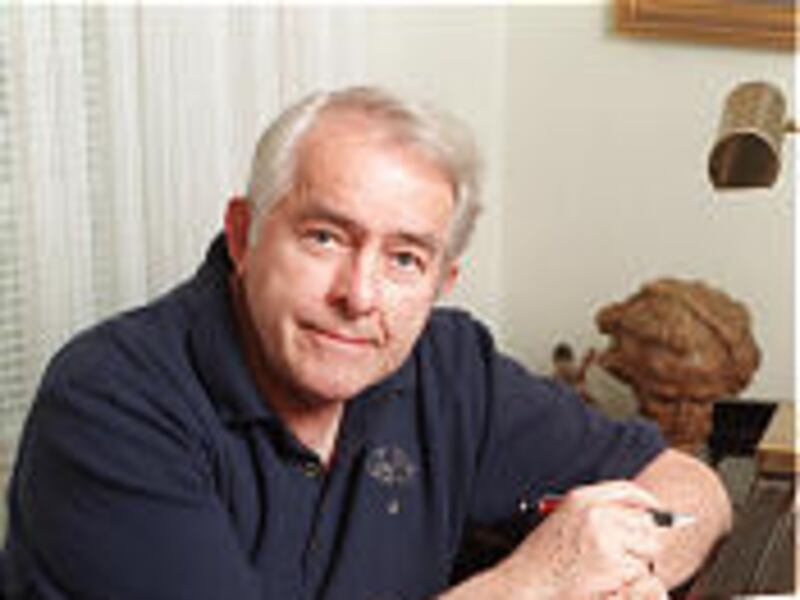
The contributions of Jay Welch provide evidence that one man can do a lot of good in his lifetime.
Among other accomplishments, the 80-year-old Welch has left a legacy of music with the Mormon Youth Symphony and Chorus, the Salt Lake Repertory Orchestra (now the Salt Lake Symphony), and his years of teaching at the University of Utah.
To some, Welch is best known for the Jay Welch Chorale — a musical entity that has changed conductors and names but is today known as the Utah Choral Artists.
On Saturday, under the direction of Brady Allred, the Utah Choral Artists will celebrate Jay Welch's life in a concert titled "Do You Hear What I Hear: A Tribute to Jay Welch." Former members of the Jay Welch Chorale, along with members of the Murray Symphony Orchestra, will join the choir in performing Christmas music and traditional favorites.
Welch's daughter, Megan Hayes, said that, as a young boy growing up in California, Welch wasn't much interested in music lessons. "His mother tried to teach him to play the piano, but it only lasted about three weeks. He was more interested in bugs, so she gave up."
When Welch was about 10, his mother couldn't attend an organ lesson and sent young Jay in her stead. "She never went back. He got to keep the organ lessons," said Hayes. "So that's how he started."
The boy showed early promise. Just two years after he started the organ lessons, he was invited to play for the governor of California, and just two years after that, he was accompanying performances of the Southern California Regional Ballet.
Following high school graduation, after World War II had broken out, he signed up for the Naval Reserve Officers Training Corps. As a young officer-in-training, Welch spent his time studying at UCLA, eventually graduating with a B.A. in mathematics.
Welch told the Deseret Morning News that he was chosen as valedictorian, but rather than making a speech, he played his own composition — a one-movement piano concerto, with the orchestra part played by the organist.
He received his military commission and served in the Navy until World War II was over. Then he was called on an LDS Church mission to France. "At the time he went on his mission," said Hayes, "it was close enough after World War II that they had to have a student's visa. He had to take a kind of lesson, and that's when he started studying over there."
While a missionary, Welch studied at the Geneva Conservatory of Music, receiving a diploma in organ. After he finished his mission, he stayed on and continued his studies at the Paris Conservatory of Music, where he graduated first in his conducting class.
Eventually, Welch boarded the Queen Elizabeth to sail home. En route, he met a fellow traveler, Darius Milhaud, the French composer. "We chatted and I told him I'd been at the Paris conservatory, but we hadn't run into each other. And he said that he was on his way to Mills College, that he alternated teaching one year at the Paris Conservatory and one year at Mills College in Oakland. I asked him if he'd like to take an aspiring composition student, and he said yes." (Welch explained that although Mills is a girls' college, it had 25 male graduate students enrolled who studied with Milhaud.)
After graduating with a master's degree in music from Mills College, Welch pursued a doctorate at the University of Utah. "Ahead of me, working on the same degree were Alexander Schreiner, Robert Cundick and Reid Nibley, and I became good friends with all of them." But he had finished only one semester when he was recalled into the Navy for the Korean War.
Welch did eventually come back to the U. and earned his Ph.D. in music while working as the "court composer" for the drama department, composing and conducting incidental music for U. theater productions. He eventually became a teacher for the U. music department.
Hayes says her father was one of the most popular teachers on campus — frequently named as "Outstanding Professor" and "Favorite Professor." In fact, his Music 101 class — taught in an auditorium that seated 400 students — had a waiting list of some 1,100 students per quarter.
In 1957, Welch became the assistant to Mormon Tabernacle Choir conductor Richard Condie, during which time he also put together a youth symphony and chorus. That evolved into the Mormon Youth Symphony and Chorus, and eventually became involved with two TV specials — "Gershwin Festival" (1973) and "Rachmaninoff Festival" (1974) — which were among PBS's most highly rated shows of those years.
When Condie retired in 1974, Welch became the choir's conductor — but only for six months. "Then I got sick. It got to be too much to handle. So I asked for a release and they gave me one."
Welch said that when he lost his health, he gave up almost all music for a time. But the music came to find him three years later as his health improved, when the orchestra conductor for Ballet West asked him to assemble a choir for a production of "Carmina Burana."
That choir, said Welch, came to be known as the Jay Welch Chorale.
If you go . . .
What: Utah Choral Artists
Where: Libby Gardner Concert Hall, University of Utah
When: Saturday, 7:30 p.m.
How much: $10
Phone: 581-7100
Web: www.kingsburyhall.org or www.utahchoralartists.org
E-mail: rcline@desnews.com