

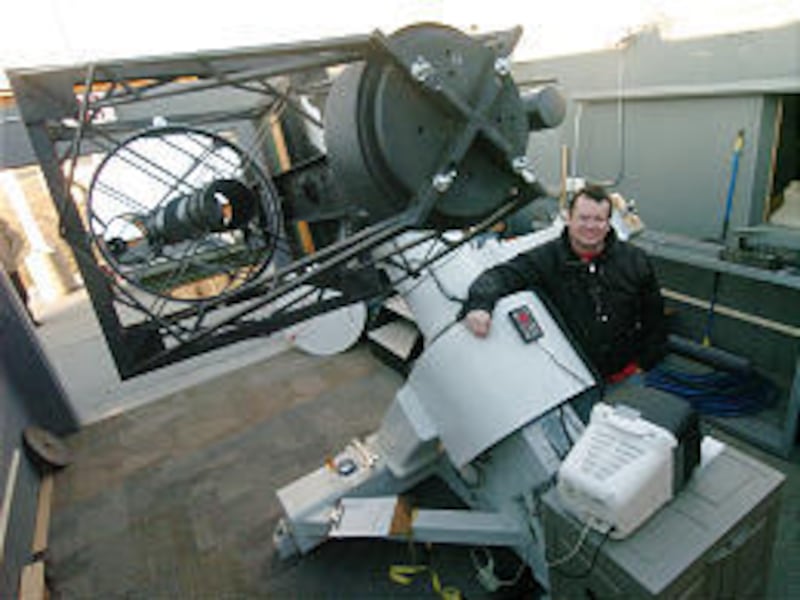

STANSBURY PARK, Tooele County — Utah astronomy entered a new era last week with the completion of the largest telescope in the state to be routinely open to the public.
The behemoth reflector, with a main mirror 32 inches across, is the result of several years of planning and work by volunteers from the Salt Lake Astronomical Society. Free star shows will be open to anyone interested in astronomy with 15 events scheduled in 2005 alone.
The telescope does not look like the spyglass design one might imagine. Its huge mirror is cradled in an open framework and celestial light bounces from it to two other mirrors, then into an eyepiece. A monitor beside the telescope shows live video of the view, taken from a separate lens attached to the telescope supports.
In the eyepiece Thursday night, the ringed planet Saturn floated in black space, surrounded by bright dots that were some of its moons. It was a bright, detailed, sharp image.
"I see at least four — five, six — of the moons, maybe seven," said Siegfried Jachmann, president of the amateur astronomy group, as he peered for the first time through the eyepiece. "Cassini's division is clear all the way around," he added, referring to the dark break in the rings.
"The shadow on the rings," Jachmann said, " — it's beautiful!" Saturn was casting a wedge of a shadow on its broad rings, adding to the spectacle.
Last December, Steve Dodds, owner of Nova Optical Systems, delivered the 2-inch-thick, 130-pound mirror to the society. It is housed in the new Harmon Observatory, Stansbury Park, which was built through thousands of hours of donated labor, tens of thousands of dollars worth of material and about $40,000 cash.
Titan, the large Saturnian moon on whose muddy terrain the European Space Agency's Huygens probe landed on Jan. 14, is easily visible in even small telescopes. But some of the little moons that showed up last week "are a struggle with small telescopes," Jachmann added.
Jachmann said it was a dream come true. "This group, led by Bruce Grim, has just done a fantastic job," he added.
"The word I'm going to use tonight is agog," said Patrick Wiggins, a NASA solar system ambassador to Utah and a member of the club who has worked on the project. "This is phenomenal."
Grim, the observatory director, noted that he studied the star cluster M-13, seeing "an excellent image" even though the darkness was not complete when he saw it.
"Excellent, outstanding," said Guy Malmborg. He was excited to see Saturn when it rose higher in the sky. "Really a nice job."
The tube assembly, which holds the telescope and allows it to slue to its targets, is about 9 feet long, said Grim.
"We built that," he said. "A steel company donated a good share of the steel to build it and contributions were used for the rest of it. A lot of the members donated some parts of the telescope. We had two drive gears . . . donated by club members."
The telescope setup is so nicely balanced that its two or three tons is easy to move by hand. "We have a fish scale, believe it or not, to pull on the axles to see whether or not it's balanced," Grim said. "We've got weight fastened on the declination axis to balance it in that direction," he said.
Weight in the back of the tube balances out the torque created by the length of the assembly.
Helping round out the system is a commercial "go-to" system, in which a computer controls a telescope so that it points to and tracks targets as they move across the sky.
Through the use of three mirrors and strategic placement of the eyepiece, the viewer need not move around the telescope. The image always comes to the same spot, regardless of where the telescope is pointing.
"The principle behind that is we have two axes that the telescope rotates around," Grim said. "If you locate the eyepiece right at the intersection of the axes, it's at a stationary point, basically. . . . It'll stay stationary while you look in, no matter which way the telescope is pointed."
Next up were the folds of dust fields and mysterious glittering stars of the Orion nebula. The light-gathering ability of the telescope was so great that some of the group, whose eyes were especially sharp, thought they had detected color in the vast nebula.
E-mail: bau@desnews.com