

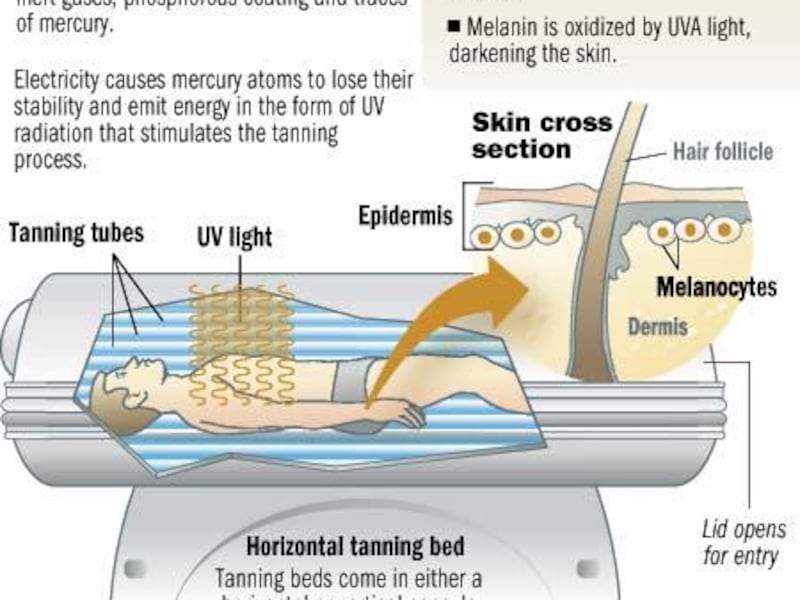

It's not shaping up to be a very sunny year for tanning salons, which have come under increasing criticism.
Now that scrutiny includes Utah County's Board of Health, which on Monday will consider whether to tighten the operating rules for public tanning businesses. The county has no plans to enact a ban but is taking public comment on what are mostly "housekeeping" issues, said Ron Tobler, director of the county's infectious disease division.
Earlier, the World Health Organization asked for a ban on the use of tanning beds by minors, a call that was joined last week by the American Academy of Dermatology.
A number of states and cities are starting to regulate who uses tanning beds, and others are considering it: A New York legislator plans to propose that anyone 16 and younger must be accompanied by a parent, and anyone 17 or 18 would have to have parental consent; Chicago's among cities looking at the issue.
The U.S. Food and Drug Administration already bans advertising that the beds are safe, because exposure to the ultraviolet rays can lead to skin cancer, Tobler said. It's not a device that can be rendered safe.
That's why national and international physician groups are calling on lawmakers to outlaw their use by children and teenagers.
Utah County's immediate goals are smaller. Officials hope to change the definition of what's exempt. Current rules exempt a private tanning bed in a private home that's used without compensation. But complaints came in recently about someone who was allowing anyone who wanted to to come in and use his tanning bed. The parents of a 14-year-old who'd done so objected.
The proposal would change the exemption to a bed in a private dwelling, used by the occupants of the home. That doesn't mean the county would come out and bother someone who let a good friend come over, Tobler said. "As long as she doesn't complain, we won't know and we don't care."
The proposal would address construction and operation of tanning facilities — requiring a thermometer in each room, for example.
It also requires new tanning facilities or any such business undergoing major renovation to install remote timers that are outside the tanning booth area. "The timers on most beds are nothing more than egg timers and they are prone to error and abuse," Tobler said. "A person on the outside should be controlling the duration."
Cleaning and maintenance requirements would also change. Most tanning booths are carpeted and not subject to a regular cleaning schedule, he said. "We've asked for a mat, like that under a desk, that can be cleaned. And when we do inspections twice a year, we can look at that mat and see if it is clean."
They also want a label on beds indicating the type of bulbs that can be properly used in it. A bulb compatibility chart would be posted in the room if the bulbs installed are not the one that came with the bed.
They want to reaffirm that an operator must be on premise if a tanning bed is in use.
And they ask that warnings be posted noting that tanning for pregnant women should only be done under a physician's guidance. A study in Europe has shown at least three cases of spina bifida caused by pregnant women tanning, Tobler said. While the ultraviolet rays cause the body to make vitamin D, they destroy folic acid.
Finally, the regulations would make it easier to close individual beds in a facility. Right now, the county operates under an all-or-nothing set of rules. "The only thing we could do if there's a problem is close down the whole place," he said.
E-mail: lois@desnews.com