




- The Centers for Medicare and Medicaid Services is ramping up attention to healthcare fraud.
- After Minnesota's scandal, the Trump administration targeted mostly Democratic states.
- Medicaid fraud usually involves providers, not low-income people trying to game the system.
Is Medicaid rife with fraud, as the Trump administration suggests? It’s a claim that was bolstered in late 2025 with news that Minnesota’s Medicaid program paid millions for fraudulent services including adult day care for people with disabilities, home health services and autism therapy, among others.
That discovery put new energy — and more headlines — into the search for Medicaid scofflaws.
The responsibility for ensuring program integrity day to day falls largely on states.
Experts agree that it’s “really hard” to measure if a state is doing well at catching Medicaid fraud. While every state receives federal funding for the healthcare program for low-income people and provides matching dollars, state procedures vary.
Some who work with Medicaid say the federal government could do more to elevate best practices and provide solid tools to catch fraud both before and after it happens. The federal government seems to agree.
Vice President JD Vance and Centers for Medicare & Medicaid Services administrator Mehmet Oz announced changes to Medicaid fraud detection earlier this month, detailing a 50-state workbook to promote best practices, and promised inquiries to all states about prosecution.
Funding to state agencies charged with fraud detection will be shut off if state procedures are deemed unsatisfactory, they said.
Medicaid fraud has made national headlines for months, starting in Minnesota, but while both Republican and Democratic-led states are included on the administration’s lists the Trump administration’s expanded efforts have a particular focus on states led by Democrats.
The administration said it won’t solely target blue states and the effort is bipartisan but that, “unfortunately,” most of the fraud happens in Democrat-led states.

Critics of the Trump administration’s hyper-focus on Democrat-led states said fraud likely exists in states led by Republicans, too, but may go undiscovered if the administration keeps its focus on blue states.
Those tasked with finding fraud in the program agree Medicaid providers, not Medicaid recipients, commit most of the fraud. They say waste is another money-eater that prevents people who need help from getting it.
What fraud is — and isn’t
In Utah, the Office of the Inspector General has a legal mandate to investigate problems with Medicaid, the goal to guard taxpayer dollars. Former interim inspector general Neil Erickson told the Deseret News that Utah’s biggest money problem with Medicaid is waste. In Utah alone, officials recently documented $24 million in unnecessary Medicaid payments. But it’s hard to get a national tally.
Fraud, he said, is “much less common.”
Most fraud, Erickson said, comes from those contracted to provide care, not from low-income people taking advantage of the system. And often it’s not fraud, but someone who needs better training on how to bill and how the program works.
Said Elise Napper, the office’s policy and training manager, “There seems to be a big perception that a lot of beneficiaries are out there defrauding willy-nilly. In our experience, the majority of the funds that go out tend to be related to a provider situation.”
Deliberate fraud by providers can include:
- Billing for services never provided or provided by someone who’s not qualified.
- Upcoding — claiming the provider performed a service that is paid at a higher rate than the actual service would have been.
- Taking pieces of a procedure that should be billed together and billing them separately to inflate cost.
The primary line of defense against Medicaid fraud is the state Medicaid agency and state law enforcement, typically Medicaid Fraud Control Units, said Andy Schneider, a Georgetown University Center for Children and Families researcher.
Often, attorneys general’s offices also investigate healthcare fraud but there’s wide variation. Utah, for example, also tasks its Office of Inspector General with investigating Medicaid fraud, while California has a Division of Medi-Cal Fraud and Elder Abuse that each year recovers money as part of the attorney general’s efforts.
Kaye Lynn Wootton, director of the Utah Medicaid Fraud and Patient Abuse division in the Utah Attorney General’s Office, is president of the National Association of Medicaid Fraud Control Units. She described different Medicaid schemes, some quite complex, and recently testified before Congress, outlining several types of fraud seen in multiple states.
Her list includes hospice fraud that enrolls patients who are not terminally ill. Patients may be recruited specifically to defraud Medicaid and taxpayers. A hallmark is a very long stay in care, followed by a live discharge because hospice services were never needed.
Some people do get better legitimately, defying expectations. “Maybe they’re actually providing great service, right?” Wootton said. “It takes a lot of expertise from nurses, auditors, investigators, attorneys to figure out what part is truly fraudulent and should be either prosecuted or handled civilly.”
“By the time a referral comes to our division,” she said, “people are viewing it as a credible allegation of fraud.”
Individuals commit fraud, but it’s rare

While far less common, individuals can take advantage of Medicaid, Napper said. Both income thresholds and asset limits can be falsified.
She noted a case where someone with insurance didn’t want to pay the copay, so he didn’t tell Medicaid he had insurance. That’s fraud. Medicaid pays only if no one else can be billed.
Deliberate fraud can include sharing an ID number so someone else receives services. That can also make medical records inaccurate and impact future care, among other challenges.
Fraud usually has a money motive, Napper said, and may create risk to an individual. Sometimes both. People are harmed if their provider isn’t qualified.
A news release from the Utah Attorney General’s office last October highlighted a case, noting the conviction of a former program director of a behavioral health company sentenced in a $13 million fraud scheme involving Utah Medicaid. Medicaid received more than 7,700 false claims for substance abuse treatments that didn’t happen or were not provided by qualified staff. Others have also been convicted in the case or have cases in the court system.
Transportation fraud is another category. Drivers may bill for what Wootton called “ghost rides,” where no ride was provided or the person on Medicaid was driven long distances for non-medical reasons.
Erickson said the Utah Inspector General’s Office has even seen cases where a relative refilled a prescription after the Medicaid beneficiary died.
Among those hurt by Medicaid fraud are people who qualify for Medicaid but are on waiting lists because there aren’t enough resources.
A small sampling of real cases that hurt individuals who were supposed to be served by the program:
- U.S. Assistant Attorney General Colin Michael McDonald said a Minnesota man with disabilities was supposed to receive constant care. Instead, he fell victim to a fraudster and died.
- Per Napper, people may lose access to a benefit because someone obtained their Medicaid information and used it, like by getting a vaccine or a procedure. If that benefit has been used, the person entitled to it can’t get it without a battle. It also creates an inaccurate medical record that could be nightmarish to fix.
- The Wisconsin Department of Justice cited a case where a private duty nurse received a suspended sentence, probation and a fine. She was charged with billing Medicaid for dates and times she was not at the patient’s residence. The nurse was charged with child neglect causing bodily harm because the child needed emergency treatment for dehydration and malnutrition. That child died.
- Wootton cited a Utah case where a woman used her power of attorney to drain her grandfather’s assets, forcing him onto Medicaid.
- Between 2016 and 2024, there were at least 710,000 people on waiting lists to receive home and community-based Medicaid services, KFF reported. Many states have waiting lists.
Napper said her office provides fraud, waste and abuse prevention training to Medicaid providers, helping them understand and comply with policies. The staff also looks into reports to their fraud hotline.
Training is especially important because the program is always changing. What was allowed at one time may no longer be and vice versa. “We wouldn’t hold a provider responsible for a policy that was in place a year later,” Napper said.
Utah’s inspector general can follow Medicaid dollars into adjacent agencies. And adjacent issues can tangle up and become Medicaid fraud.
Wootton said Utah’s fraud cases by Medicaid beneficiaries are handled through the Department of Workforce Services, with an assistant attorney general assigned. Her office looks at recipient fraud if it’s committed in collusion with a provider.
YouTube sensation sparks Medicaid frenzy

In December 2025, independent Utah YouTube journalist, Nick Shirley, now 24, posted a video looking into the allegations of billions of dollars in fraud in Minnesota. The video showed Shirley investigating Somali-owned healthcare companies and knocking on adult-daycare facility doors in the state. It racked up millions of views.
It caught the eye of Vance and tech billionaire Elon Musk, propelling Shirley to stardom. However, some of the claims in Shirley’s video have been disputed or remain unverified. The viral video likely fueled the heightened attention on Minnesota, but investigations there were already ongoing, as the Deseret News reported.
Scrutiny of Minnesota’s public services began during the Biden administration. In December 2024, the FBI raided two autism treatment providers and attention grew from there.
The U.S. House Oversight Committee last December began investigating Minnesota’s social programs, including Medicaid. A hearing was held in January — a tense time for all things Minnesota with federal officials conducting immigration enforcement raids, which resulted in protests and the deaths of two American citizens.
Vance, dubbed America’s “fraud czar,” had already been tasked with investigating fraud in Minnesota, but President Donald Trump signed an executive order in March creating the new task force. He directed Vance to look at social services and fraud nationally.
The focus on Minnesota heightened when Gov. Tim Walz announced he would not seek a third term amid fraud case pressure.
Meanwhile, state prosecutors charged individuals in multimillion-dollar Medicaid fraud cases. The state halted or delayed payments to providers in many programs even before fraud findings expanded. They also stopped enrolling new providers and launched a massive review of existing providers in programs state officials deemed high risk.
Under the administration’s Comprehensive Regulations to Uncover Suspicious Healthcare (CRUSH) initiative, CMS increased its focus in Minnesota, California, Maine, New York and Florida. CMS wants answers to questions about state practices to “uncover suspicious healthcare.”
Is CRUSH initiative partisan?
The initiative shows that CMS is shifting from a stance of “pay and chase” to withholding money from states where fraud is suspected.
“Certainly the administration has been placing a sort of new emphasis on addressing fraud in the government at large with a particular focus on Medicaid,” Robin Rudowitz, vice president of KFF, told the Deseret News.
Rudowitz, who authored an article detailing changes at CMS, compiled a list of CMS and congressional inquiries. CMS has inquiries out in the five states and the House Energy and Commerce Committee sent inquiries to those and seven others. Of the states currently being examined by Congress or CMS, just Nebraska and Florida are led by Republican governors.
Rudowitz said it’s not known why some states stood out to the administration originally, but critics accuse the choices as political.
Florida in particular is causing some controversy. The CMS letter to Republican Gov. Ron DeSantis was sent the same day the House Energy and Commerce Committee held a hearing with CMS deputy administrator Kim Brandt.
Democrats on the committee said it was “painfully obvious” the administration was targeting blue states and “weaponizing” fraud. GOP members countered that “if anything could be bipartisan,” it would be rooting out fraud in Medicaid. They pointed to the Florida letter as proof the administration isn’t targeting Democratic states alone. Utah GOP Rep. Mike Kennedy also joined the conversation, saying at a roundtable event that fraud should concern Republicans and Democrats alike.
Still, Schneider highlighted how the letters sent to Democrat-led states differed from the CMS’ letter to Florida.
Schneider, who acknowledged he’s partisan and was a political appointee under former President Barack Obama, said that “you can draw your own conclusions” about the letters, but noted the Democratic governors received letters written in a “pretty belligerent and aggressive tone,” while the one to DeSantis had “far less questions” and was “far more deferential.”
But Vance maintains “this does not have to be a red state or blue state issue. This is just basic good government.” Still, the administration’s focus is on Democrat-led states, he said, because “we also unfortunately have some states” not taking fraud seriously.
More federal help to streamline
“There’s an old adage … ‘If you’ve seen one Medicaid program, you’ve seen one Medicaid program,’ because they all operate within broad federal rules in different ways,” Rudowitz said.
“There’s an old adage … ‘If you’ve seen one Medicaid program, you’ve seen one Medicaid program,’ because they all operate within broad federal rules in different ways."
— Robin Rudowitz, vice president of KFF
Long-time Medicaid experts agree it’s hard to track fraud across states. States differ on how they administer Medicaid, but also on fraud detection, prosecution and prevention.
Schneider, with more than 50 years’ experience with Medicaid, said fraud in Medicaid or Medicare can’t be quantified.
“What we do have data on is successful prosecutions and we do have data on the number of investigations at the state level,” Schneider said.
Wootton said the national association not only trains and meets regularly nationwide, but convenes regionally so chief investigators and directors discuss fraud trends proactively. While most investigations are done quietly, she said when a scheme in Nevada spilled into Arizona, the two shared it with others, believing it would move to other states. Within a week, it did.
She emphasized there are many good providers, but fraudulent ones are becoming “more sophisticated and brazen to try to hit multiple states before getting caught.”
Asked by the federal government what else can be done at the federal level, several states and experts offered suggestions.
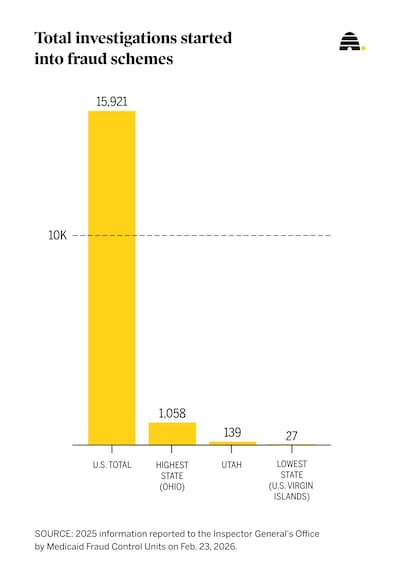
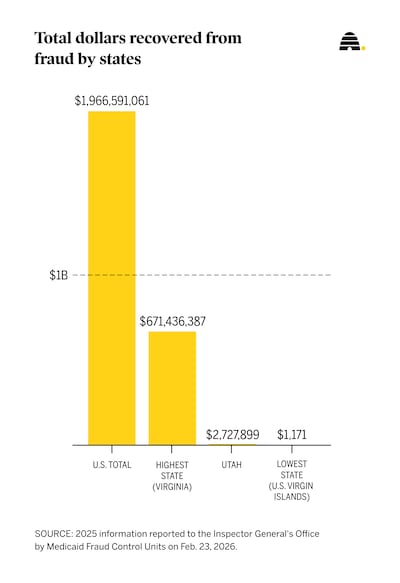
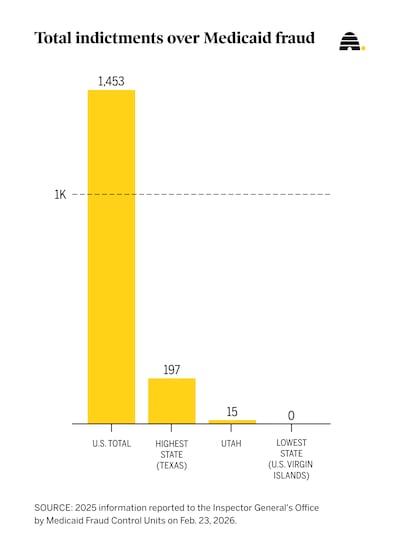
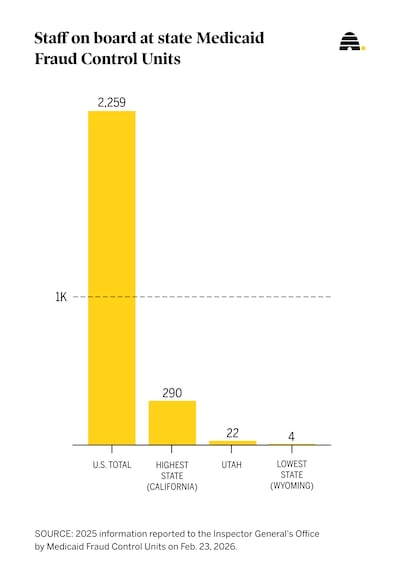
The 2025 report from the Office of the Inspector General (OIG) for the U.S. Department of Health and Human Services (HHS) compiles each state’s data on how many investigations have been started, the number of indictments and convictions related to Medicaid fraud, staff size and how much money each state recovered from fraud.
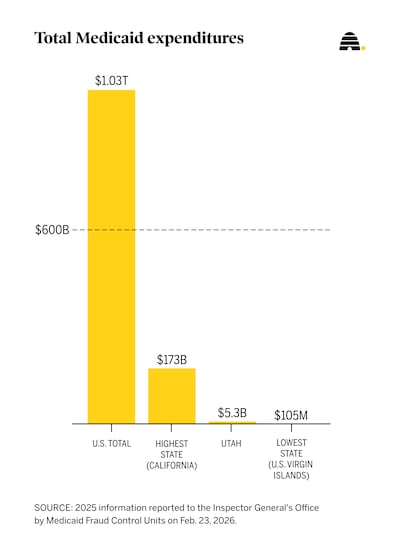
But Schneider called that data incomplete and unable to prove more fraud happens in one state or another. One may pour more resources into prosecuting fraud, while another might put more into preventing it. MFCU staff sizes vary and include different combinations of experts, including those from medical, investigative and legal fields.
He said the report provides a basis for states doing well to consider why and whether they could do better. States doing poorly could consider ways to improve. “But honestly, for me, those are the kinds of things that OIG and CMS and (the Center for Program Integrity) should be doing. That’s where the federal government can be helpful.”
Scott Peterson, spokesman for the Minnesota Department of Human Services, said both state and federal agencies are tasked with preventing, tracking and dealing with fraud. Among Minnesota’s “long-running partnerships” are Minnesota’s MFCU, Minnesota’s Bureau of Criminal Apprehension, and federal agencies, including Health and Human Services, the FBI and Minnesota’s branch of the U.S. Attorney’s Office.
His department must refer fraud suspicions to the MFCU, but has increasingly sent cases to other prosecuting agencies when MFCU can’t take on a case. “We have especially increased our cases sent to BCA in recent years,” he said by email.
Tackling fraud together
“The federal government can support those efforts financially. It can help provide information about what’s working in one state to other states, best practices, tool kits and it can do periodic … reviews of how each state is doing so they get a better sense of how they’re doing vis-a-vis their peers,” Schneider said.
Brandt told the House committee in March that the federal government plans to improve how it works with states on Medicaid fraud.
She didn’t confirm how many more letters will go out and which states they would focus on, but said CMS wants to create a “50-state playbook” this year that highlights best practices.
CMS declined to provide an on-the-record response, but according to public comments made by Vance, Oz and Brandt, the administration plans a more aggressive stance on fraud and will play a larger role in leading states — a departure from the administration’s stated policy of returning more power to states and leaving the federal government out of certain matters.
Oz said he believes that half of the country’s fraud is related to healthcare. The administration created a “Medicaid War Room,” using artificial intelligence and sought public comment earlier this year to improve CMS fraud detection efforts.
The planned playbook will help officials understand “states where their data shows there’s high instances of fraud, what is it that’s working, what is it that’s not working and how can we help them to learn from others or how can we help other states be able to build better safeguards,” Brandt said.
The Trump administration has also announced changes to Medicare — a program primarily for older adults who have contributed to it during their earning years — including a six-month freeze on new providers applying to receive payments.
No compliance, no money
CMS is now withholding more than $1.3 billion from California for not responding to some of the government’s inquiries in its Jan. 27 letter. CMS believes the state “should have taken proactive steps” and hasn’t taken fraud “very seriously.” That’s in addition to withholding millions from Minnesota.
The $1.3 billion deferral against California — which has the most Medicaid enrollees — is the largest in the program’s history.
California disputes the notion it’s not doing enough, noting on Attorney General Rob Bonta’s Medi-Cal Fraud webpage that the division “aggressively pursues criminals who are directly or indirectly involved in filing false claims for medical services, drugs or supplies.” The state, it says, “pursues hundreds of entities every year” and “continues to be one of the aggressive and successful healthcare fraud prosecutorial agencies in the nation.”
Since Bonta was elected, the California DOJ said it has conducted 294 hospice-related investigations and filed 119 criminal investigations, 51 of which have already resulted in convictions.
Schneider called funding deferral a routine part of Medicaid, but said it’s not one that previously played out with press conferences at the White House.
Meanwhile, Vance and Oz said that across all 50 Medicaid programs, letters would be sent requiring them to show they are “effectively and aggressively prosecuting fraud.” If a state can’t prove that, the federal government will turn off funding to its MFCUs. Vance said that isn’t the goal, but they want to ensure it’s being taken seriously. Oz highlighted that members of the Anti-Fraud Task Force are officials from CMS, the Office of the Inspector General, the Justice Department and the FBI.
“You put those things together, you make a powerful fist, and that’s the fist we’re going to punch through bureaucracies and realities that are stopping our ability to protect the American people,” he said.
Meanwhile, in Minnesota and Washington
McDonald, in the Justice Department’s National Fraud Enforcement Division, announced last week criminal charges against 15 defendants in Minnesota for fraud schemes that targeted more than $90 million that span seven state-managed Medicaid programs.
He said he wanted to be clear that the announcement was “not the end” of the administration’s work in the state, calling fraud in Minnesota “shocking.” He said the Justice Department created an 11-person prosecuting team from various agencies to quickly charge the defendants. They will work “coast to coast” to target fraud.
“The common theme throughout these cases is fraudsters exploiting vulnerable programs and vulnerable people to enrich themselves, no matter the consequences to the programs or to the people,” McDonald said. “The Department of Justice will continue expanding our reach across the country to pursue all fraud, no matter how large, no matter how small, no matter how hard.”
McDonald, at a roundtable this week with several state attorneys general and staff, laid out the plan for the government’s three asks of the states regarding fraud.
- Re-energize and fully mobilizing state MFCUs to eventually be renamed “Making Fraud Completely Unprofitable Unit.” Asks for number of active investigations in the state and if they are willing to partner with the Justice Department.
- Join the department’s “newly launched special attorneys program,” ready with $300 million to combat fraud across several sectors by training attorneys at their local U.S. attorney’s office. Interested states will receive a 20% premium to boost resources.
- Bring your state’s investigators and data to the table. The Justice Department needs the state information to bring a case to court. “Come to the table and solve this problem with us,” he said.
Peterson said many states have reached out to Minnesota’s department since it began an exhaustive review of its Medicaid programs and fraud detection practices. He said they have shared with national associations their experience with some of the projects Minnesota initiated to boost program integrity.
The Minnesota department “is actively engaged in national organizations and collaborative forums that facilitate ongoing communications with other states,” he said. Minnesota regularly shares information with those partners on emerging issues, best practices and strategies related to program integrity.
Peterson said the public should know that Minnesota DHS “is acting aggressively to detect and prevent fraud and will shut off money to providers when credible allegations of fraud come to light.”