



In 2012, after 15 years of practice as therapist, Jonathan Alpert took his own industry to task, writing in The New York Times about the prevalence of psychotherapy that goes on for years without improvement in patients.
“Research shows that, in many cases, the longer therapy lasts the less likely it is to be effective,” Alpert wrote, describing long-term and ineffective therapy as “disturbingly common.”
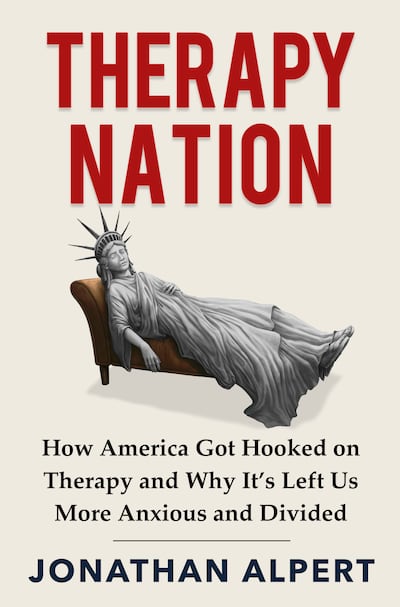
With those words, Alpert became persona non grata among many in his own field, but he has continued to speak out, most recently with his book “Therapy Nation.” In the book, Alpert argues that America has become a “therapy culture” that focuses on validation and affirmation at the expense of personal responsibility and growth, and that this approach to therapy has seeped into the larger culture and is contributing to polarization and division.
“The more therapy people get, the more fragile, anxious, and dysfunctional they seem to become. This isn’t just an individual crisis — it’s a societal one,” Alpert writes in the opening to “Therapy Nation.”

Like Abigail Shrier, who published “Bad Therapy” in 2024, Alpert is taking on a field that has the power to do both good and harm. The number of people in therapy is on the rise, and Health and Human Services Secretary Robert F. Kennedy Jr. has pledged to crack down on what he considers to be the overuse of psychiatric medications.
And Alpert isn’t the first to question the benefits of incessant navel-gazing. Dr. Sally Satel, a psychiatrist and senior fellow at the American Enterprise Institute, has pointed out that historian Christopher Lasch and others have written about the negative effects of “interminable self-scrutiny.” (She neglects to cite her own book, “One Nation Under Therapy,” co-written with Christina Hoff Sommers.)
What’s new, according to Alpert, is the expansion of therapy “beyond the consulting room into a cultural worldview,” as people with no medical training co-opt the language of clinical diagnoses to casually label each other as “toxic” or “narcissist” while interpreting ordinary discomfort as trauma and disagreement as harm.
But public health officials often use the term “crisis” to describe Americans’ mental health. Last year, for example, researchers in the Johns Hopkins Bloomberg School of Public Health Department of Health Policy and Management issued a report saying that 1 in 10 Americans said they had experienced a mental health crisis in the past year, with the rate climbing to 15% among the youngest adults. And the field is grappling with change, to include the emergence of telehealth, which now accounts for more than a quarter of therapy visits, and AI chatbots.
At the heart of the issue is a question that confronts everyone who has ever wondered if they need mental health care: How do you know if your therapist is helping or not? That’s one of the questions that Alpert is seeking to answer in his new book.
Which Americans are getting therapy?
In the opening to “Therapy Nation,” Alpert lays out a dilemma: “Despite more people than ever in therapy, our nation’s mental health continues to worsen.”
He notes a recent Gallup survey that shows an erosion in how Americans assess their mental health, a decline that has worsened since the pandemic, especially among young adults. At the same time, the number of young adults who said they have sought mental health services has increased, with 36% of Gen Z adults getting mental health care, compared to 15% of baby boomers.
At the same time, Alpert writes, rates of suicidal ideation, major depressive disorder and anxiety have been climbing, especially among young people.
“Today, 30% of people between eighteen and twenty-nine and 24% of those aged thirty to thirty-nine are affected by anxiety or depression — statistics that are nothing short of alarming,” he writes.
Meanwhile, the number of people seeking help through psychotherapy is also rising. One 2024 study published in JAMA Psychiatry found 8.5% of Americans received psychotherapy in 2021, compared to 6.5% in 2018.
Other research has shown even higher rates. The National Center for Health Statistics reports that in 2024, 14% of Americans had received counseling or therapy in the past year, and that 19.3% had taken medication for their mental health.
The increases in therapy are driven in part by the growth of telehealth and the expansion of the category of mental health providers who can bill Medicare for their services. (Most recently, licensed professional counselors and marriage and family therapists were added to that list in 2024.)
The rising rates are also driven by a particular demographic: young, college-educated women with higher income levels, according to a study entitled “Trends in Outpatient Psychotherapy Among Adults in the US.”
That study found, however, that rates differed by level of patient distress.
“A significant increase in use of psychotherapy also occurred among adults with mild or moderate distress but not those with serious distress,” according to Dr. Mark Olfson and his co-authors, writing in JAMA Psychiatry.
That may seem to indicate that some people getting therapy are among those that Shrier has called “the worried well,” or those who are seeking help for getting through challenges like divorce or a death.
Indeed, a 2007 study found that about half of people who sought the help of mental health providers didn’t have a clinical diagnosis, but were seeking help for problems such as getting over a death or divorce.
And that was before the rise of “mental health influencers” who, Alpert notes, tell their audience that therapy is as essential as getting enough sleep or eating enough vegetables.
“Our culture seems to have forgotten the crucial difference between needing a professional therapist and simply needing a friend or a sympathetic ear when facing everyday challenges. Not every problem in life needs to be pathologized,” he writes.
In fact, while most everyone agrees that it’s good that seeking help is no longer stigmatized, some worry that the pendulum has swung too far the other way.
As Abigail Shrier told the Deseret News in 2024, “We have this idea that we can’t possibly overcome a problem unless we talk it out with a therapist. And it’s not true; it’s never been true. Some people don’t need to talk through their problems. They’re better off putting their problems behind them.”
Too much therapy or not enough?
Olfson, a psychiatrist and professor of epidemiology at Columbia Mailman School of Public Health, said that as an epidemiologist, he is most concerned about people who need mental health care and are unable to get it, which is often the case for people in rural or low-income communities, and those on Medicaid. Even those with private health insurance can struggle to find providers, as ProPublica has reported.
“We still have substantial portions of the population with mental health problems who receive no treatment, either psychotherapy or medications,” Olfson said. “So while it’s true there’s been this recent growth (in therapy) in the broader context, there’s a lot of unmet need at the population level.”
And while the expansion of telehealth has helped to a degree, Olfson said, “My sense is that people who have an established, personal relationship with a therapist can make the transition with very little or no detriment, but if there was never an in-person meeting, and the person you are meeting with is geographically remote, there’s some evidence that it may be less effective.”
Olfson said he had not read Alpert’s book but has seen some of the news coverage about it and agrees with some of Alpert’s assessments: “More people are accessing mental health services than ever before,” Olfson said, adding that Alpert is right that we haven’t seen population-wide decreases in mental disorders despite advances like the 988 crisis hotline that was established in 2022.
While Alpert’s book does not rise to the rigors of a peer-reviewed academic study, “the underlying point he makes is a fair one,” Olfson said.

Therapy and family estrangement
Although Alpert initially started speaking publicly about what he believed was substandard levels of mental health care, he said he observed in subsequent years how therapy language began to infiltrate the wider culture, and how politics became a focus of therapy as people began to make politics part of their identity.
Writing for The Wall Street Journal, Alpert considered the question “Is Trump Derangement Syndrome Real?” and “obsessive political preoccupation” by any party benefits from “collective reinforcement.”
For The Free Press, he wrote, “Too much of modern therapy culture keeps people stuck, reinforcing grievance, externalizing blame, and turning everyone else into the reason their lives are so miserable.” And in the Los Angeles Times, he rued the changing focus of therapy from resilience to an ethos of “emotional projection.”
Despite all this, Alpert believes in the benefits of therapy done right: He practices in New York and Washington, D.C., and sees clients online. When podcaster Megyn Kelly told him on a recent show that she’d been in cognitive behavioral therapy for 15 years, Alpert told her she must have a great therapist.
“Families have always disagreed. Therapy should help people build healthier boundaries and communication, not make estrangement the default solution.”
— Jonathan Alpert
And he told me that therapy can help meet the needs of a population that has fewer friends and spends more time in isolation than in previous generations.
“Feeling heard is undeniably valuable. Many people are isolated and genuinely lack meaningful relationships. A therapist can provide empathy, support and acceptance during difficult periods,” he said.
As for how long therapy should last, “there isn’t a universal timeline because people and problems differ,” he said. “But therapy should be goal-oriented. Patients should know what they’re working toward and periodically ask, Am I functioning better? Am I becoming more independent? Ideally, therapy helps people need therapy less over time, not indefinitely.”
In expanding the function of therapy beyond its core principles — resiliency, responsibility and growth — Alpert said that some therapists have contributed to serious ruptures in families by encouraging people to cut off family members or interpreting ordinary conflict or political disagreement through the lenses of toxicity and abuse.
“Of course, there are situations where estrangement is absolutely appropriate, particularly in cases of abuse. But I’ve become concerned that some clinicians too quickly validate separation rather than helping families navigate conflict where reconciliation is still possible. I believe therapists should be very cautious before encouraging permanent ruptures because those decisions often have lifelong consequences,” he said in an email.
“Families have always disagreed,” he added. “Therapy should help people build healthier boundaries and communication, not make estrangement the default solution.”
How to find a good therapist

In her review of “Therapy Nation” for the Washington Free Beacon, Satel, who is a lecturer at the Yale University School of Medicine, said Alpert “makes a persuasive case that there is a lot of bad therapy out there — indulgent, regressive, and unaccountable — and that patients should be more demanding when they don’t see progress. But whether therapy is dividing us or ‘accelerating societal decline,’ as the author claims, I am not sure.”
In an email, Satel told me, “It’s an interesting hypothesis but very hard to demonstrate. It would be nearly impossible to distinguish correlation from causation.”
In his conclusion, Alpert tells readers, “If therapy isn’t pushing you forward, it’s holding you back” and that the best candidates for therapy are those who have “a willingness to change, to confront uncomfortable truths, and to take responsibility for their growth.”
Finding a therapist, however, can be challenging, even for those with private insurance, and only about 1/3 of psychotherapists accept Medicaid, Olfson said. (Medicare acceptance rates are higher, but still lower than other medical specialties.)
As for finding a good match among the options that are available, Alpert says to start by asking questions, not looking for a person who feels “warm and validating.”
“A good therapist should be able to explain their approach, define what success looks like and describe how you’ll know therapy is helping,” he told me.
“Look for someone who is willing to challenge you respectfully, not simply affirm everything you say. Therapy should leave you more capable of handling life’s difficulties, not more dependent on therapy itself. And if, after several months, you don’t feel you’re making meaningful progress, it’s perfectly reasonable to ask why or seek a second opinion.”