

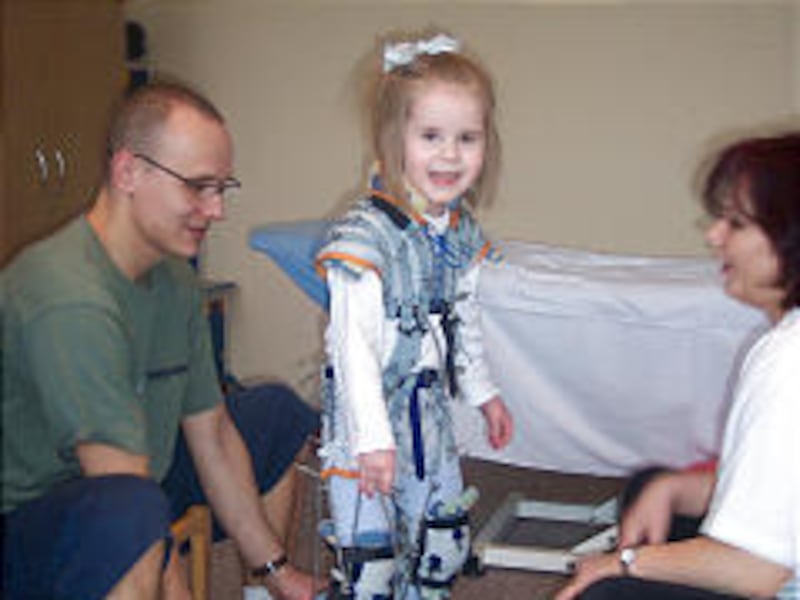

OREM — Colby Christensen can ride a tricycle now, just like most other 4-year-old girls. She's even eating grapes with "righty," her once tightly clenched right fist, thanks to a new therapy for children with cerebral palsy.
The only drawback is the treatment is in Poland. And it costs $10,000. But her mom, Tracey, said it's worth it: "Any parent would do what's best for their child."
So mom and daughter spent this past February in Mielno, a coastal city in Poland, where Colby worked six hours a day, six days a week, in a suit specially designed to help her small body learn correct posture.
But the Christensens aren't the only ones who have benefitted from the European treatment and the patented "Adeli" suit.
Two other Utah families have saved up and shipped off to undergo what many describe as the best treatment available — therapy that has changed children's lives.
Since 1994, Poland's Euromed Rehabilitation Center has been the home of the special Adeli suit and therapy programs that help children with cerebral palsy.
CP is caused by damage to the brain and affects motor skills, balance and often speech. There are varying levels of ability, with some children able to use their arms and legs, while others may be in wheelchairs or paralyzed on one side.
The Adeli suit was originally adapted from suits designed for astronauts. After months in weightless space, astronauts would lose balance and muscle strength, much like the conditions affecting a child with cerebral palsy.
The vest, shorts, knee pads and special shoes are all connected using a series of bungee cords or giant rubber bands and extra weights. The suit aligns the child's body in the anatomically correct standing position. Once in the suit, the child goes through two or three hours of suit therapy involving walking, crawling or moving while the body is properly aligned. As the child trains, his brain is learning the correct way to walk and his once-weak muscles are being exercised.
Colby Christensen
Colby Christensen was born with right-hemiplegia, or paralysis to her right side. She's been in therapy since she was 6 months old, doing things like physical, speech and even horseback therapy. But therapy is expensive, and most insurance policies pay for 12-20 visits each year, not quite enough to meet the needs of a growing child.
After hearing about Euromed from family friends, the Christensens held a fund-raiser and headed to Europe.
Despite the culture shift, time change and financial strain, the experience has been life changing, Tracey Christensen said.
"She really amazed me," Christensen said of Colby's efforts. "She has a really good understanding that she wants to do better. She loved to see the progress she made. (She would say) 'Can you believe that I can do it!' "
With support from Dad and two younger brothers at home, Colby is continuing to improve and looks forward to future trips to Poland. Tracey Christensen said she's now a "big fan" of the therapy.
"I never felt at anytime that there was anything unsafe, anything bad," Christensen said. "It's just exercise in that suit. . . . It's just a little different way than I'd ever seen before."
Alexis Hills
As a 6-year-old, Alexis Hills is almost too heavy for her mom, Leslie Hills, to carry her around everywhere the rambunctious girl wants to go. So Lexie moves herself in a "bunny hop" by putting her right hand down on the floor and scooting her two knees forward.
But with high hopes and the dream of walking on her own, Lexie and her mother headed to Poland last week, where they will spend the next month in therapy at Euromed.
At first, Leslie Hills and her mother, Marilee Campbell of Provo, said they were skeptical about the program.
"If this isn't standard treatment, (you) wonder if it's something that really would be worthwhile," Campbell said. However, when they attended a free seminar in August 2004 with doctors and therapists from Poland who introduced the program, answered questions and even pre-approved (for treatment) almost 30 children, they became excited. Approval requires doctor examinations, checkups and occasional X-rays of hip bones.
Although Lexie only started therapy on Thursday, Hills said she is enjoying the chance to move and stretch.
"She loves stimulation," Hills said. "She gets to move around and do things."
Lexie's favorite treatment now is called "the spider," which uses four stretchy bungee cords that attach to her suit from the corners of a "cage" and allow her to jump up and down, stand and kneel.
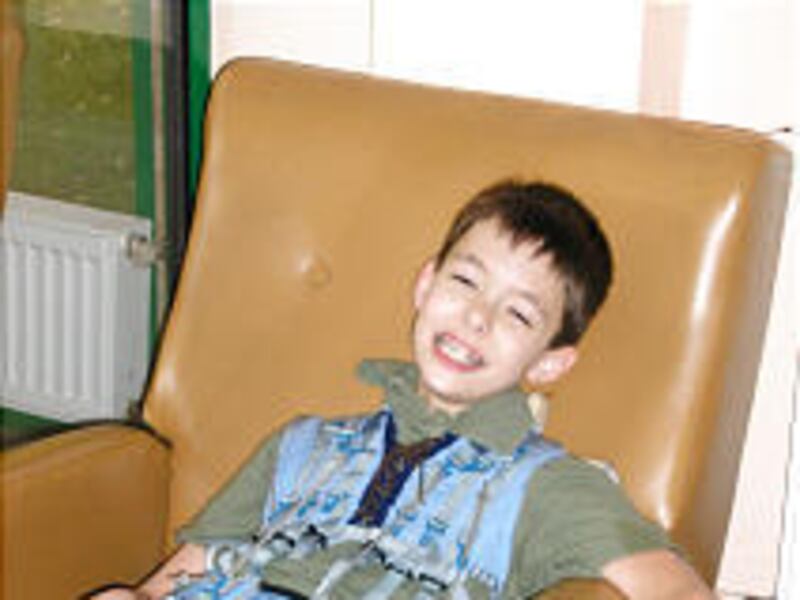
Andrew Justvig
The advice of 12-year-old Andrew Justvig to other children with CP is, "Hey, you could be like me. You could walk or maybe even run in track meets."
Although his sentences come slowly, they are understandable. Remarkable for a boy who was limited to a 20 percent communication ability a few years ago.
"We're very very lucky," Andrew's dad, Harry, said. "All his limitations are completely physical. Cognitively, he's actually a very gifted student."
And physically, he's beginning to catch up with his brain, thanks to the nine trips he has made to the Euromed center.
Harry Justvig, who is a volunteer coach with Dixie College football in St. George, compares the therapy to athletic workouts.
"The month of therapy is like training camp," he said. "You work like crazy, your legs are sore, you ache, you're whining . . . then a little before half-way through, you get through the soreness and your body really starts to go. About two weeks after you get home, your body completely recovers and it's like, 'wow.' That's what happened after Andrew's second trip."
Andrew, who suffered from a lack of upper-body balance and needed a walker to get around, now whizzes around the house and wants to be an engineer for Disney, designing roller coasters.
Justvig was the man behind the August 2004 Euromed conference in Provo and continues to spread the word about the therapy that has changed his son's life.
"There's a lot of families that have lost hope about any improvement with their kid," he said. "The thing with CP — it's a condition, not a disease. What you have is what it will be, and it will only get better."
E-mail: sisraelsen@desnews.com