

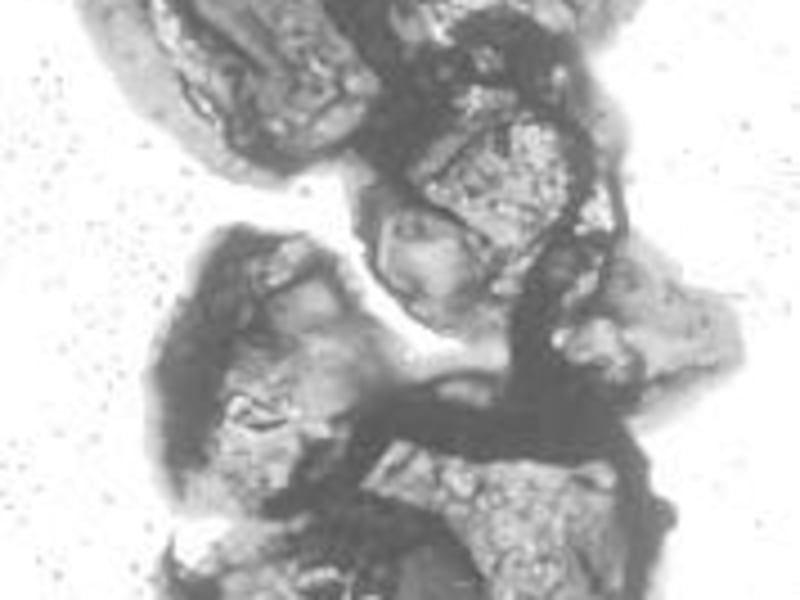

Utah's earliest fossils made their debut in the latest issue of "Survey Notes," the magazine published by the Utah Geological Survey — and they are really old!
They are remarkably well-preserved cyanobacteria fossils from the eastern Uinta Mountains, tiny bacteria that lived 740 million to 950 million years ago. They date to the Precambrian era, a period when fossil remains are rare.
Although Precambrian rock crops out in Big Cottonwood Canyon, it has been heated in the distant past, which may have destroyed delicate fossils.
To understand the age of the Uinta fossils, consider that the dinosaurs ruled Earth until 65 million years ago. The trilobites of Millard County, from the middle Cambrian era, may be about 540 million years old. The few Precambrian fossil bacteria found before recently were from the late part of the period, about 740 million years ago.
Some of the newly announced bacteria remains are up to 200 million years older.
Although microscopic, they retain clear evidence of internal cellular structure. Photographs of them look much like pictures of modern bacteria taken through a powerful microscope.
Douglas A. Sprinkel, senior geologist with the Survey, made the first of the new discoveries in 2000, part of a geologic mapping project he has been working in the eastern Uintas since 1999. Since then he has continued sampling the rocks and has located a number of fossil sites, from the lower part of the Uintas to an area at about 11,000 feet elevation.
Some of the discoveries were published earlier as part of his "open file" map project, but the "Survey Notes" article is the first announcement to be issued for public consumption.
Cyanobacteria are sometimes called blue-green algae, and the type survives today. They are single-cell organisms. Scientists believe the new discoveries represent about four species.
"Some have simple walls, and as we go younger (more recent rocks), the cell walls become a little more complex," Sprinkel said. "And as we go even younger, they begin to form colonial organisms." They had some tendency to clump together in colonies.
"And then we do see some species that are definitely colonial type organisms," he said. "They're forming a nice clump-of-grapes sort of thing."
The bacteria remains are so nicely preserved because of the environment in which they were deposited. Bacteria fell into water that had little or no oxygen to eat away at the tiny organisms. After sediments hardened into rock, "there hasn't been a lot of the sort of post rock-forming events" to damage the fossils' structure.
So far, geologists have not been able to determine a definite age of the rocks but have a general idea. "We do have some pending radiometric rating that they're trying to get down right now."
Levels of grains of zircon in the rocks are being analyzed at the Australian National Laboratory to get a more exact date.
Australia is famous among paleontologists for spectacular Precambrian fossils, including stromatolites, large colonies of bacteria that formed structures like coral heads. In fact, some stromatolites still live in shallow waters of Australia.
"It's possible that we could have stromatolite organisms or more complex organisms in the rocks of the Uinta Mountains," he added. "So far, no one has really found any that I'm aware of."
A complex procedure had to be followed to expose the microfossils. Gerald Waanders, a consulting independent expert from Southern California who was the other co-author of the article, crushed rock into a powder, then applied acid to bring out the tiny fossils. Then he studied the material in a microscope to see what was there.
When he passed samples along to Waanders, Sprinkel wasn't expecting to find any fossils. When Waanders called and said "we had a whole bunch of cyanobacteria in our samples, it was pretty exciting," he said.
Then he corrected himself: "Really exciting."
E-mail: bau@desnews.com