

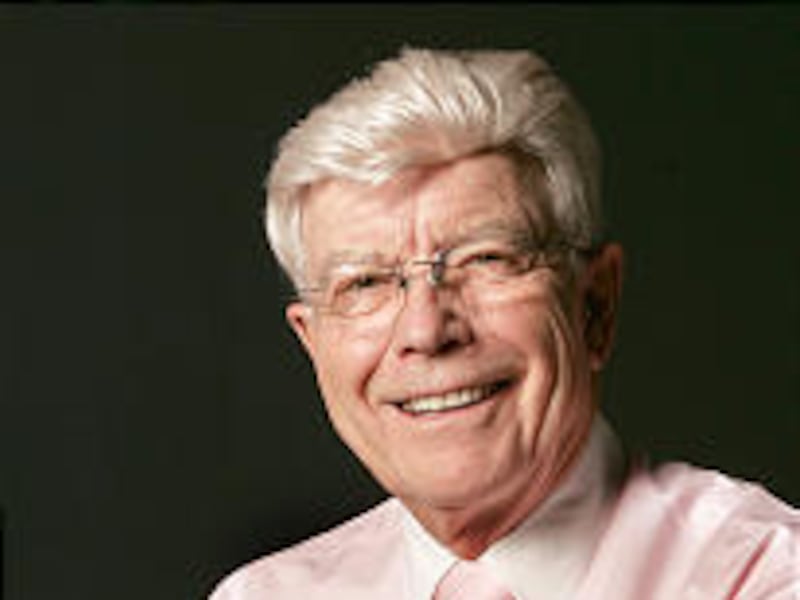
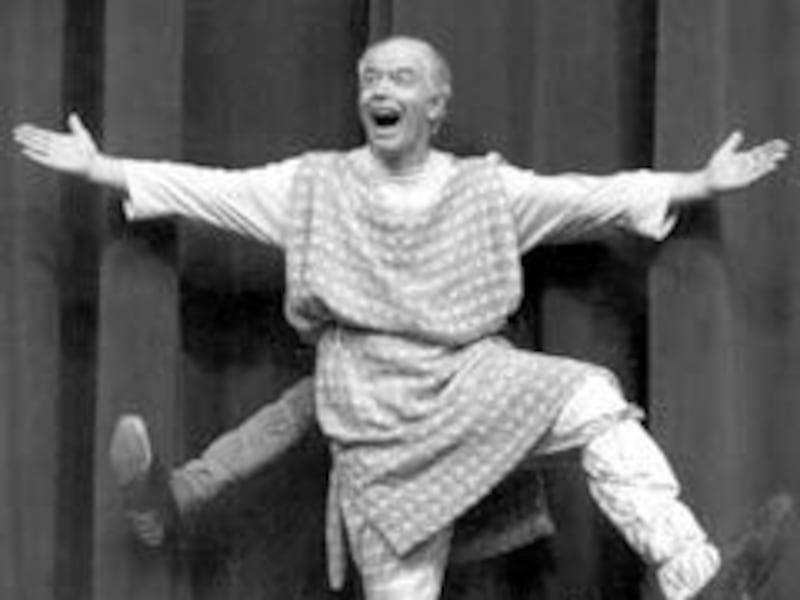
Fred Adams has been described as a modern Don Quixote by those who know him, and that seems a fair description for the man who, against all odds, faced with cynicism and even laughter, brought the world-renowned Utah Shakespearean Festival to Cedar City, of all places.
Adams' quest really began when he was a young man staring up awestruck at the Northern Lights while standing in the woods of Finland, and he has spent a lifetime trying to get others "to look up, to see something beautiful, to be lifted up."
Adams really talks like that at times, as if he's on stage, and he practices what he preaches. A recent visit to the new Salt Lake City library left him almost breathless, gushing about its architecture.
Adams, 74, is an old man with white hair, but he is still dreaming impossible dreams. This time he is attempting to build a world-class Shakespeare center in Cedar City. In Adams' mind, the center would become a destination point for theater lovers from around the world, with three theaters, costume and scenery shops, high-end condos, restaurants, gift shops, bookstores and art galleries. And all it will cost is between $50 million and $60 million.
He has collected about $6 million so far, but Adams dismisses any suggestion that he faces a daunting task. He's already received a commitment of $22 million from developers, he notes, so he needs to come up with "only" another $22 million or so.
"There will be nothing like it in the world," he says. "I've traveled all over the world, and I've seen where art projects have worked and failed. They work when you think outside the box."
Adams has never been in the box. He grew up on Shakespeare in backwater towns in Idaho and Utah, took a dancing job on Broadway while waiting to become a director, and somehow wound up back where he started from. He started the Utah Shakespearean Festival with $1,000 and an audience of 3,276 that first season in 1961; today it operates on a budget of $5.5 million and draws an audience of 155,000.
"I often liken him to Don Quixote," says R. Scott Phillips, Adams' right-hand man. "He's always chasing windmills. Nothing is too big or too grand for him. He wants things to be more beautiful in the world. We see that windmill, so we follow him into the fray."
This is how big Adams thinks: While everyone else was wondering if the festival would survive the early years, he was sketching plans for his $60 million Shakespearean Center from the very beginning, four decades ago.
People ask, "Are you surprised at the growth (of the festival)?" says Adams. "How on earth would I be surprised? It was what we intended. There are no surprises."
Well, he does acknowledge one surprise. In 2000, the festival was awarded a Tony as the nation's Outstanding Regional Theater. Over the years, the festival has been praised by national media — Newsweek, Look, Sunset, Time, New York Times, Chicago Tribune, Washington Post, the L.A. Times, the BBC.
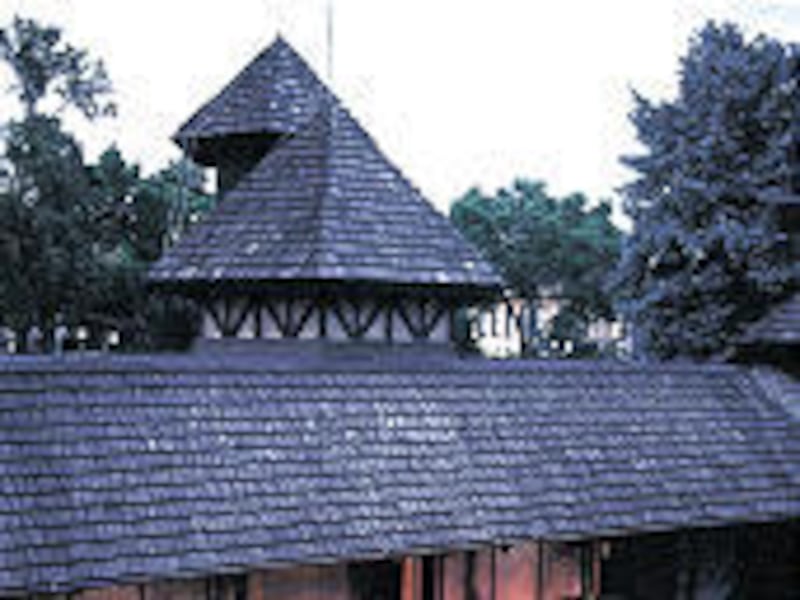
Adams and his friends don't just put on Shakespeare every year in Cedar City, they knock it dead. While working on a documentary about the history of theater, the Royal Shakespeare Company flew its cast and crew from England to Cedar City in 1981 to spend two weeks filming a BBC sequence that covered Elizabethan drama and William Shakespeare. They filmed it in the festival's theater because they considered it the closest replica in the world to what Shakespeare might have performed his plays in originally (before Shakespeare's Globe Theater was rebuilt).
Once, when Adams and several of his festival patrons were taking a backstage tour of the Royal Shakespeare Company's theater in Stratford-on-Avon, they overheard one of the other guests ask a tour guide, "Where would you go to see Shakespeare in America?" The tour guide replied, "If you want to see Shakespeare the way he would have done it, go to the Shakespearean Festival in Cedar City, Utah."
Representatives from design institutes have flown across the country to Cedar City to study the festival's costumes because of their remarkable authenticity.
The man who is responsible for this is of course Adams, the founder and director and a man who is widely admired. Check his reviews:
"He's a creator in the greatest sense of the term," says Ken Adelman, former security adviser to President Reagan and now a consultant in Washington. "He made the festival from nothing. Mike Peters (the syndicated cartoonist) called Fred 'pure light.' It's his joy of life and people."
"He is an institution all by himself," says U.S. Sen. Bob Bennett. "It shows what can happen when someone pursues a goal with absolute single-mindedness. Many times, the true mark of genius is the ability to see what others can't."
"He's really a visionary," says Ivan Lincoln, the Deseret Morning News' longtime theater critic. "What he's done in Cedar City is amazing. It's his baby."
"His passion and energy instill passion and energy in others," says Phillips, who changed his major from business to theater after taking one of Adams' theater classes at Southern Utah University. "Fred will never retire. We say we're going to bronze him and stuff him and animate him like 'Great Moments of Mr. Lincoln.' He believes people are good and that they will look for beautiful things that will uplift them."
"He's a very special man," says Donna Law, the festival's director of marketing and public relations. "He makes me crazy sometimes, but he's so passionate about what we do."
"He's my hero," says opera singer Michael Ballam, head of Utah State University's music department. "He's got more energy and vision in one finger than the rest of us have in our entire body. I'm in awe of him. I'd like to grow up to be Fred Adams. Think about what he's done."
This is what he has done. Forty-four years ago, the mining industry in Cedar City was being killed by foreign competition, and people were moving out. If that wasn't enough, there was a proposal to build the new I-15 freeway 15 miles west of town where land was cheaper. City leaders were desperate to find a way to attract people and dollars to Cedar City.
Adams appeared in front of the City Council and the Chamber of Commerce and told them he had the solution: Build a Shakespearean theater that would attract visitors looking for something to do at night after they had visited the many national parks in the area. Their reaction was predictable. He heard snickering as he left the room.
"It went over like a pregnant pole vaulter," Adams likes to say. "They thought it was a dumb idea. Really dumb."
He went around town looking for money to start the festival and struck out everywhere until the Lions Club agreed to underwrite his plan with $1,000 after he told them he expected to recover all of the money in ticket sales. He brought in $3,000 that season in 1961, and the festival has become, for Cedar City, exactly what Adams said it would be.
Many of the festival's patrons return each year, traveling from the cultural centers of the world to the sagebrush country of southern Utah.
Adelman, a longtime theater buff, and his family started coming to the festival 16 years ago after hearing about it from a relative who lives in Utah. They come annually and bring 50 or 60 of their friends with them, including, over the years, Donald Rumsfeld and Paul Wolfowitz.
"Now we have people from Buffalo, Washington, Chicago and San Diego who come to the festival," says Adelman. "Friends invite their friends, and once they come, they stay. It does not look like the kind of place that would attract first-rate theater. Then you go and find that the shows are fabulous."
How did Adams know Shakespeare would sell to a town of ranchers and miners? Adams tells this story: After being lured away from New York to Southern Utah State College to start a theater program, he produced a season of theater that consisted of three productions — a musical, a play and Shakespeare's "Taming of the Shrew." Shakespeare packed the house; the other productions drew maybe 50 people. Adams was puzzled until he did some research.
"I started looking at the community," he says. "They were far away from any metropolitan influence. There was no TV. They made their own theater and culture. They had a symphony that's older than the Utah Symphony. They had produced the entire Messiah for half a century. They had a juried international art exhibit. They produced more grand opera in Cedar than in Salt Lake. I thought, that's what these people want. They don't want Broadway fluff. They want meaty stuff. They want Shakespeare.
"The earliest wagon train in Cedar produced Shakespeare's 'Merchant of Venice' a week after arriving here, while they were living in wagons. They came from these civilized lands where theater was important."
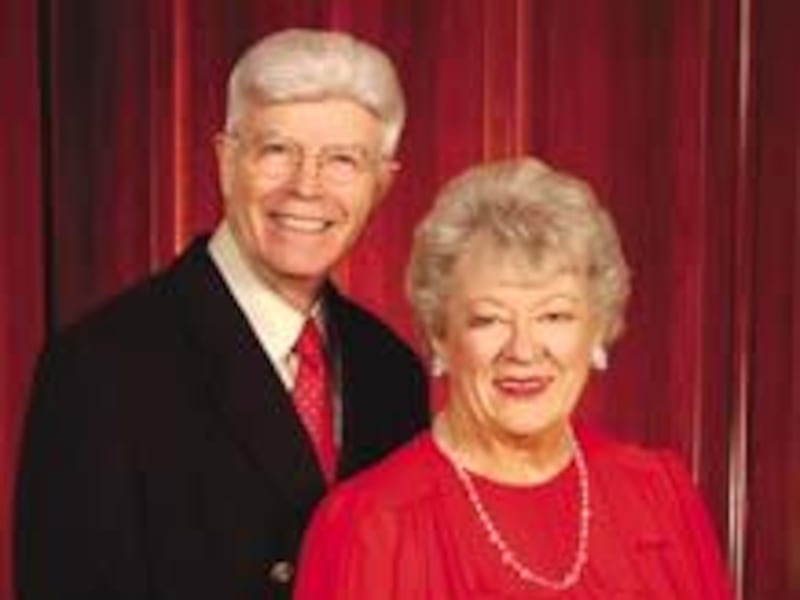
At the outset, Adams and his wife Barbara climbed into a car and set out to visit Shakespeare festivals in Oregon, Canada and Connecticut, where Adams observed and interviewed their founders, making detailed notes. He ended the interviews with the same question: "If you had to do it over again, what one thing would you do and what one thing would you not do?"
It took years to attract actors, directors, designers and reviewers. One of the latter was Harold Lundstrom, the Deseret News' theater critic who had a passion for Shakespeare. He traveled to Cedar at his own expense and reviewed the festival.
"It opened the floodgates of Salt Lake City," says Adams. "We still wouldn't be anything if not for Harold. And he knew his Shakespeare."
Since the early days, the festival has grown into a massive undertaking. Each season, festival officials hire 350 employees, only 50 of whom are actors. They are mostly seamstresses, carpenters, painters, dancers, designers, box office staff, child-care workers, management, housing staff. They own 96 apartments in which they house many of their employees, and they house the others in apartments around town, which means they own furniture and bed linens for all of them.
If there is some detail Adams has overlooked, nobody can think of it. They offer an orientation on the play audiences are about to see. The festival provides child care for theater patrons.
In addition to doing six plays during the summer season, they do three more in the fall, then a Christmas season. After that, they take a reduced Shakespeare play on the road for three months, performing for some 65 high schools and 85,000 high school students around the Mountain West. In the summer, they do workshops, camps, seminars and backstage tours. In the winter, they visit grade schools to teach students and teachers how to do Shakespeare, and eventually they select schools to perform their productions in Cedar City.
"It's about a lifelong love of Shakespeare and theater, regardless of whether you can come to Cedar City," says Law. "It's the core of what we do."
The man in the middle of all this, with his hand in everything, is Adams, who claims he retired in 1997, but adds, "I only work eight hours a day now. I was doing 14 or 15 before." Mostly, his job is to raise money, but he also has been known to vacuum the costume shop or plant flowers in the courtyard, and he oversees everything from billboards to the photos that are used in the program. In the early years, he directed the plays as well.
All this because of the words a man wrote 400 years ago and a man who read them as a child.
Adams likes to tell this story: When he was in the second grade, his teacher asked the kids if they had read "Goldilocks and the Three Bears." He was the only one in the class who didn't raise his hand. He'd never even heard of it. Nor had he heard of "The Three Little Pigs" and other traditional children's stories. The teacher accused him of lying, and he went home in tears.
The next day, at his mother's urging, he told the teacher he had never read those stories, but he could tell her the entire plots for "Macbeth," "King Lear" and "The Taming of the Shrew." He had read most of Robert Browning's poetry and several of Shakespeare's plays by then.
Born in Cedar City, Adams moved to Clifton, Idaho, as a young boy after his father Paul lost his land and sheep in the Depression. Years later, the family moved to Delta, where his father, who had gone back to school to become a pharmacist, opened a drugstore and his mother, Louise, worked as a teacher.
Adams studied theater at BYU — he was named the school's top actor — and spent his summers serving as an assistant in the direction of the LDS Church's Hill Cumorah Pageant in New York. He was drafted into the Army and served as a Russian translator and later was appointed director of overseas entertainment (USO tours) in the Pentagon.
After quitting the Army, he finished his degree at BYU and then served a three-year mission for The Church of Jesus Christ of Latter-day Saints in Helsinki, Finland. It was there that he had an epiphany.
One night when he was depressed by the gray winter and 40-below temperatures and two months without sunlight, he and his companion rode their bikes across town to a church youth activity, which, they learned, consisted of hiking to a cabin through the woods outside of Helsinki.
"We sang inane songs in the cabin and drank fruit juice that goes right through you," he recalls. "I was depressed. All I could think about was that we had to walk back. Later, as we were walking back, I lingered behind. I hated it. I hated being a missionary and being cold. I was kicking at frozen clumps of snow and mud when suddenly a little girl in front yelled, 'Look up!' It was the Northern Lights. It was the first time I had seen them. They were shimmering curtains of green, blue, pink and gold. It was so magical. You could actually hear it zing. The static electricity made the hair on the back of your neck stand up. It was that close. You could almost touch it. It was a miracle. Long after the light danced away from us, I looked at this sky of black velvet that was studded in stars so big you thought you could get on a ledge and touch them.
"I was transfixed by this miracle. I have thought of it many times. What if that girl had not cried, 'Look up!' I discovered that I was there to call people to look up. And that's why I do Shakespeare. And if you don't look up, you miss all these miracles. Whatever it is — a painting or a sunset — if you don't look up, you're going to miss a miracle that won't be repeated. I like affording people an opportunity to see and enjoy great theater. I am a devoted fan of history, of culture, of opera, ballet, symphony, painting, even buildings. I just walked through the Salt Lake library. I was blown away by beauty. I couldn't believe it. It's magnificent! The glass and the curves and the heights. Dang! It was mind-affirming that man can think that well and do that well with glass and rock and steel."
After taking a master's degree in theater at BYU, Adams went to New York City as an aspiring Broadway director. To pay the bills, he got a job as a swing dancer on Broadway.
"I was on call, but thankfully no one ever called," he says. "I would have made an ass of myself."
He didn't like New York, but he was networking, trying to make connections that would give him a career as a director. "But it wasn't the lifestyle for me," he says. "I didn't like New York. I was a small-town boy."
Royden Braithwaite, the president of Southern Utah State College, as it was called then, saved him. He flew to New York and recruited Adams to start a theater program at his school. Adams started without a single prop in 1959 and has been there ever since. Two years later he started the festival.
"We were so dumb, we wouldn't have known we were in trouble," says Adams. "It was never smooth sailing. You don't build world-class theater in rural southern Utah easily. It took years to get it going."
Adams still reads Shakespeare regularly. (He selects the plays that will be produced at the festival each year.) His life-long passion for the Bard has never waned.
"What's made Shakespeare what he is?" Adams asks. "Because he knew 400 years ago how Fred Adams felt, how he thought, how he operates. He understood an 80-year-old king with three daughters, and a 14-year-old-girl in love, and a military man who wants to be king. I never read the same Hamlet twice. Or Lear. I read it when I was a student in high school, then when I was a college kid, and it was a totally different play. Then I read it when I got married, and it was different again. Then I read it when I had children and it was different. And now I read it when I have grandkids, and it's a different play. I'll be reading, and it's like, 'When did he say that?' "
Adams is still looking up, still looking for beauty and a miracle wherever he can find it.
E-mail: drob@desnews.com