


GLEN CANYON NATIONAL RECREATION AREA — To stare at the cracked, brownish bones embedded in gray shale is to travel back in time 93 million years.
The towering walls of nearby cliff walls are replaced by a vast, shallow sea. A rocky outcrop reverts to a sandy shoreline. The Tropic Shale is gone, the rock once again the sea's mud floor. Suddenly, small fish scatter as a giant, robust reptile hurtles after them, arms and legs shaped like paddles propelling it as fast as a shark can swim, its mouth wide open and 100 sharp teeth showing.
It is a plesiosaur, a top predator in that long-disappeared ocean.
The best-preserved plesiosaur ever discovered in the region is being removed from the shale and taken to a museum in Flagstaff, Ariz. Scientists say it's a new species, judging by its morphology.
On Tuesday, officials of Glen Canyon National Recreation Area, where it was found two years ago, led reporters to the site. They asked that details about the location not be published, other than the fact that it is on the Utah side of Lake Powell. About five paleontologists and volunteers are working here at any time, and as many as 15 have helped since the dig started in earnest two weeks ago.
"The sea extended from about Cedar City in Utah to Kansas," said Dave Gillette, chief of the excavation. "It was warm water, and it had lots of life in it."
The former Utah state paleontologist, Gillette is now Colbert curator of paleontology at the Museum of Northern Arizona, Flagstaff. He hopes the last massive slab of rock and fossils will be carried out before the Fourth of July, when visitors may interrupt the work. It will have to be moved by litter so that vehicle tracks don't mar the desert landscape.
The plesiosaur is an extinct reptile whose family died out when the dinosaurs did, 65 million years ago — long after the newly found animal was swimming here. It was related to both dinosaurs and crocodiles. While many may imagine plesiosaurs as looking like the mythical "Nessie," with its long neck, this one happens to be a short-neck variety.
Gillette said its general body plan was something like that of a porpoise or seal. The reptiles were big, with some from this area reaching 20 feet long.
Lex Newcomb, an official at GCNRA, has been putting together a paleontological management plan for the recreation area, which is a unit of the National Park Service. Park officials commissioned the Museum of Northern Arizona for the project. A survey crew member ran across the plesiosaur two years ago, and because it is on an eroding hillside, saving the fragile fossil is deemed an emergency project.
According to the recreation area, the project is part of a research partnership between the National Park Service, Grand Staircase-Escalante National Monument (adjacent to the recreation area), the Museum of Northern Arizona and Northern Arizona University, both in Flagstaff.
Fragments of tail bones were exposed on a hillside. A trail of bones led up the slope to the animal's burial site. Last fall a preliminary dig found the skull, and the actual excavation has been going on for the past two weeks.
"We've found probably several hundred sites that had fossils that we collected," Gillette said of the survey. Only a dozen, however, are this important, warranting a full-blown project. To save money, the crew has been camping out.
The team is focusing on the Tropic Shale, the formation deposited by silt falling to the bottom of the sea, layers that have been largely ignored by paleontologists until now. The Straight Cliffs, formed after the region emerged from the ocean, has dinosaur remains.
This isn't the first plesiosaur recovered from the shale. A 20-footer on display at the John Wesley Powell Museum in Page is actually a composite of two individuals. The new species probably stretched 15 feet or 16 feet long in life.
"It has a complete skull," Gillette said. "This one is exceptionally well preserved."
That's not to say the bones are in good shape. Many have been shattered by the hillside slumping over time. Water from the infrequent rainstorms worked its way into cracks between bone fragments, further separating them.
Still, the bones were fossilized nicely and almost all are present. That means lab workers will be able to put the skeleton back together. But first, he said, "we'll have to get rock off and glue everything together."
Preservation was helped by the fact that this was a quiet sea bottom, without a lot of bacteria in the mud. When the plesiosaur died, it sank slowly and lay on the soft mud. Soon it was covered by silt. The bones fell apart but were preserved nearby, the long skull remaining in one piece.
"These were ambush predators, and they were top of the food chain," he added. They had long slender heads with 25 teeth on each side of each jaw, with a gap in the middle. "So you had 100 piercing teeth," he said.
The teeth fell out of the jaw, leaving holes where they once were rooted. Excavators found the sharp, curved teeth. One, still embedded in shale, remained at the site on Tuesday.
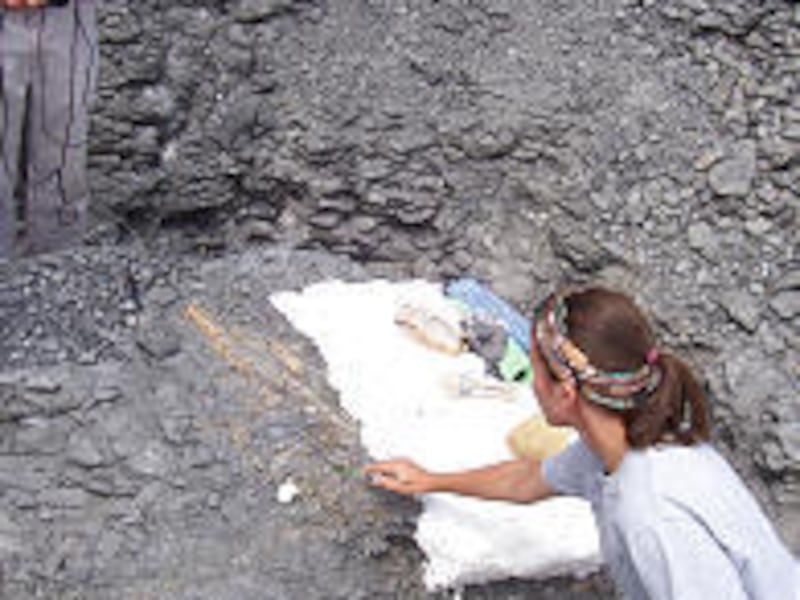
Most of the creature's bones have been removed or were already encased in the plaster jacket that will protect them during transportation. But on Tuesday, the skull remained uncovered at the top of a large block of shale.
The head is "2 1/2 feet or so. It's really a dainty skull," he said. A short neck once connected it to a stout, powerful body, the arms and legs were in the form of "big, long paddles," like canoe paddles.
Gillette said that inside each paddle were five long finger bones, which had many segments. They gave the paddles flexibility to shift the animal's direction as it hunted. According to the calculations of another expert, he said, the strong limbs could propel the plesiosaur about 45 miles an hour, so it competed with large sharks for prey.
Distinctive plesiosaur teeth marks on another plesiosaur's bones showed they bit, ate or scavenged each other.
Becky Schmeisser, a graduate student at Northern Arizona University (where Gillette is a research professor of geology), showed how the jaws were "kind of closed down tight, which is really cool." The master's degree candidate from Lake Mills, Wis., will write her dissertation about the discovery.
She was most delighted by a rare find: 97 stomach stones carried by the plesiosaur. These gastroliths were used either to help digest food, like a chicken's gizzard or were for balast or both.
Most of the stomach stones were worn smooth by grinding in the animal's gut. But some were angular, indicating the plesiosaur had swallowed those later, and they had not been fully smoothed by the time of its death.
Kaitlin McCormick, from Ottawa, Ill., and also a graduate student at Northern Arizona University, has been studying the shales to determine the site's depth under the ocean. "With the gray shales, we know it's an open marine environment," she said.
Single-cell organisms fossilized in the layers will give a better idea of the depth. But for now, she said, remains of oysters lead researchers to believe the sea was shallow.
Until recently, few fossil sites had been discovered in the region.
But with this and other new finds, said Gillette, "Glen Canyon is, I think, a rising star in the world of paleontology because of all its resources."
E-mail: bau@desnews.com