


Editor's note: In quoting from early sources, the original spelling and punctuation have been retained.
New York City pulled out all the stops for the Fourth of July, 1853. Military units and veterans of the War of 1812 paraded. Carelessness with firearms, said the New York Times, produced "the usual catalogue of small disasters." A brawl erupted when a stage driver, unable to control his horses amid the noise and confusion, blundered into the line of march of an Irish society.
But the highlight was New York City's guest of honor. "A patriot of the Revolution, aged 94 years, is now in the City," the New York Tribune reported on the Fourth. "If to-day be clear, he will receive visits in the Governor's Room, City Hall. He is a native of Canajoharie, N. Y., and is named Samuel Spencer."
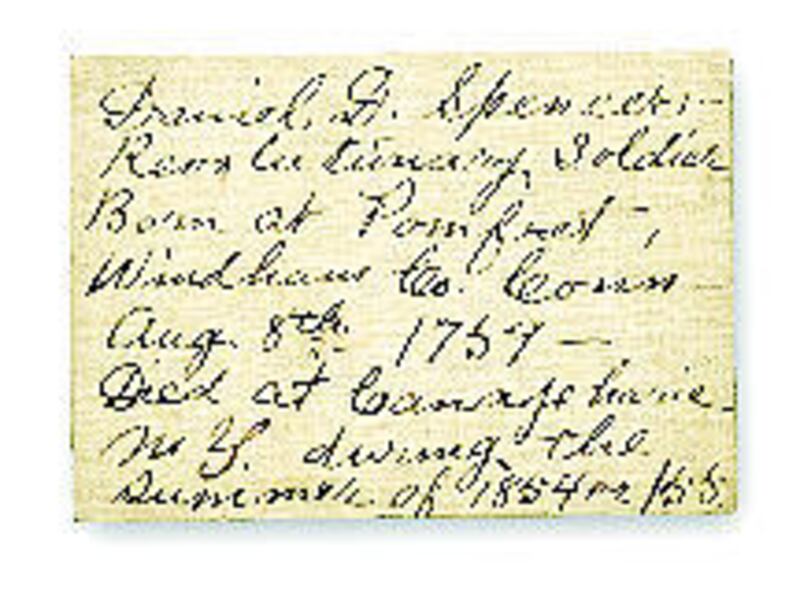
Actually, his name was Daniel Spencer, and he was a native of Connecticut; he had moved to Canajoharie after the Revolution. The Tribune got his name right the next day, although that report had his age 20 years too young: "Daniel Spencer, aged 74 years, and who was many years engaged in the Revolutionary War, was present and joined in the festivities of the day. He was received very cordially by the Mayor."
The Times, in its July 5 coverage, devoted the lead article to the celebration, including the "Riot in the Ninth Ward" and "Accidents, Fires &c."
The 1812 veterans performed a marching salute in front of City Hall. They were, the Times wrote, "accompanied by DANIEL SPENCER, an old patriot of the Revolution, hailing from Canajoharie, N. Y., now in his 95th year, who had accepted their invitation, jointly with that of the Common Council, to unite with our citizens in the celebration of the Nation's birthday."
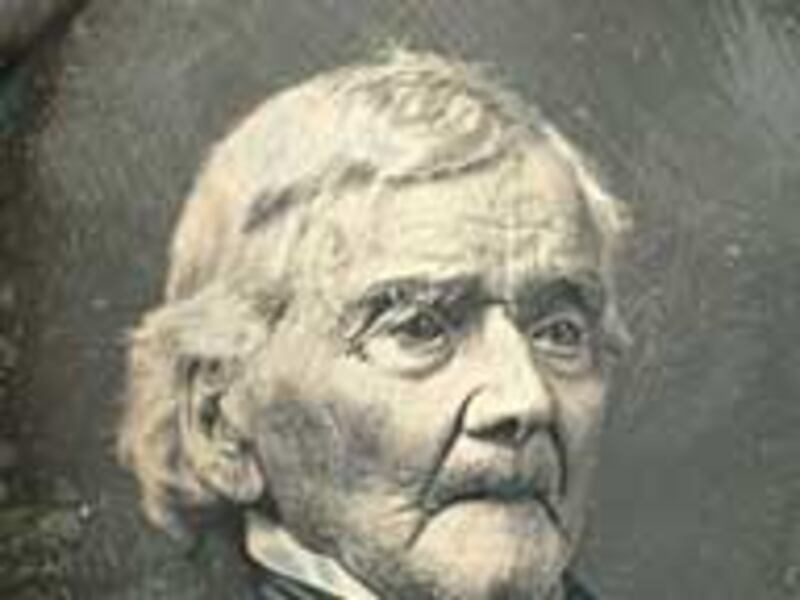
Sometime during the festivities, Spencer agreed to have his image preserved for posterity. He went to the daguerreotype studio of Robert A. Carden & Co., 293 Broadway, and his photograph was taken.
That daguerreotype, now somewhat scratched and abraded, shows Spencer as a calm, determined-looking old man. He sports a shock of white hair and is missing some teeth. His face is peppered with beard stubble.
Although taken in July, he wears a heavy overcoat — perhaps he was concerned about catching cold, as the Tribune had mentioned he would receive visitors if the weather was clear.
Daniel Spencer was a dark-haired young shoemaker from Pomfret, Conn. On July 8, 1780, exactly one month before turning 21, he began his service in Capt. John McGregier's Company of the 4th Infantry Regiment, Connecticut Continental Line. The outfit had suffered through the harsh winter at Valley Forge.
A historian named Jeptha R. Simms published a two-volume work, "The Frontiersmen of New York," in 1882 and 1883; a microfilm copy is kept in the Family History Library of The Church of Jesus Christ of Latter-day Saints. Simms had interviewed many sources, including (decades before the publication) Daniel Spencer.
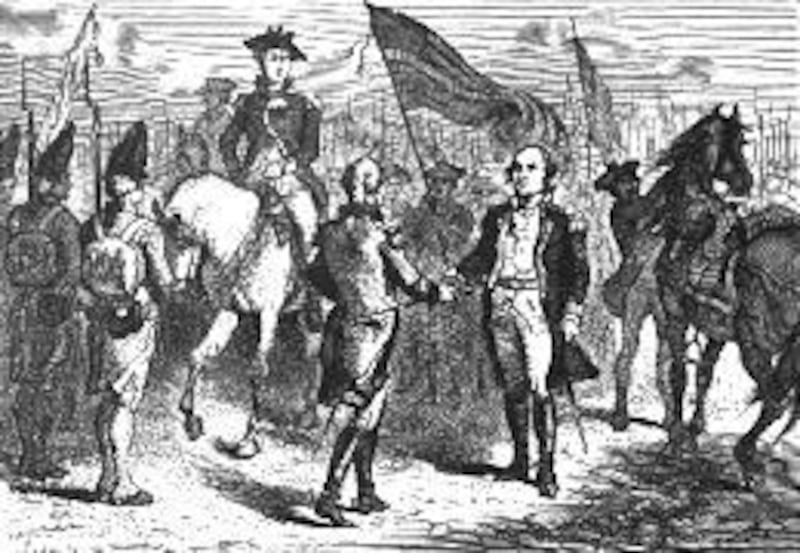
In October 1780, an attempt was made to capture the traitor Gen. Benedict Arnold. After failing to deliver West Point to the British, Arnold had escaped to the English lines. Stationed in New York City, which was controlled by the enemy, Arnold commanded a regiment made up of American deserters.
Anxious to bring Arnold to justice, Gen. George Washington endorsed a plan by Col. Henry ("Light Horse Harry") Lee to capture him.
Arnold must be "brought to me alive," Washington wrote. "No circumstance whatever shall obtain my consent to his being put to death. The Idea which would accompany such an event would be that Ruffians had been hired to assassinate him. My aim is to make a public example of him. . . . "
Sgt.-Maj. John Champe volunteered to pretend to desert and join up with Arnold. On a certain night, Champe and a partner would overpower the traitor and drag him to the waiting Americans.
Believing Champe really was deserting, soldiers from his unit pursued him hotly and almost caught him. The narrow escape was convincing. Champe managed to get into New York and link up with Arnold.
But on the afternoon of the night set for the abduction, Arnold shifted his quarters and the plan fell through.
Meanwhile, Lee went to the rendezvous point with 30 men and two spare horses, one for Champe, the other for his prisoner.
To protect them in case the kidnapping was discovered and they were pursued, 900 infantrymen from the command of Maj. Gen. William Heath were "marched down from the American camp on the west side of the Hudson, to the vicinity of the British posts," Simms wrote.
If the plot failed, Champe might be able to try again. He certainly would be in danger. So to preserve secrecy, the troops could not be filled in on the expedition's purpose.
"They moved forward just at night-fall, and after a tedious march of some hours, the night being dark and rainy, they drew near the river not far from Hoboken. The troops were concealed in the woods beside the road, where they could distinctly hear the sentinels upon a British guard-ship anchored in the river, exclaim at each hour, 'all's well!' When the troops gained this position, sentinels were posted in pairs at short intervals, with arms ready cocked, and were enjoined not to speak aloud on penalty of death. The whole corps were in readiness for immediate action. . . ."
Although they waited through the night, nothing happened. "While marching back after sunrise, the jaded men, not knowing the object of their unpleasant journey, swore lustily at being dragged through the mud so far for nothing. . . . It was long after the event transpired, when the men learned that they had been sent to succor Lee, and why they had 'marched down the hill and then marched up again.' "
Simms added, "The facts respecting the intended succor of Lee, are from Daniel Spencer, an old pensioner of Canajoharie, who was one of the 900 men sent out by Gen. Heath."
At the end of 1780, Congress ordered the consolidation of the Continental regiments. Connecticut's eight regiments were compacted into five. Some officers, including Capt. McGregier, were retired from the service; sometimes soldiers joined other units during this shake-up.
On May 1, 1781, Spencer enlisted in Col. Elisha Sheldon's Light Dragoons. This renowned group, the 2nd Dragoons of the Continental Army, could operate as cavalry or, dismounted, as infantry. Spencer was a private in the company commanded by Capt. George Hurlbut.
Spencer's 1818 pension application says "he cannot recollect having been in any battle of importance, though he remembers having been in skirmishes at Thog's Point & Valentine Hill in the vicinity of New York. . . ."
Those fights, in July 1781, were among the first on land carried out jointly with the French army. When Washington's troops formed in line of battle beside the Hudson River, the Connecticut State Brigade held the advanced position on the left while Sheldon's Light Dragoons were stationed in the advance on the right; both were ahead of the first line of troops.
The diaries of George Washington (printed by the University Press of Virginia and placed online by the Library of Congress) detail an action of July 15, 1781. Three or four American vessels had arrived at Tarrytown, N.Y., and were attacked by the enemy, Washington wrote, "and with infinite difficulty, & by great exertion of Colo. Sheldon, Captn. Hurlbut, (who got wounded) — Captn. Lieut. Miles of the artillery & Lt. Shayler (the vessels) were prevented from falling into the hands of the Enemy as they got a ground 100 yards from the Dock and were set fire to by the Enemy but extinguished by the extraordinary activity & spirit of the above Gentn. Two of the Carriages however were a good deal damaged by the fire.
"The Enemy however by sending their armed Boats up the River took the Vessel of a Captn. Dobbs laden with Bread for the French Army — Cloathing for Sheldons Regiment & some passengers. This was done in the Night — it being after Sunset before the Vessels passed the Post at Dobs ferry."
Hurlbut suffered a gunshot wound to the groin. Years later, advocating payment of compensation to Hurlbut's family, Washington wrote about the young captain's fate: "I do hereby Certify to all whom it may concern, that Cap.tn George Hurlbut of the 2d Reg.t of Light Dragoons received a wound in the gallant performance of his Duty at Tarry Town in the summer of 1781, of which, after having languished in the most exquisite pains untill the 8th of May 1783, he expired," he wrote.
But Hurlbut may not have died of the wound. In a letter to Washington in 1783 seeking permission to go home, Hurlbut wrote, "The wound which I received almost two years ago is at length healed, but the disagreeable symptom, with which I have been afflicted during the winter hast forbid me to expect a return of health."
What killed Hurlbut?
According to Simms, on the night of the engagement Sheldon's Dragoons were stationed near White Plains, N.Y. A sloop left Albany and anchored near their position. Hurlbut, a Sgt. Litchfield and half a dozen privates went aboard to guard it until morning. Meanwhile, two British ships in Haverstraw Bay sent out several small boats carrying marines, to capture the sloop.
"Several of the enemy who first attempted to gain the sloop's deck, fell back with shattered heads or drooping hands; but his sergeant having been killed by a bullet through the head, finding himself overpowered by numbers who were gaining the deck opposite, the Captain abandoned his trust and told his men to take care of themselves. They plunged into the water, and, amid a shower of bullets, swam to the shore, on gaining which, the Captain halted to bandy harsh epithets with his foes, and received for his temerity a dangerous bullet wound in the groin. He was, however, borne off by his men to the camp," Simms wrote.
"The night Capt. Hurlbut was wounded, my informant, then a private soldier in his company sat up with him, his vigil lasting until day-light; and as the weather was warm he had to fan his patient constantly. The next day Capt. H. was removed to the West Point hospital, where, under skilful hands, he was nearly cured; when he became intimate with the bane of a Military camp — a profligate woman — who poisoned him with disease and he died soon after much regretted; as he was an active man and daring officer just past his majority in years. He was a native of New London, Connecticut."
Simms identified his informant as "Daniel Spencer, of Canajoharie, N.Y."
Did Hurlbut die of his wounds or from a disease he caught from a camp prostitute? It's almost impossible to know today. Perhaps he suffered from internal injuries or infection caused by the wound. Or maybe Spencer was right and Washington was wrong.
By July 4, 1853, those days of hardship and danger were relegated to the dim past. Daniel Spencer basked in celebrity as one of the last surviving soldiers of the Revolution. He was honored for being part of that brave band of Americans whose sacrifice paid for our country's freedom. He died a year later.
"Several of our leading men gave the old patriot a hearty welcome in the 'Governor's Room,' " the New York Times noted, "and as his pension is but a mere pittance, we trust that something more substantial was awarded him."
The daguerreotype
Taken By: Carden & Co.
293 Broadway, New York City
The daguerreotype of Daniel Spencer was taken in 1853 — the year Spencer was the guest of honor at New York City's Fourth of July celebration.
Current owner: Joe Bauman
Spencer's miltary units
4th Connecticut Regiment
Organized: May 1775
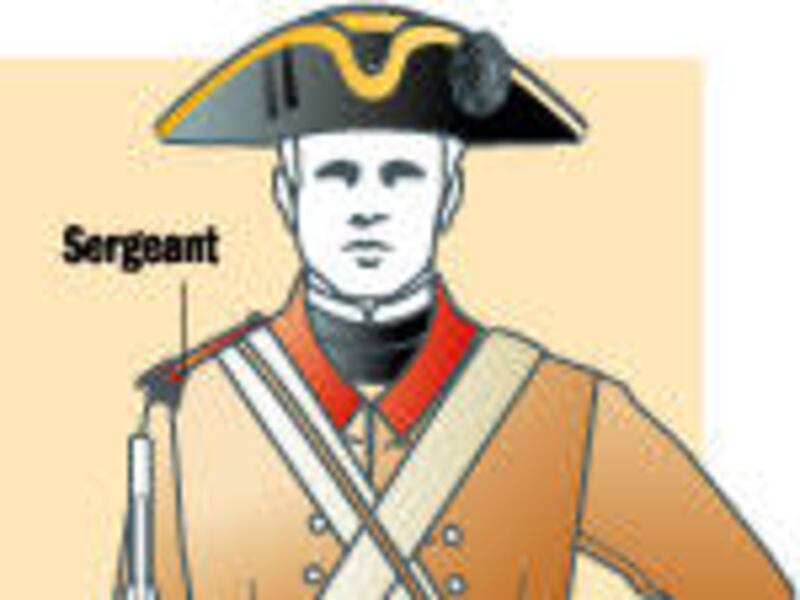
Size: 10 companies, each consisting of one captain, two lieutenants, one ensign (cornet), four sergeants, four corporals, one drummer, one fifer and 100 privates
Battles: Quebec, siege of Boston, Brandywine, Germantown, Whitemarsh, Philadelphia, Monmouth and Yorktown
Sheldon's Horse
2nd Continental Light Dragoons
Sheldon's Horse grew out of a group of Connecticut mounted volunteer militia. The unit, under the command of Col. Elisha Sheldon, volunteered for service early in 1776 but was rejected because of insufficient forage for the horses and men. The dragoons entered active service after the defeat of the Continental Army at White Plains, N.Y., in October 1776. Sheldon was commissioned colonel commandant.
Why dragoon?
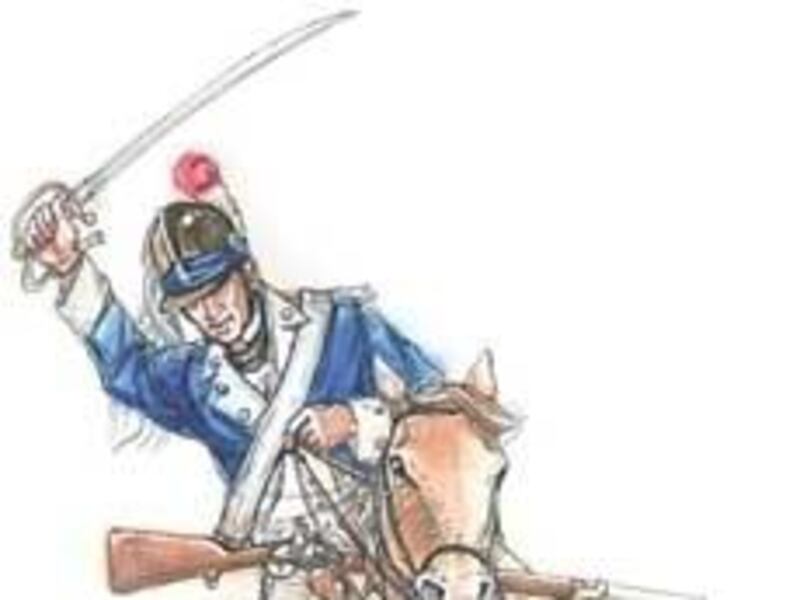
The name dragoon is derived from the carbine (the dragon) carried by Frederick the Great's medium cavalry. Most of their fighting was done on foot with the horses being used primarily as transport (mounted infantry). Dragoons were invaluable in reconnaissance and as messengers.
Sheldon's Horse
Unit makeup: Sheldon's Horse consisted of four troops from Connecticut and one troop each of Massachusetts and New Jersey natives. In addition there were two companies of light infantry.
Battles: Woodbridge, Brandywine, Germantown, Kingstown, Saratoga, Flockey*, Whitemarsh, Morrisania and Yorktown
Sheldon's Horse fought in numerous skirmishes and battles, including whaleboat raids.
Elements of Sheldon's Horse were personal bodyguards to Gen. George Washington.
*Site of the first cavalry charge in America
Horses: Dragoon mounts were generally smaller than those used by heavy cavalry. Horses had to be bay, black, chestnut or gray in color. The typical load carried by a horse could be 250 pounds, including equipment and rider.
Carbine or musketoon (French 1777)
Lighter and shorter than regular musket; its size made it ideal for light cavalry use; attached to shoulder musket sling
Long boots with knee guards protected and stabilized the rider's lower leg
Pistol holsters on the saddle containing two French cavalry pistols for use in close quarters
Other equipment: Wooden canteen, bedroll, feed bag and picket rope
SOURCES: US Wars.net; Sons of the Revolution in California.com; American Revolution.org; www.replications.com; Global Security.org; dragoons.info; 2powercom.net; Battle (Eye Witness Books)
E-mail: bau@desnews.com