

Utahns understand pilgrimages to places that evoke a deep cultural, recreational or spiritual connection.
Bikers seek out Moab by the thousands. Latter-day Saints are drawn to Temple Square and Emigration Canyon. Tourists of all types flock to the Beehive State's bevy of national parks and wide-open spaces.
But few would guess that an obscure Carbon County town has become a pilgrimage site of sorts for railroad fans from around the world, drawn to the whistle of steam and the grind on steel tracks at the railroad yards north of Price.
SueAnn Martell, director of the Western Mining and Railroad Museum in Helper, agrees most Utahns have never heard about her tourist stop. Yet the museum and the nearby Denver Rio Grande engines that pass through Price Canyon and over Soldier Summit each day draw nearly 10,000 people annually from nations around the world.
While Germans seem to outpace visitors from other locales, the museum sees people from Great Britain, Iraq, Iran and other surprising locales. Two weeks ago, Martell talked with visitors from Algeria.
"They come from everywhere — you name it, we've pretty much seen it. I've seen Helper referred to as the Mecca of Railroading on at least one Web site," she said, adding many visitors tell her, "If you're a true railroad fan, you have to make one pilgrimage in your life to Helper."
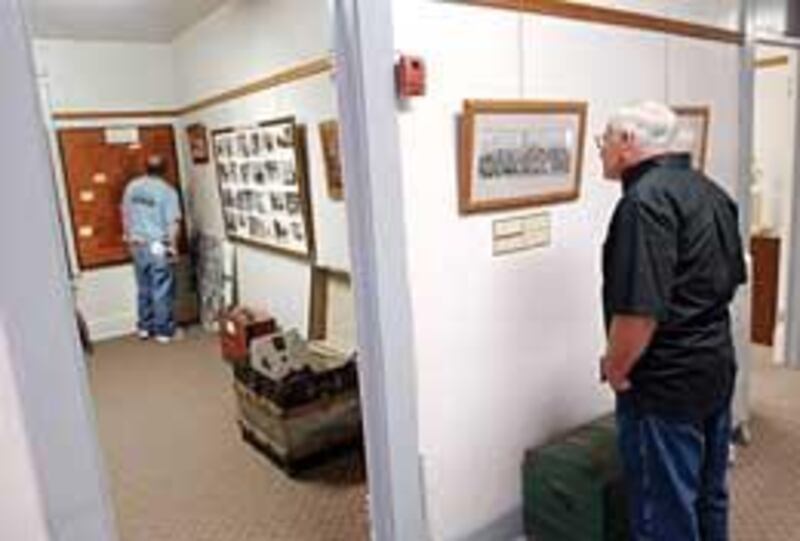
The romance with the rails hasn't been lost on city officials, who have made the museum a city department with its own budget of $50,000 annually. What began 40 years ago as resident Fred Vall's passion in one room of the Helper Auditorium has expanded to a four-story 13,000-square-foot exhibit that fills the old Helper Hotel, built in 1913.
Surprising as it may seem, growing interest spurred city officials to break ground last month for a 7,500-square-foot expansion of the museum, complete with an elevator to facilitate disabled visitors.
The museum doesn't charge admission but brings in enough money from grants and donations, in addition to city funding, that future visitors will see expanded and upgraded exhibits, Martell said.
It features three outside lots with engines, and a courtyard next to the building with Utah Railway Caboose No. 55, which was in operation from 1917 until the 1980s. A Denver & Rio Grande snow plow or "spreader" is also located on the back lot, illustrating how it once pushed the snow out of the way over Soldier Summit to keep the lines open in winter.
The museum also chronicles immigrant life in Carbon County during its early days of mining and railroading, featuring re-creations of a doctor's office, beauty shop, general store and other businesses that thrived during the height of coal mining. The daughter of Italian immigrants, Martell enjoys telling visitors the town once boasted 57 ethnic groups
All of them came either to help build the railroad or work in the mines whose output filled the rail cars, she said. Today, "you can walk down Helper's Main Street and see some Rio Grande engines still in operation. This is one of the few places you can see that."
So integral is the railroad to the history of the town that it got its name from the fact that it was the division point where train engineers hooked "helper engines" to the regular locomotives to provide additional pull to get loads over Soldier Summit and into Salt Lake City.
Though long-haul trucking has eliminated much of the cargo formerly hauled by train, at least one "helper" engine each day helps haul what has come to be known locally as the "Dirty Dirt Train" up over Soldier Summit, Martell said. It hauls garbage from the Wasatch Front to a landfill in East Carbon.
Most of the train tourists are seeking out the Rio Grande specifically, she said. "It was a favorite of fans, and the scenery here in central Utah just makes it perfect for those who come and take photos. They go out and spend a week" in Price Canyon, looking for just the right shot of a train chugging through what has become known worldwide as "outlaw country." Butch Cassidy lived in Helper for a time during the 19th century, plotting some of his infamous robberies.
"You can walk out to where the tracks are and you're right there. It's a combination of the rural setting and the scenery, with the cliffs as a backdrop for the trains going by. One of the best opportunities for railroad photos in the world is right here."
Martell said watching her international guests has prodded her to take the camera out on weekends, looking for the perfect shot. She understands the passion people feel for the sights, sounds and smells of what was once dubbed the "iron horse."
A lifelong resident of Helper, "I live literally 50 yards from the tracks," she said. "I saw my first train when I was literally a day old. People just go nuts for it."
The museum, 296 S. Main, Helper, is open year-round, Monday through Saturday 10 a.m. to 6 p.m. from May 1 to Sept. 30 and Tuesday through Saturday, 10 a.m. to 4 p.m. Oct. 1 to April 30. Call 435-472-3009 for information, or visit the Web site at www.wmrrm.org.
E-mail: carrie@desnews.com