

OCEANSIDE, Calif. — The morning commute is timed and precise.
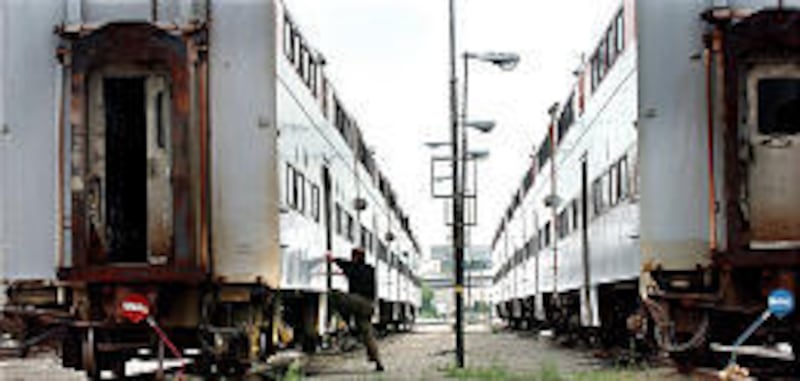
At 7:15 a.m., a train speeds toward the Oceanside station, whistle blowing as more than 650,000 pounds of metal are cajoled to a stop. An officer checks tickets. Passengers board. Many sit on the train's second level, where tinted windows offer a glimpse of beach-front properties and the Pacific Ocean.
It's idyllic, in a sense, with the combination of train, scenic views and a "leisurely" commute.
California doesn't have density like New York City, but it's getting there. Population and housing prices continue to inflate. City centers are expanding outward. More people mean more cars, which translates into congestion and the construction of 22-lane highways.
Rail transit — specifically high-speed commuter trains — appears to make sense here.
"It all goes back to getting cars off the road and cutting down on smog," said Jeff Tucker, a California state employee. He sits on the Coaster train headed toward San Diego, legs stretched out and arms behind his head.
"You don't want to get like here where you're two miles away from an 11,000-foot mountain and you can't see it."
For daily commuters in Utah, TRAX is currently the only option for passenger rail service.
The system is ideal, passengers say, for those who live near stations. It fails in the outskirts, when the time to drive to the station, then ride the train, takes longer than a commute by car.
"That's when you lose your advantage," said Lehi resident Russ Carbon, who travels by express bus to his job in downtown Salt Lake City.
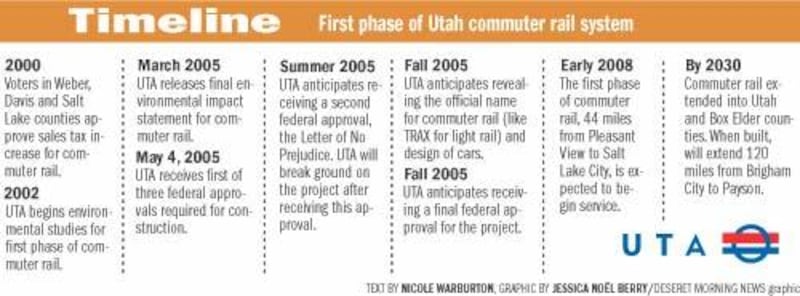
Enter commuter rail: a high-speed train designed to shuttle passengers from suburbs to metropolitan centers. Speeds can exceed 79 mph. Come 2008, residents in Davis and Weber counties will have the option of riding a commuter train into Salt Lake City, and vice versa.
Within days, the Utah Transit Authority anticipates federal approval to break ground on portions of the Davis and Weber segment. Full construction will begin when UTA receives final federal approval, expected this fall.
"We're anxious to get going," said Steve Meyer, UTA manager of commuter rail construction. "The public should start seeing some limited bits of activity."
In Utah and Box Elder counties, commuter rail extensions should be finished by 2030 — completing a train system that will extend 120 miles, from Brigham City to Payson. It will be comparable to TRAX, with trains scheduled every 20 minutes. Speeds are greater, as are the number of passengers a commuter train can hold.
However, stops will be fewer than TRAX. The goal is movement, said John Inglish, UTA general manager. Commuter rail will be like the freeway, with light rail and the bus providing access to destinations, including the airport and downtown Salt Lake.
When extended into Utah County, stops may include Orem and Provo. In Salt Lake County, Murray will have a station, just across from the new IHC hospital on the corner of 5300 South and State.
"It's the spine," Inglish said. "It's the I-15 of the region, and 50 years from now it'll be carrying hundreds of thousands of people."
Yes, optimistic. But Inglish said he is basing his words on projections for growth. Like California, Utah's population is expanding. Congestion has worsened as people move from Salt Lake to outlying cities and counties.
High-speed trains won't solve traffic woes, but they will take 5,900 people off the road, according to opening day projections for commuter rail's first phase. UTA officials anticipate that ridership will be greater, given the success of TRAX.
But the question remains whether that dip in traffic is worth the expense. Who will ride commuter rail? Is it a necessary, "fiscally responsible" use of taxpayer dollars? Will it benefit commuters?
"It gives us, certainly, one more arrow in our quiver," Inglish said. "We're at that point where traffic is growing much faster than the systems in place can develop capacity to support. We're all in kind of a bind, and what are we going to do? Well, this nation is resilient, we find new ways. One of the ways is public transit."
Making connections
Metrolink, based in Los Angeles, has weekday ridership of at least 40,000. The Coaster, based in Oceanside, has weekday ridership of about 6,000. Both systems, two of 19 commuter rail systems operating in the United States, are over 10 years old.
At least 27 new commuter rail systems have been proposed, many in the West.
Francisco Oaxaca, Metrolink manager of media and external communications, said commuter trains are a product of growth in the suburbs and a work force that travels to congested business centers. The train provides a connection between home and work, an alternative to a lengthy commute, he said.
"You've got multiple areas that you can consider employment centers, and the affordability of housing is moving farther and farther (away)," said Oaxaca, who is based in Los Angeles. "You've got the combination of people living where they can afford it and working somewhere they can get paid enough."
He sits with legs crossed, relaxing as the train passes cars on the adjoining freeway. Here, on the train from Claremont to Los Angeles, speeds reach 79 mph. Down track, the train will slow to less than 30 mph as the operator drives through a narrow corridor, lined by homes.
On another segment during the two-hour ride to Los Angeles, the train will stop as the operator waits on a side track for a passing freight car.
Most transit officials agree that reliability and timeliness are key to a successful commuter rail system. Also, convenience and connections. If it is easier to drive to work, if necessary connections haven't been built, if the train is frequently delayed — people won't ride it.
Meyer, UTA manager of commuter rail construction, said timeliness is the No. 1 issue for Wasatch Front commuters, based on market studies. One problem with Metrolink, operated by the Southern California Regional Rail Authority, is that the train shares track with Union Pacific.
Freight trains often take precedence over commuter trains.
Said Kathy Waters, vice president for commuter rail operations with Dallas Area Rapid Transit: "What sells our service is that if we tell you we're going to be here at 8:05 a.m., the train is 90 percent of the time going to be here at 8:05."
All but a portion of the track for Utah's commuter rail system will be managed by UTA. They can dictate when freight trains operate on the track. Because UTA will run trains every 20 minutes, movement by freight trains won't be allowed during the day.
Also, unlike their counterparts in California, UTA will manage all transit connections to commuter rail: bus, light rail and paratransit. A TRAX extension to the airport should be built by 2015, with a connection to commuter rail.
Other extensions to Draper, West Jordan and West Valley City are planned.
Costs and concerns
Rail transit is a "financial disaster" that does little to decrease congestion, according to Randal O'Toole with the Center for the American Dream, based in Golden, Colo.
"They are financial disasters because rail projects spend billions of taxpayers' dollars and produce little in return," he wrote in a 2004 report. "They are mobility disasters because rail transit almost always increases regional congestion and usually reduces transit's share of commuting and general travel."
Few Utahns are as vocal about their concerns. Notable exceptions: Michael Packard, a Sandy construction safety consultant, and Drew Chamberlain, chairman of the local anti-light-rail group Coalition for Accountable Government.
Rail transit steals riders from the bus, which is a precursor of route adjustments that affect the poor, Packard said. Rail transit also causes pollution and does little to reduce traffic when considering the cost, he said.
UTA estimates the first phase will cost about $582 million.
"The big machines look impressive, but they're insignificant to all that travel every place else in user-paid automobiles," said Packard.
Utah lawmakers are now considering legislation to adjust how UTA is governed. John Valentine, Utah Senate president, said some state officials question whether there's enough oversight and input into multimillion-dollar decisions made at UTA, a quasi-government agency.
"I am a very active supporter of commuter rail and really truly believe it will add a lot of assistance to our transportation problems," said Valentine. "There is an ongoing debate on how UTA makes its decisions and how the governance of UTA is occurring."
UTA officials are quiet about the issue. "As an agency we haven't seen any bills and legislation, but on the other hand, we know it's out there," said Jones.
Meyer, on the other hand, responds to Packard's concerns. First point: Commuter rail will conform to federal guidelines for emissions.
Second point: Commuter rail will provide greater access to both the bus and TRAX.
Third point: Voters in Weber, Salt Lake and Davis counties already agreed in 2000 to pay for commuter rail with a sales tax increase. That amount is small when compared to the federal funding UTA may receive for the project, he said.
The Federal Transit Administration could approve funding for up to 80 percent of commuter rail's cost, although the number is questionable according to some local officials.
In California, both Metrolink and the Coaster were funded by the state, cities and counties through local taxes. Federal dollars weren't requested. Voters in Denver just approved a $4.7 billion ballot initiative for public transit, which committed them to a sales tax increase.
The true question voters should ask is whether Utah's project is a "good project — regardless of who's paying for it," Meyer said.
He says commuter rail is needed.
"You talk to the folks in Weber and Davis and they say we certainly need it now," said Meyer. "We're putting in a base for another part of the transportation (solution) in this corridor. It's critically important."
Added convenience
Utah's first phase of commuter rail is expected to begin service by 2008. For now, transit officials throughout the West have one word for skeptics: patience.
"In the beginning, people will probably be judgmental," said Karen King, executive director of the North County Transit District, which operates the San Diego Coaster. "If you can get them to try it, they'll realize the extra 15 minutes it may add (to a commute) is well worth not being in traffic."
UTA officials anticipate that residents in Davis and Weber counties — who sometimes face an hourlong commute into Salt Lake City — will soon be grateful for the train. Commuter rail can provide a connection to jobs and to entertainment, said Jones, UTA spokesman.
In Davis County, commuter rail will provide a connection to Hill Air Force Base. UTA anticipates a 30 percent reverse commute — riders who travel away from Salt Lake City. Cities are already planning for development around commuter rail stations, a sharp contrast to attitudes before TRAX opened in 1999.
"I think people in this community have high expectations for transportation, and I think they're beginning to realize it's going to take more than highways to maintain an exceptional quality of life," said Inglish.
On the train from San Diego to Oceanside, Amy Hoyt Bennett echoes Inglish's statement. "I don't want to be stuck in traffic," she said, book in hand. "It's obviously more pleasant. I can read a book."
Questions of safety
On January 26, a Metrolink commuter train crashed into a Jeep parked on its tracks by a man attempting suicide. Nearly 200 people were injured in the crash and 11 killed in one of the nation's deadliest commuter rail accidents since 1999.
Francisco Oaxaca, Metrolink manager of media and external communications, said the incident was a "one-in-a-billion event, one if you tried, you couldn't re-create." Later analysis proved his statement true: Had timing of the accident been one-second later, the car would have easily been pushed to the side — causing no deaths.
Still, the accident prompts questions of safety. Officials with the Utah Transit Authority are reviewing several safety standards for commuter rail. Safety plans will focus on both the trains and areas where road intersects with track, called grade crossings.
Plans include the installation of cameras at the front of rail cars. Raised medians will be built at grade crossings, making it more difficult for a car to maneuver around safety gates.
UTA is currently studying how operators will be trained. They have the option of contracting with an agency such as Amtrak, which would train drivers and negotiate with labor unions. The authority could also train its own drivers, as they do with TRAX.
The training period for a commuter rail operator takes nine to 12 months, versus the six weeks it takes for a light rail operator to be certified.
The new buzzword: Transit-oriented development
SAN DIEGO, Calif. — The Santa Fe Depot is the "end of the line" for commuters headed into San Diego via the Coaster commuter train. A tall building, still under construction, is within walking distance of the station.
It will soon become high-density housing.
While this development cannot be directly attributed to the Coaster commuter train, its proximity to the station likely influenced the decisions of developers, according to Tom Kelleher, spokesman for the North County Transit District and the Coaster.
"It's a great example of development incorporating public transit," said Kelleher. But direct results of this development — known as transit-oriented development (TOD) — are still hard to see around the nation's commuter systems. It's more prevalent around light rail systems, such as TRAX.
Regardless, officials with the Utah Transit Authority hope their commuter rail system will be one of the first in the nation to be tied to a TOD. Development plans are already progressing in cities such as Layton, Clearfield and Farmington, all in Davis County.
The Farmington station is expected to be a "flagship" for TOD's in Utah and the Western United States. A Farmington developer, in combination with a national development team, plans to bring a mix of shops, housing and offices to a 100-acre site centered around the Farmington commuter station.
Steve Meyer, UTA manager of commuter rail construction, cautions cities that the train alone won't spawn development. But the train can be a catalyst for development, he said.
In San Bernardino County, small developments are scattered around Metrolink commuter rail stations, owned and managed by individual cities and counties. Rancho Cucamonga's station has a new office complex near it, in addition to high-priced condominiums. The Claremont station is near an eclectic shopping district, already in place before the train was built.
"We hope cities see the commuter train station as a benefit to residents," said Francisco Oaxaca, Metrolink spokesman, "but also as a nexus for other plans they have in that area."
E-mail: nwarburton@desnews.com