

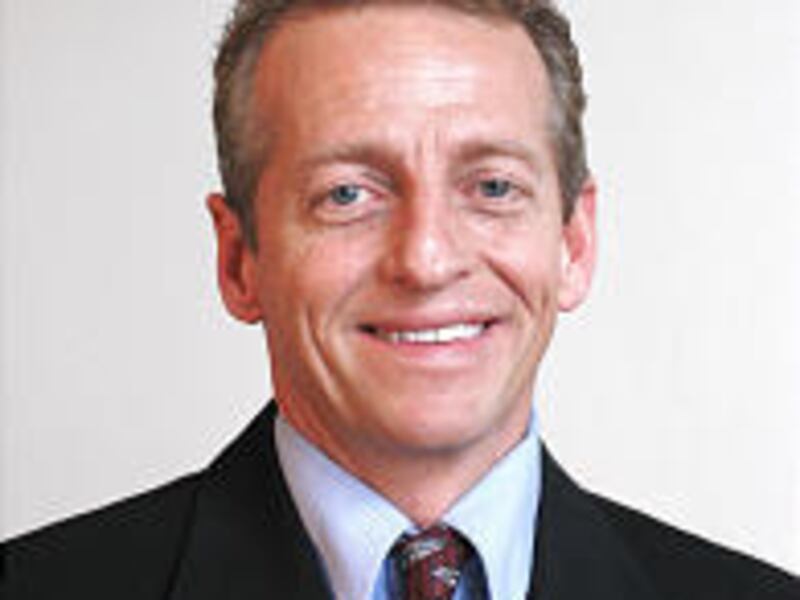
In stark contrast to many of today's politicians, the new Democratic Party chairman is not much of a sound-bite guy.
To best understand Wayne Holland, time will be needed. He speaks methodically, testing his words carefully, and often contemplates a question beyond a few beats before responding.
Not that he is a man of few words — one question about his personal history sparks a half-hour answer that ranges from street ball to assassina- tions to the Founding Fathers — or politically naive. Instead, he is an articulate speaker who has worked on political campaigns for more than three decades.
His political beliefs were shaped by growing up in Magna in a family of "Roosevelt New Deal Democrats," with a father who was devoted to the labor unions and politically active. As a child, he joined his father for candidate honk-and-waves or helping the families of striking workers.
The mold was firmly set by the assassinations of President John F. Kennedy, Martin Luther King Jr. and especially Robert Kennedy — an event Holland remembers distinctly even though he was only 10 when it happened. It was his idolization of the younger Kennedy that led a high school-aged Holland to work with the 1974 congressional campaign of Wayne Owens, who had been a close associate of Robert.
"At a young age, those assassinations really kind of rocked my world," Holland said. "It burst my bubble about the future of this country, that the people talking about a better America were gunned down."
Those events impacted him enough to have kept Holland, 47, involved in politics for more than 30 years, although primarily in behind-the-scenes roles as campaign managers and labor representative. It was only earlier this year, after working in battleground states during the 2004 election and noticing many similarities with the so-called "deep red" Utah, that he decided to pursue the state party chairmanship.
"Utah is really not that different than many of those states," he said. "There are similar cultural policies and beliefs about government throughout the West."
What surprises him about Utah, however, is that so many people continue to support the increasingly right-wing Republican platform, since many of those policies are being pushed by the same kind of people "who yell and scream about the LDS Church being a cult." Most recently, he points to the possible introduction of the "intelligent design" debate into next year's legislative session as an example of a major issue pushed by the evangelical Christians who often dispute the Christianity of Mormonism.
"We hold our religious beliefs much more internally in Utah," said Holland, who is a practicing Mormon. Despite that, "it's interesting that the Republican leadership seems more concerned about staying true to the right-wing ideals than to Utah values."
To improve Democratic positions in the state — and admittedly, they can't get much worse — Holland wants to focus on building candidates from local governments. Instead of finding immediately high-profile names, he would prefer to find people who have built a reputation as fair and honest and who will receive support from their constituents not because of party affiliation but because of respect.
"The candidates we find strongest are those who are very involved in their community and who people trust regardless of their label," he said. "We need candidates who are well-liked and trusted."
He admits it will not be easy to gain many seats in the Legislature next year, primarily because of the redistricting that "carved some counties to pieces" and cemented the seats of Republicans until the next decade. Still, Holland plans to work with candidates to spread the word about the party as much as possible, especially where constituents have grown tired of "Republican hot air" and "power-obsessed" politicians.
"You know what you believe in your heart, and then you find that many people are talking about the same issue, only in different words," he said. "We are just going to focus on what is important to us, and on getting those messages to resonate."
If there is a person who can earn the trust of the populace, it is Holland, Rep. Jim Matheson, D-Utah, said. After all, even those who may be on the other side of an issue seem to like and, more important, trust him.
"He's a very solid guy. Anybody who talks to him knows he's a straight-shooter," Matheson said. "He can reach across to all of the constituents of the party."
As for the prospects of the party, House Minority Leader Ralph Becker, D-Salt Lake, is "hopeful" that Holland can turn things around, even if it's still early in his chairmanship.
"He's clearly an everyone guy, articulate and has a lot of savvy," Becker said.
E-mail: jloftin@desnews.com