


Susan Purdy has friends in high places. She lives in Connecticut, which is at sea level — the elevation most cookbooks are written for. She borrowed kitchens of acquaintances living at 3,000 to 10,000 feet in elevation to write her high-altitude cookbook, "Pie in the Sky" (HarperCollins, $29.95).
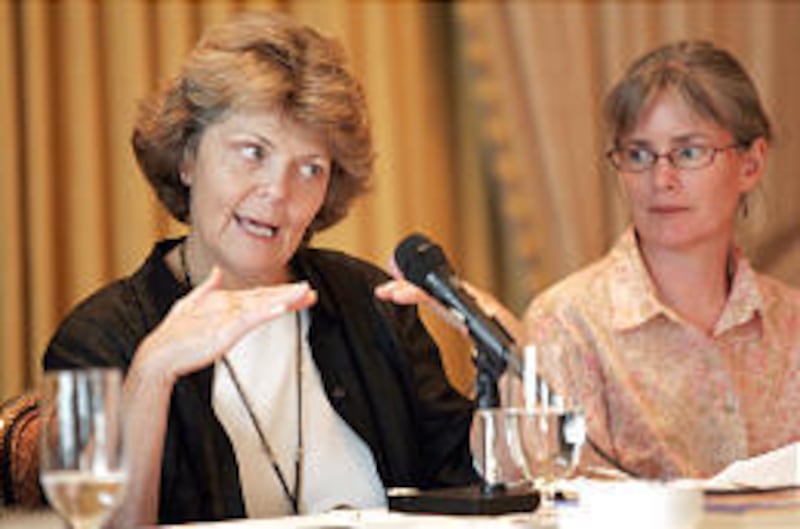
Currently touring the country to promote the book, Purdy made even more friends a few weeks ago when she shared some of her knowledge with the Utah Baker's Dozen at the Grand America Hotel. The Wasatch Front is 4,200 to 4,600 feet above sea level — and up to around 8,000 feet in areas like Deer Valley Resort, where executive pastry chef Letty Flatt bakes her signature desserts. Flatt was a seminar panelist with Purdy, as well as Ruth Kendrick of South Ogden, co-author of "Candymaking"; Mary Cech of Santa Fe, N.M., pastry chef and author of "The Wine Lover's Dessert Cookbook"; Greg Patent of Missoula, Mont., author of "Baking in America"; and Elizabeth Perreault, a Boulder, Colo., pastry chef/instructor.
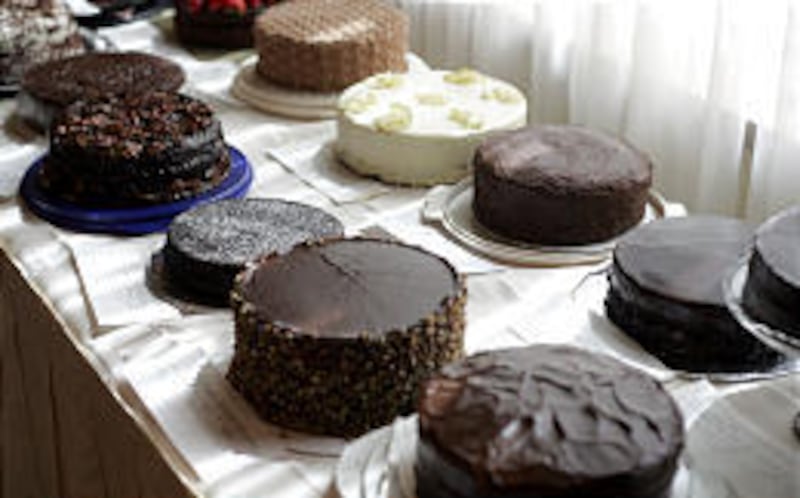
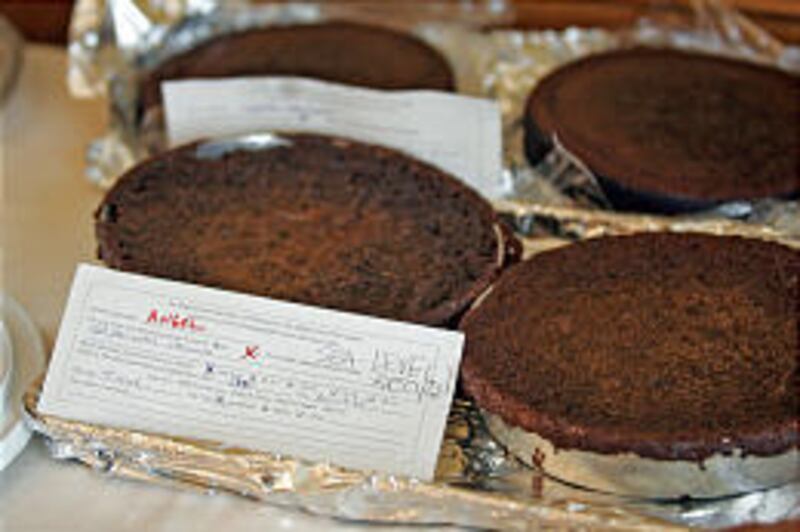
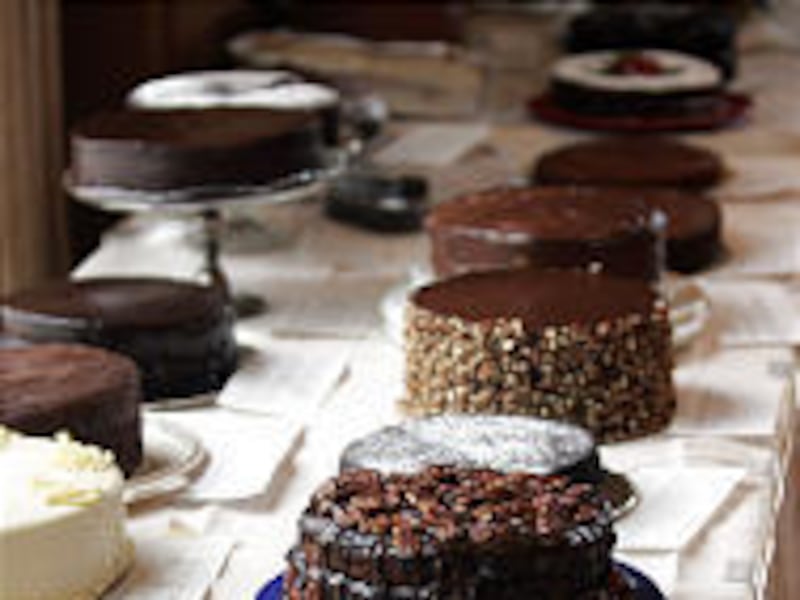
About 50 local Baker's Dozen members baked Purdy's recipe for Chocolate Buttermilk Cake and brought their results to share. To illustrate what could go wrong, Angel Skedros Manfredini, pastry chef at The Mandarin in Bountiful, made her cake using sea-level directions. The sad-looking cake had overflowed the pans and collapsed.
That's about the same result Purdy had when she tried baking a cake in the 7,000-foot altitude of Santa Fe five years ago. "It collapsed, so we covered it with whipped cream and called it pudding cake," she said. "I was teaching a baking class there, and I decided I'd better get it right, so I worked to develop some cake recipes for that altitude. "
Purdy realized there was a market for a cookbook with recipes altered for high altitudes.
"I saw it was a problem that needed solving, and I love an adventure and to travel," she said.
So she picked her 100 favorite recipes from other cookbooks she'd written, and sought kitchens at different altitudes that she could borrow for several weeks. Each recipe was tested 15-plus times, or until she got them right.
"I shipped my entire kitchen to every location because you have to use the same baking pan when you're testing," she said. "This is the hardest book I've written — ever! I almost jumped off those mountaintops. There were some cakes I just wanted to give up on. The lemon meringue pie almost did me in."
Each recipe in Purdy's book has a chart for adjustments to make at sea level, 3,000 feet, 5,000 feet, 7,000 feet and 10,000 feet.
A few things happen the higher one goes in elevation:
Water boils at a lower temperature.
Liquid evaporates faster, leaving a higher concentration of sugar and fat in a batter, which weakens it.
There's less atmospheric pressure so leavening gases expand more quickly. With no structure to hold a batter up, it rises quickly, then collapses.
Here are some general fixes — although Purdy cautions that every recipe is different and often requires trial-and-error tinkering:
— To strengthen a batter, you may add a little more flour, or more egg (use extra-large eggs instead of the size called for in the recipe). You can also reduce the ingredients that weaken a batter — sugar and fat.
"If your cookies tend to spread and get hard, cut the sugar and add a little more flour," Purdy said.
— To help bread dough rise more slowly, let it rise overnight in the refrigerator, and cut back on the amount of yeast.
— Purdy added more vanilla and salt to her recipes, because she feels that flavor diminishes at higher elevations.
— For quick breads that tend to sag or go gluey in the middle, use a tube or bundt pan instead of a loaf pan for better heat distribution.
— Acidity causes batter to set more quickly. So in recipes that call for milk, Purdy substitutes buttermilk. Other acidic ingredients are dark chocolate, citrus juice, sour cream and yogurt. She also uses less baking soda, which is alkaline and neutralizes acids.
— When making fruit pies, you may have a hard time getting the fruit to cook through before the pastry gets overbrowned. The solution is to use softer apples, like McIntosh or Golden Delicious (instead of Granny Smith), and slice them very thinly.
"If the pie top browns too quickly, cover it with a piece of foil," Purdy adds. "Some professional chefs cook their apples on the stove top first."
— Cornstarch may not get hot enough to begin thickening in certain pie fillings. Elizabeth Perreault uses tapioca or tapioca flour in pie fillings, because they thicken at 167 degrees.
— When making meringue or souffles, beat the egg whites into softer peaks (sea level recipes call for stiff peaks). This will allow for a little bit of expansion during baking.
— Place a pan of water in the bottom of the oven when baking bread, to keep the crust from developing too soon and not letting the bread rise fully.
While staying in a Breckenridge, Colo., ski chalet, Purdy solved the mystery of her neighbor's "exploding pecan pie." It worked fine in Kentucky, but when the woman tried baking it at 10,000 feet, it turned into a smoking volcano. Purdy found that the sugar concentrated and formed a cone, with the rest of the filling erupting in the center.
"After many experiments, I cooked the filling on the stove in a saucepan first, and added a little cornstarch and water to thicken it," Purdy said. The recipe appears in the book as Red Door Pecan Pie.
Although cake mixes are known for being road-tested to work in most conditions, they droop in the middle at elevations above 6,500 feet, Purdy said. The "high altitude" directions given on most labels (add 1/4 cup more water, 1/4 cup more flour and bake at 25 degrees higher) work only up to 6,500 feet. If you live above that, you should add 6 tablespoons of flour and 1/4 cup of water to your cake mixes, Purdy said.
Other tips from the "Peak Experience" panelists:
— Candy mixtures boil and evaporate at a lower temperature — about 2 degrees for every 1,000 foot difference from sea level, said Kendrick, whose kitchen is at 5,050 feet in the South Ogden foothills.
Kendrick recommends using a good-quality candy thermometer. To calibrate it to your altitude, put the thermometer in boiling water, and subtract the thermometer's temperature reading from 212 degrees (the sea-level boiling point). When you make candy, subtract that number from the temperature given in the recipe. For instance, if your thermometer reads 204 degrees, you would subtract that from 212 and get 8. From then on, subtract 8 from the temperature given in candy recipes.
Kendrick doesn't rely on the "cold-water" test, where you put a few drops of candy syrup in cold water. (If it makes a soft ball, the candy is at "soft-ball" stage. If it's hard, it's at "hard-ball" stage, and so on.) This test doesn't change with altitude, she said, but it's not as exact as a thermometer; and in the time it takes to do it, the mixture may overcook.
If your candy overcooks, resist the impulse to quickly pour it out of the pan, Kendrick advised. Instead, add a little hot water to put moisture back into the solution.
— When baking, don't preheat the oven, said Greg Patent, who lives at 3,250 feet. This gives the bubbles in the batter time to expand and set as the oven warms up. He also cuts the leavening (baking soda or baking powder) by half. Other panelists said they found that raising the oven temperature by 25 degrees causes the cake's structure to set more quickly and avoid collapsing.
— To adjust her sea-level lemon bar recipe, Letty Flatt subtracted 2 tablespoons of sugar for each cup called for in the recipe. "Everything else remained the same."
CHOCOLATE BUTTERMILK CAKE
(Adjusted for an altitude of 5,000 feet)
Vegetable spray, sifted cocoa for coating pans
4 ounces unsweetened chocolate, chopped
2 cups plus 3 tablespoons sifted all-purpose flour
1 1/4 teaspoons baking powder
1/2 teaspoon salt
1/4 teaspoon nutmeg
1 cup (2 sticks) unsalted butter, at room temperature
1 1/2 cups plus 3 tablespoons granulated sugar
1 teaspoon vanilla extract
4 large eggs at room temperature
1 1/2 cups buttermilk
Place oven rack in center. Preheat oven to 375 degrees. Coat 2 9-inch shiny round metal pans with no-stick vegetable spray or solid shortening. Line with parchment or wax paper. Grease again, then dust with sifted cocoa; tap out excess cocoa.
Melt chopped chocolate in microwave or in top of double boiler set over boiling water and heat until you can stir it smooth. Remove chocolate from heat and set aside to cool.
In a medium bowl, whisk together the flour, baking powder, salt and nutmeg. In the large bowl of an electric mixer, cream together butter and sugar. Scrape down the bowl and beater, then beat in the vanilla and the eggs and scrape down bowl. again. With the mixer on the lowest speed, alternately add the flour mixture and the buttermilk. Stir the melted chocolate to be sure it is smooth, then scrape it into the batter and beat well.
Divide the batter evenly between the pans and bake at 375 degrees for 25-30 minutes, then run a knife between the cake and the pan sides to release them. Top each layer with a cake disk and invert; remove pan, peel off parchment, and cool layers completely. Fill and frost as desired. — "Pie in the Sky" by Susan Purdy
GOLDEN CARAMELS
(Adjusted for an altitude of 5,000 feet)
2 cups whipping cream
1/2 cup milk
1 1/4 cups light corn syrup
2 cups sugar
1/4 teaspoon salt
1/2 cup evaporated milk
1 teaspoon vanilla
Butter an 8-inch square baking pan; set aside. In a 4-cup glass measure, combine cream and milk. In a heavy 4-quart saucepan, combine 1/3 of the cream-milk mixture, corn syrup, sugar and salt. Place over low heat and stir occasionally with a wooden spoon until mixture comes to a boil. Simmer for 30 minutes or until mixture turns a light tan color. Increase heat to medium and insert thermometer. Without stopping the boiling, slowly add the remaining cream mixture. Cook until the thermometer reaches 232 degrees. Add evaporated milk and cook to 232 degrees again, stirring constantly. Remove from heat and stir in vanilla. Without scraping, pour into prepared pan. Allow to stand at room temperature overnight. Cut into squares and wrap or dip in chocolate. Nuts can be added with vanilla, if desired. — "Candymaking" by Ruth Kendrick and Pauline Atkinson
QUICK PENOUCHE
(Adjusted for an altitude of 5,000 feet.)
2 cups whipping cream
1 tablespoon light corn syrup
2 cups sugar
1 cup brown sugar
3 tablespoons butter
1/2 cup white compound coating
1 1/2 cups pecans, toasted
Line an 8-inch square baking pan with plastic wrap; set aside. In a heavy 4-quart saucepan, combine cream, corn syrup and sugars. Place over medium heat and stir with a wooden spoon until mixture comes to a boil. Clip on thermometer. Cook, stirring occasionally, to 226 degrees. Remove from heat. Without stirring, add butter. Let stand until thermometer cools to 200 degrees. Without stirring, add compound coating. Let stand 1 minute. Add nuts and stir with a wooden spoon until coating is melted and butter is incorporated. Candy should be thick and creamy. Scrape into prepared pan. Refrigerate 3 hours or until firm. Makes 64 pieces. — "Candymaking" by Ruth Kendrick and Pauline Atkinson
RED DOOR PECAN PIE
(Adjusted for an altitude of 5,000 feet.)
Pastry:
1 1/2 cups flour
1 tablespoon granulated sugar
1/2 teaspoon salt
1/2 cup walnuts or pecans
6 tablespoons unsalted butter ( 3/4 stick)
3 tablespoons solid vegetable shortening, chilled
1 large egg yolk, at room temperature
1 tablespoon fresh lemon juice or white vinegar
3-5 tablespoons ice water
Filling:
3/4 cup dark brown sugar, packed
3 large eggs, at room temperature
6 tablespoons unsalted butter, melted
2/3 cup dark corn syrup
1 tablespoon unsulfured molasses
1/4 teaspoon salt
1 teaspoon fresh lemon juice
1 teaspoon vanilla extract
1 1/4 cups pecan halves
Position rack in lower third of the oven. Preheat the oven to 425 degrees.
To prepare the pastry: In a food processor, pulse together the flour, sugar, salt and nuts until the nuts are finely chopped. Add butter and shortening and pulse 8-9 times. Add egg yolk, lemon juice or vinegar, and 1-2 tablespoons ice water through the feed tube and pulse a few times. Dough should just begin to get clumpy. If it's too dry, add another tablespoon of water and pulse a few more times. Dough is ready when it holds its shape when squeezed between your fingers.
(Alternately, you can mix the pastry ingredients together in a bowl with a wire pastry blender, fork, or your fingertips.)
Turn dough onto a piece of plastic wrap; gather it into a ball, and press it into a flat disk. Wrap and refrigerate it about 30 minutes, or overnight.
Roll out the dough on a lightly floured surface with a floured rolling pin, to a circle 2 inches larger than the pie plate edge (turn the plate upside down in the center of the dough to measure it.) Loosen the dough on the edges with a bench scraper, then fold the dough into quarters and fit into the pie plate. Unfold the dough and gently drape it over the pan; don't stretch it. Trim excess dough to 3/4 to 1 inch and reserve. Fold under the overhanging dough and pinch the edge into points or scallops around the rim. If the dough cracks, add a drop of water to the spot and press it back together.
Place a cookie sheet on the lower oven rack to get hot.
Cut a 12-inch square of foil, spread a little butter or nonstick vegetable spray on the shiny side, and set it greased side down in the pastry-lined pie plate. Fill the plate with weights and place on the hot cookie sheet. Bake for 15-17 minutes, until no longer translucent but still pale. Remove the cookie sheet with the pie plate on it, and lift out the foil with the pie weights. If you see any breaks or holes in the crust, patch them by brushing on a little water, then gently pressing on bits of the reserved raw dough. (The patches will bake along with the filling.)
To prepare the filling: In a large bowl, whisk together the brown sugar and eggs. Mix in all the remaining ingredients except the nuts. Pour the filling into the partially baked pastry shell and arrange the nuts on top. Bake the pie 20 to 25 minutes, or until a table knife stuck in the center comes out clean or coated with a clear syrup. Cool the pie on a wire rack. Serve at room temperature. — "Pie in the Sky," by Susan G. Purdy
E-mail: vphillips@desnews.com