

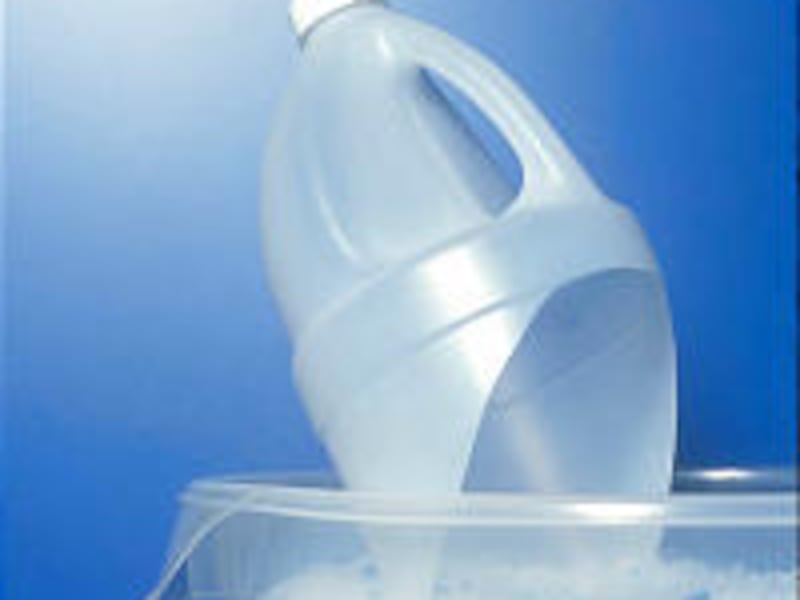
All that trash piled into your recycling bin might actually be treasure. The hastily discarded laundry-detergent bottle, for instance? Cut the top off, and it makes a fine watering jug.
You may remember bleach-bottle piggy banks from elementary school, or perhaps you've seen the plastic bottles fishermen convert into bailers and keep tied to the sides of their boats.
Most people empty all types of containers every month — ones used for water, fabric softener, bleach, ammonia and more. With a little ingenuity, there are several ways to turn these ubiquitous vessels into tools for everyday tasks. So before you toss out empty plastic bottles, why not consider one of the projects that follow?
It's important to clean any bottle you turn into a tool. Soak the bottle in warm water for 20 minutes to help remove the label. Then clean the container thoroughly, and let it dry completely.
When choosing a bottle to use with ingestible items, such as pet food or mouthwash, use only containers that once held foods or drinks.
Once you've selected and cleaned a bottle, all you have to do is mark it with a grease pencil, cut according to the marked lines, and sand the edges smooth. It's as simple as, well, taking out the trash.
Tools and materials
Grease pencil
Plastic bottle
Heavy-duty glove
Utility knife
150-grit sandpaper
How to make the projects
1. With a grease pencil, draw a line on the bottle to guide your cutting (see the suggestions that follow).
2. Hold the bottle in one hand (protected by a heavy-duty glove) and a utility knife in the other. Steady the bottle on a work surface, and push the knife through the plastic. Continue cutting so that the knife is moving away from you. Be careful: The plastic may resist, causing the knife to skip.
3. Sand the container's cut edges until they are smooth.
Heavy-duty scoop
Make it easy to dig into bins of rock salt, cat litter or potting soil by turning a bottle into a scoop with a handle at one end.
Start by choosing a tall bottle with a high-set handle (such as an ammonia bottle) with the cap still on it. With a grease pencil, draw a diagonal line that starts just below the handle and extends nearly to the base of the bottle, opposite the handle.
Following the drawn line, cut off the bottom half of the bottle at an angle. Discard the bottom half and use the top half as a scoop.
Watering jug
You can use a refashioned laundry-detergent bottle as a sturdy container for watering houseplants.
Look for a bottle with a wide top and a strong handle. With a grease pencil, draw an oval just underneath the bottle's neck so that one side slopes up toward the neck and the other away from it, ending just above the handle.
Following the drawn line, cut off the top of the container at a slight angle, so it rises to form a "spout" end opposite the handle. Discard the cap and top, and use the base as a watering jug.
Paint holder
When you cut off the top of a large bottle (such as one used for bleach) and invert it inside the bottom of a smaller bottle, the two pieces make a steady holder for paint.
With a grease pencil, draw a circle around a large bottle with a cap just below the handle (this is where you will cut the top off). Following the drawn line, cut off the top portion. Discard the bottom portion.
To make the stand, use a narrower bottle: Draw a circle around the bottle just below the handle, but include an approximately 1-inch-square notch in the bottom portion (the handle of the large top piece will rest in this notch). Following the drawn line, cut around bottle. Discard the top portion.
Invert the original large top piece, cradling it in the narrow bottom piece, and use it as a paint holder.
Funnel
To make it easy to decant liquids, such as mouthwash, into smaller bottles, turn a water bottle into a funnel by cutting the top part of it off and then inverting it.
Start with a slender bottle that has a narrow mouth. With a grease pencil, draw a circle around the middle of the bottle. Following the drawn line, cut the bottle in half.
Discard the lid and the bottom half of the bottle. Invert the top portion of the bottle to use it as a funnel.
Bunny Wong, a senior writer at Martha Stewart Living magazine, writes often about crafts, homekeeping and decorating. © Martha Stewart Living Omnimedia LLC. Distributed by New York Times Special Features