

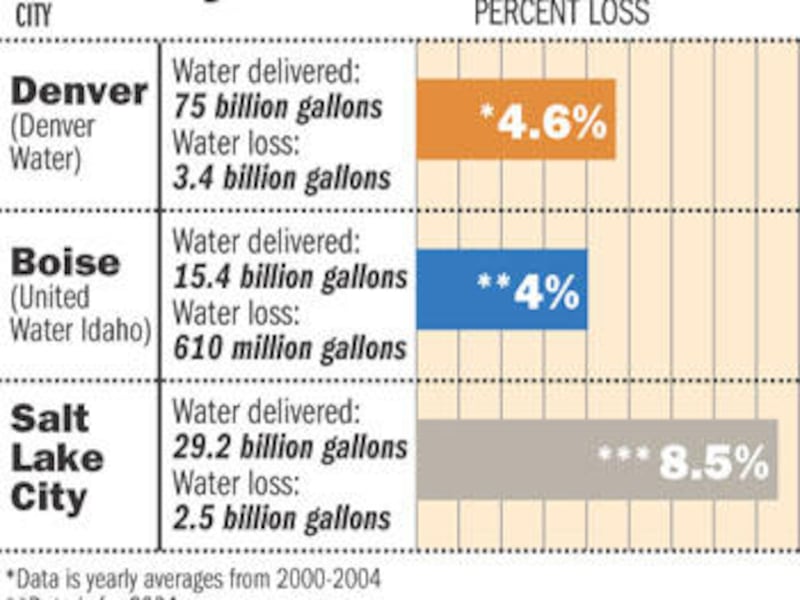
A new audit — still in its draft form — shows Salt Lake City, which prides itself as a champion of water conservation, is losing nearly 2.5 billion gallons of water each year.
And while 10 million to 30 million gallons (less than 1 percent) of that is lost through fighting fires and annual system flushing, and another estimated 40 percent (or roughly 1 billion gallons) is lost through illegal or faulty meters, some 1.5 billion gallons of clean, treated, drinkable water is wasted, leaking into the ground through bad pipes and faulty pipe connections.
It's a lot of gallons to be wasting, especially at a time when the city's department of public utilities has engaged in an aggressive campaign to get residents to conserve water and the City Council has adopted a water rate system designed to reward conservation.
While 1.5 billion gallons is a staggering number, Department of Public Utilities finance director Jim Lewis maintains the audit shows Salt Lake City is doing a good job. After all, it had the lowest water-loss rate of 12 cities that have undergone the independent water loss audit.
That said, two other Intermountain water districts contacted by the Deseret Morning News reported far less water loss, although, Lewis points out, their numbers haven't faced the scrutiny of independent auditors.
"The problem is unless they go through a study, you're not really comparing apples to apples," he said.
The audit showed Salt Lake City lost 8.5 percent of all the treated water it tried to deliver in 2003, although city officials say updated figures show the number is more like 7.5 percent. All told, the city supplies some 29 billion gallons of water yearly to nearly 100,000 customers.
While Salt Lake City's water-loss percentage is below the American Water Works Association's recommended standard of 10 percent, it is almost double the rate maintained by two nearby Western water districts that have similarly been plagued by drought.
In Boise in 2004, the water district lost only 4 percent of its water or 610 million gallons. United Water Idaho spokesman Mark Snider attributes the low number to massive new development and redevelopment in the Boise area, which has forced the replacement of many old, decaying pipes.
"We are not an aging system," Snider said.
In Denver, since 2000, the water district has lost an average of 4.6 percent of its water annually, or 3.45 billion gallons. That figure, according to Denver Water spokeswoman Trina Mcguire-Collier, was the result of an analysis of a newspaper, which examined the utility's water loss since the millennium.
Unlike Salt Lake City, Denver Water has an advanced leak-detection system that uses devices known as "permalogs," which constantly check and report back electronically when leaks are detected.
"We were very low last year," Mcguire-Collier said. "We think it's the permalogs."
Mark Stanley, operations and maintenance director for the department, told auditors that since Salt Lake City adopted its blue-stake program, which marks underground water lines, workers also have lacked the time to proactively go out and search for leaks.
"We used to have a leak-detection crew and then we discontinued that when we went to blue-stake process," Lewis said.
Still, since the city's water-loss rate is lower than the national average, Lewis said there has been no clamor to reinstate the leak-detection crew.
"If we had water loss up above the national average then it would be to our advantage to hire a crew to do that," Lewis said.
Cost is also a factor.
The department looks at the price of tearing up concrete to fix each leak and decides against fixing leaks that prove too expensive, public utilities director LeRoy Hooton Jr. said in the audit.
"It wasn't cost effective to fix the small leaks due to tearing up the road," auditors wrote.
Another factor, according to Hooton, is that contractors will sometimes neglect to pinch off water connections that are no longer connected to anything.
For instance, a developer may take over an area that used to contain 20 houses with 20 residential water connec- tions. The houses would be torn down and replaced with a strip mall.
By code, the contractor would be required to seal off those 20 connections, but some developers don't take that step and instead leave water flowing to the empty connection. That water, then, flows into the ground.
"Commercial areas with redevelopment (like 400 South) may have abandoned lines that haven't been killed," Nick Kryger, Salt Lake City's Geographic Information Systems manager, told the auditors.
Some public-utilities em ployees say the department is too lenient when contractors don't follow the law.
"Salt Lake City is seen as easy on contractors," Sybilla Dalton, public services customer service manager, said in the audit.
Despite problems, Lewis said the audit shows Salt Lake City is doing a good job preserving as much water as it can within the system. The bottom line, he said, is that any system will lose copious amounts of water.
"We don't have enough manpower or enough money to fix all the leaks in the system."
E-mail: bsnyder@desnews.com