

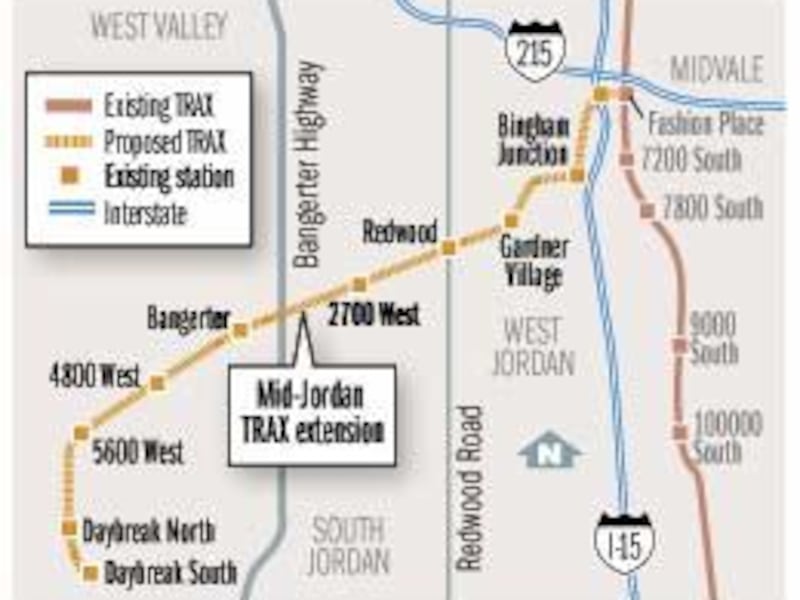
MIDVALE — The Utah Transit Authority plans to build a 10-mile TRAX extension from Midvale to Kennecott's Daybreak community, and construction could begin as soon as 2009.
A lot has to happen between now and then, with perhaps the biggest concern being how to fund the estimated $300 million project.
But UTA moved one step closer to making the light-rail spur a reality Friday as it opened a 45-day public comment period for its draft environmental impact statement.
UTA will hold a public hearing/open house to receive public comment on the draft EIS on Tuesday, Aug. 30, 4-8 p.m., at West Jordan City Hall, 8000 S. Redwood Road.
The document, required by the federal government before work can begin, recommends light rail as the transit option of choice.
"That has been recommended in the EIS as the best alternate," said UTA project manager Greg Thorpe. "We looked at enhanced bus. We looked at diesel multiple-units and also (the effects of taking) no action.
We figured the bus rapid-transit wouldn't work on the same corridor."
The Daybreak line is one of several proposed light-rail projects serving western Salt Lake County that have been vying for UTA's attention. Among the others is West Valley City's hopes of building a line to its city center area, which it plans to redevelop into a residential-governmental-commercial mixed-use area. City leaders have hoped the redevelopment would center around an intermodal transportation hub hinging on TRAX.
But West Valley's assistant city manager Paul Isaac said he was not surprised that the Mid-Jordan line is the subject of the current thrust.
"We actually expected this to happen," he said. "We're just hoping to get a piece of this someday."
Midvale's Mayor JoAnn Seghini said that Kennecott Lands, and the Midvale, Murray, West Jordan, South Jordan and Daybreak communities put money together, based on population, to fund an Environmental Impact Study and the final EIS. That funding, along with the already existing track, gave the Mid-Jordan line an upper hand in UTA's selection, she added.
"I think UTA has been looking at existing tracks on all the possible east-to-west tracks," Seghini said. "The fact that Kennecott Lands and these cities worked to pay for it made it possible for them to move a little bit more quickly."
The proposed corridor is next to an existing — and still in use — freight rail line owned and operated by Union Pacific Railroad. For that reason, the environmental work revealed fewer potential problems than might have been the case if UTA were starting from scratch in its pursuit of right-of-way.
"The impacts that we have noted in the EIS are fairly minor," Thorpe said. "There were no significant impacts in the corridor — a little bit of property-taking that would have to be done, but nothing excessive."
Fewer than seven homes or businesses would have to be removed to accommodate the project, he said.
UTA estimates the Mid-Jordan line would have 9,500 daily riders by the year 2025. The Daybreak development eventually is expected to be home to about 30,000 to 40,000 residents.
Nine new stations would be built along the line: at Bingham Junction, Gardner Village, Redwood Road, 2700 West, the Bangerter Highway, 4800 West, 5600 West and two locations within the Daybreak community.
South Jordan officials have been involved in the EIS process and have been following the plans closely. They say they are excited about what a light-rail line would mean for residents in their area.
"We're welcoming it obviously," assistant city manager Gary Whatcott said. "We think it has great benefit not only now but in the future for the southwest part of the valley."
The 2009 time line, he said, is in line with the projected progress of Daybreak development. But he said light rail isn't the only thing that needs to be done as growth continues in southwestern Salt Lake County.
"I think it's just one solution. There have got to be increased busing routes and there have got to be a lot more alternatives explored as well," Whatcott said.
UTA spokesman Justin Jones said the TRAX extension project was included in the recent six-year transportation bill passed by Congress, meaning it is eligible for federal authorization and funding within the next six years. The project, in fact, received a very high rating — "one of the best projects in the nation" — and is in a good position relative to new-start projects elsewhere, Jones said.
But without additional local funding — perhaps through an equalization of sales tax contributions throughout UTA's district or another method of funding being recommended by the Wasatch Front Regional Council — the project might not be constructed until 2025 or later, Jones said.
For now, however, UTA is concerned with receiving public comment on the draft EIS so it can complete the final EIS and then seek a federal record of decision, putting the project officially on the map.
The EIS document is available at local libraries and on the Web at www.rideuta.com. Comments can be submitted on the Web site or by mail at: UTA, Mid-Jordan Corridor DEIS, P.O. Box 30810, Salt Lake City, UT 84130-0810. Comments must be received by Sept. 19.
Contributing: Natalie Clemens
E-mail: zman@desnews.com; dsmeath@desnews.com